Industry Guides
Last Updated:

Deepak Singla
IN this article
Verified numbers and a full timeline for Klarna's AI assistant: the first-month results, the reversal that followed, the workforce impact, and what the case means for support teams in 2026.
What Is the Klarna AI Assistant?
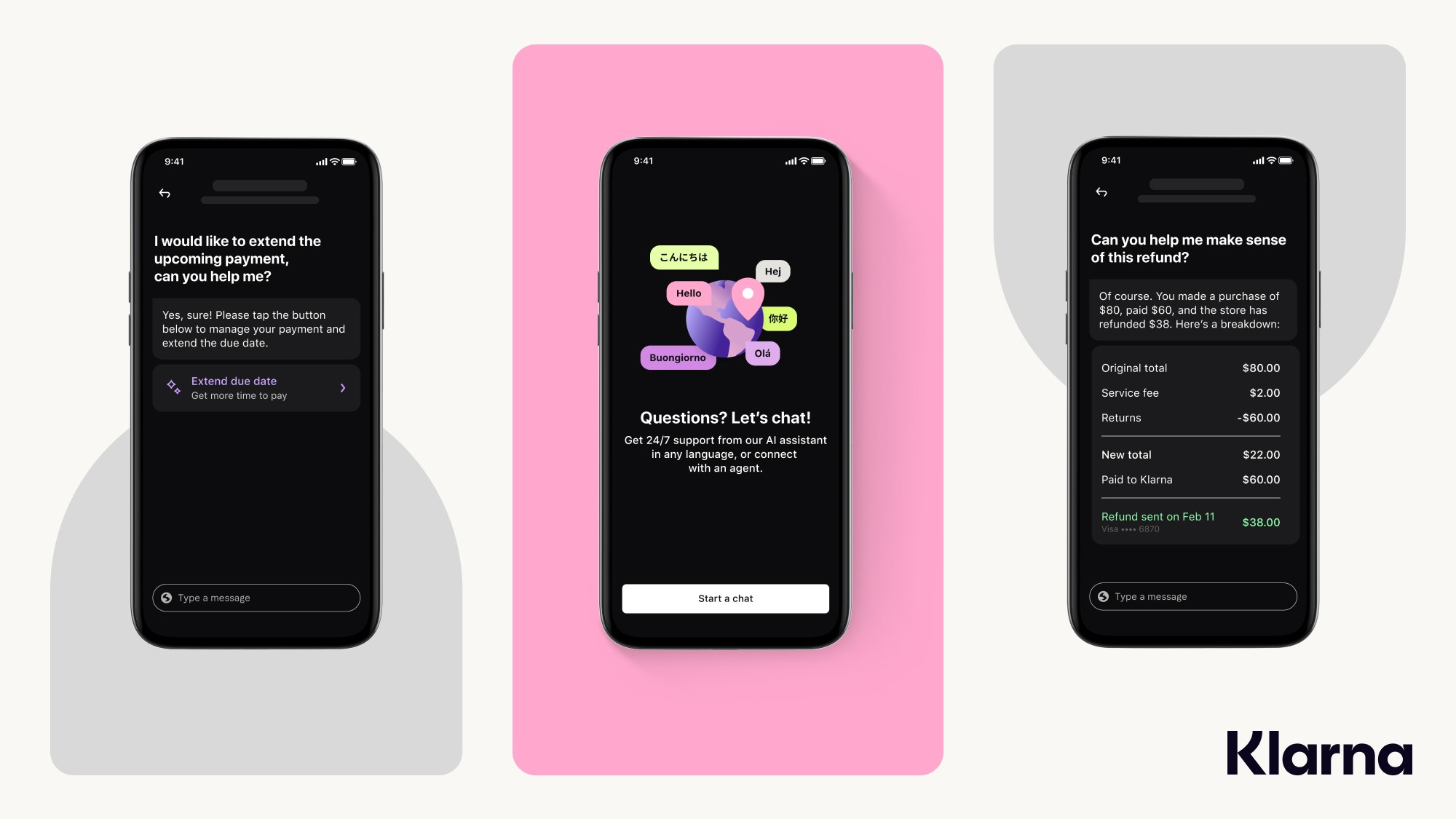
The Klarna AI assistant is an OpenAI-powered customer service agent that Klarna launched globally on February 27, 2024. It autonomously handles refunds, returns, and payment questions in Klarna’s app, resolved two-thirds of all support chats in its first month, and as of 2026 operates alongside guaranteed human agents.
Many people search for it as the “Klarna chatbot,” but it is more than a scripted bot: it is a conversational AI system built on OpenAI models that resolves inquiries end to end and escalates complex cases to humans. Klarna announced the results in an official press release titled “Klarna AI assistant handles two-thirds of customer service chats in its first month,” published on February 27, 2024 (Klarna).
The story did not end there. In May 2025 Klarna publicly reversed parts of its AI-only strategy and began hiring human agents again, and by late 2025 it reported the assistant doing the work of 853 full-time employees. This page covers both halves of the story with verified, dated numbers.
What Klarna’s AI Assistant Achieved
In its first month after the February 2024 global launch, Klarna’s AI assistant handled 2.3 million customer conversations, two-thirds of all of Klarna’s customer service chats. Klarna said that volume equaled the work of 700 full-time agents, with customer satisfaction on par with human agents (Klarna, 2024).
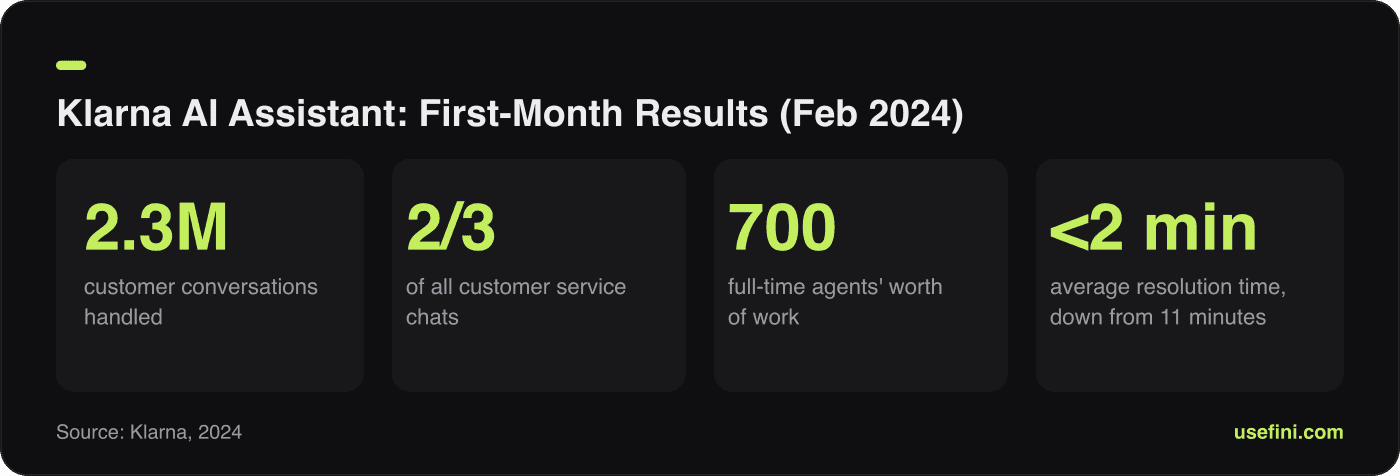
First-month results after the February 2024 global launch
The quality numbers were the real headline. Average resolution time dropped from 11 minutes to under 2 minutes, and repeat inquiries about the same issue fell 25%, Klarna’s proxy for more accurate first-contact resolution. The assistant ran 24/7 at launch across 23 markets in more than 35 languages, a footprint that raises the kind of data residency obligations most support teams underestimate.
A correction worth making explicitly: figures still circulating online, including a “47% satisfaction increase” and a “15-minute” prior response time, appear in no Klarna source. Klarna’s own numbers were “on par” satisfaction and an 11-minute baseline, and the automation share was two-thirds, not “over 80%.” Klarna also projected a $40 million profit improvement for 2024 from the assistant; it never published a deployment cost, and the “$2 to $3 million” figure sometimes attributed to its CEO has no verifiable source.
Both companies leaned into the moment. “Klarna is at the very forefront among our partners in AI adoption and practical application,” said OpenAI COO Brad Lightcap in the announcement. CEO Sebastian Siemiatkowski added that “this AI breakthrough in customer interaction means superior experiences for our customers at better prices,” while acknowledging “the profound impact on society that AI will have.”
Impact on Klarna’s Workforce
The launch landed in a charged context: Klarna had laid off roughly 700 people in 2022, the same number of full-time roles the assistant was now said to replace, and had frozen hiring in late 2023 while citing AI. Klarna maintained that no jobs were cut as a consequence of the assistant itself, because its support was run by outsourcing partners.
Coverage in February 2024 from Gizmodo and Quartz made the 700-for-700 symmetry the story (Gizmodo, 2024). Klarna spokesperson Filippa Bolz responded at the time: “Klarna’s customer service is supported by 4-5 large global partners who collectively have over 650,000 employees… When one of the companies, like Klarna, requires less support, these agents are assigned to new tasks at another company.”
The hiring freeze was real. In December 2023, Siemiatkowski said Klarna was “not currently hiring at all, apart from engineers,” explicitly citing AI productivity gains (The Next Web, 2023). The freeze lasted more than 12 months, and in May 2025 Siemiatkowski told CNBC that AI had helped shrink Klarna’s workforce by about 40%, through attrition and the freeze rather than AI-triggered layoffs (CNBC, 2025).
What has happened since
Between February 2024 and mid-2026, the Klarna story evolved from an AI triumph into something more instructive: a company that pushed automation hard, publicly admitted the quality cost, and settled on a hybrid model. The AI assistant never went away; by November 2025 it was doing more work than ever, alongside rehired humans.
Automation changed the slope of the cost curve, not its direction
Timeline: Klarna’s AI assistant, 2023 to 2026
Anyone searching for Klarna’s AI assistant customer service results across 2024 and 2025 is really asking about two different phases: the automation sprint and the correction. The dated record looks like this.
Date | Development | Source |
|---|---|---|
Dec 2023 | Hiring freeze announced, AI cited as a factor | |
Feb 27, 2024 | First-month results: 2.3M chats, two-thirds of support, 700 FTEs of work | |
Feb 2024 | Backlash over the 2022 layoffs; Klarna says outsourced agents were reassigned | |
May 14, 2024 | 90% of Klarna employees use generative AI daily | |
May 9, 2025 | Reversal: Klarna recruits human agents again, guarantees a human option | |
May 14, 2025 | CEO: AI helped shrink the workforce by about 40% | |
Sept 10, 2025 | NYSE IPO (ticker KLAR) priced at $40/share, ~$15.1B valuation | |
Nov 18, 2025 | Q3 earnings: AI does the work of 853 FTEs, $60M in savings | |
June 18, 2026 | KLAR trades around $17.66, roughly 56% below the IPO price |
The 2025 reversal: why Klarna started hiring humans again
In May 2025 Klarna announced it was recruiting human support agents again through a remote, flexible pilot, and guaranteeing every customer the option of reaching a person. Siemiatkowski told Bloomberg the cost-cutting push had gone too far and produced “lower quality” service, per reporting from CX Dive on May 9, 2025 (CX Dive).
His framing was unambiguous: “Really investing in the quality of the human support is the way of the future for us,” and “there will be always a human if you want.” Notably, the AI assistant still processed two-thirds of inquiries throughout the reversal. Klarna repositioned AI as the volume layer, not the whole service.
Then came the numbers that complicated the simple “AI failed” narrative. On the Q3 2025 earnings call on November 18, 2025, Siemiatkowski said the assistant now does work equivalent to 853 full-time employees, up from 700 at the start of 2025, with $60 million in cost savings and responses 82% faster (CX Dive, 2025). “We continue to see very demonstrable value from Klarna’s AI assistant,” he said.
2024 claims vs. reality by 2026
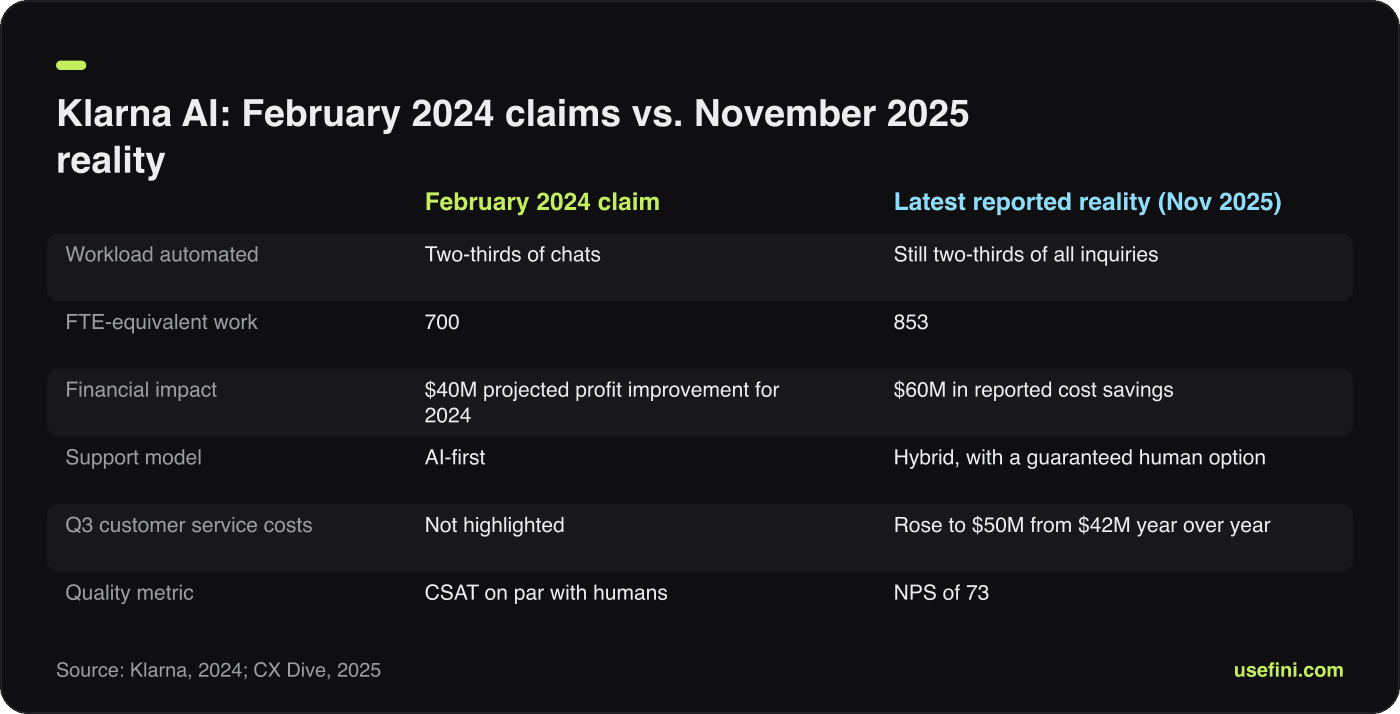
The gap between the launch narrative and the later record is where the useful lessons live. Several claims aged well, some aged badly, and one detail almost nobody quotes: Klarna’s customer service costs went up anyway.
Metric | February 2024 claim | Latest reported reality (Nov 2025) |
|---|---|---|
Workload automated | Two-thirds of chats | Still two-thirds of all inquiries |
FTE-equivalent work | 700 | 853 |
Financial impact | $40M projected profit improvement for 2024 | $60M in reported cost savings |
Support model | AI-first | Hybrid, with a guaranteed human option |
Q3 customer service costs | Not highlighted | Rose to $50M from $42M year over year |
Quality metric | CSAT on par with humans | NPS of 73 |
The cost line matters most. Even with 853 FTEs of automated work, growth in Klarna’s user base (114 million active users, up 32% year over year, per the same CX Dive report) pushed absolute support spend higher. Automation changed the slope of the cost curve, not its direction.
What the skeptics say
Skeptical analysis has been part of this story from the start, and the top search results for the topic include Reddit and Hacker News threads driven by the layoffs-then-rehiring arc. The most substantive critique came from The Pragmatic Engineer’s hands-on deep dive, which argued the assistant primarily automates Level-1 support, the tier scripted flows and help-center deflection already targeted, and documented prompt-injection vulnerabilities alongside the guardrails Klarna deployed.
That critique holds up in 2026. The two-thirds automation share never grew into the “fully AI-powered” service the launch language implied, and the security findings are a reminder that any customer-facing agent needs adversarial testing before and after launch, the discipline formalized as AI red teaming. None of this makes the results fake; it makes them bounded.
Where this stands in 2026
As of mid-2026, Klarna runs a deliberate hybrid model: the OpenAI-powered assistant handles roughly two-thirds of customer inquiries, does the work of 853 FTEs per the latest reported figures, and has generated $60 million in savings, while every customer keeps a guaranteed path to a human agent. Klarna is now a public company, and its stock traded around $17.66 on June 18, 2026, down roughly 56% from its $40 IPO price after a difficult start to the year on BNPL credit-quality concerns (IG, 2026).
For support and CX leaders, the Klarna case now functions as both the flagship success story and the leading cautionary tale. The practical takeaways as of 2026:
Plan for a hybrid model from day one. Klarna spent 15 months discovering that “always a human if you want” is a requirement, not a fallback. Define escalation triggers before launch.
Measure quality, not just deflection. Repeat-inquiry rate and NPS caught what raw automation percentages hid. Klarna’s 25% repeat-inquiry drop was its most durable claim.
Budget for growth, not just savings. Klarna’s support costs rose from $42M to $50M year over year even at two-thirds automation.
Treat compliance as part of the build. Fintech support touches regulated workflows, from disputes to identity checks like KYC automation, so agent governance and AI compliance reviews belong in the deployment plan, not after it.
More Generative AI Customer Service Examples
Klarna is the most cited of all generative AI customer service examples, but it is no longer an outlier. Gartner predicted in March 2025 that agentic AI will autonomously resolve 80% of common customer service issues by 2029, cutting operational costs by 30% (Gartner). Gartner also forecast in August 2025 that 40% of enterprise apps will ship with task-specific AI agents by 2026, up from under 5% in 2025 (Gartner).
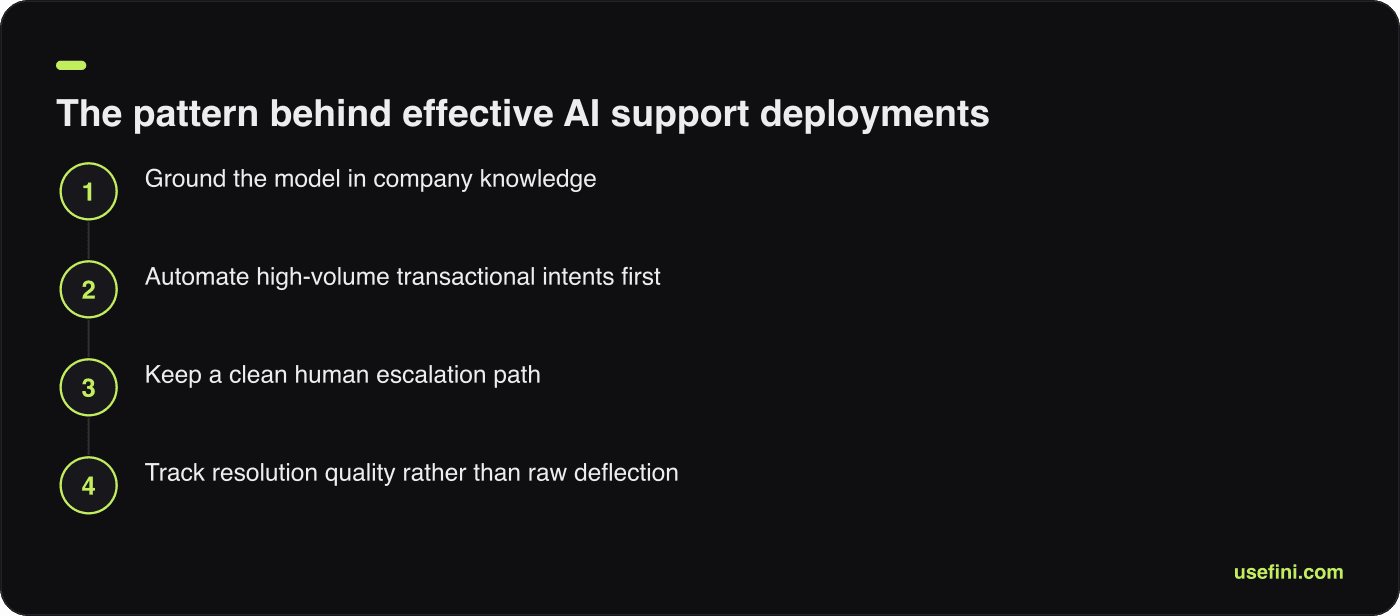
Deployments that skip a step tend to relearn Klarna’s May 2025 lesson the hard way
Klarna itself supplies examples beyond the support queue. By May 2024, 90% of its employees used generative AI daily, its internal assistant “Kiki” served 85% of staff with around 2,000 queries per day, and its lawyers cut contract drafting from about an hour to roughly 10 minutes with ChatGPT Enterprise (CNBC, 2024).
The pattern across working examples is consistent. Effective deployments ground the model in company knowledge, automate high-volume transactional intents first, keep a clean human escalation path, and track resolution quality rather than raw deflection. Deployments that skip any of those steps tend to relearn Klarna’s May 2025 lesson the hard way.
Achieving Similar Results with Fini
Teams do not need Klarna’s engineering organization to get Klarna-class automation. Fini deploys AI support agents that reach 99% accuracy and a 90% resolution rate, live in 30 days, with the hybrid escalation model Klarna converged on built in from the start rather than retrofitted after a public correction.
Fini’s platform is SOC 2 Type II certified and ISO 27001 certified, HIPAA-compliant and BAA-eligible, and aligned with GDPR and CCPA, which matters if your support queue touches payments, health data, or regulated identity workflows. Pricing is published: every resolution costs a starting rate of $0.49, including calls over standard telephony. There are no per-seat fees and no monthly minimum.
One honest caveat, because Klarna’s own arc demands it: your results depend on your intent mix and where you draw the human handoff line, which is why Fini deployments start by defining escalation rules and quality metrics, not by chasing a deflection number. If you are weighing a Klarna-style rollout for your own support queue, whether in fintech, commerce, or SaaS, book a 30-minute walkthrough with the Fini team and pressure-test the two-thirds benchmark against your actual ticket data.
FAQs
What is Klarna’s AI assistant and who built it?
Klarna’s AI assistant is a customer service agent built by Klarna on OpenAI’s models and launched globally on February 27, 2024. It handles refunds, returns, and payment questions inside Klarna’s app and escalates complex cases to humans. Companies that want a comparable agent without an in-house build typically use a dedicated platform such as Fini, which deploys production support agents in 30 days.
How many customer service chats does Klarna’s AI assistant handle?
Two-thirds of them. In its first month after the February 2024 launch, the assistant handled 2.3 million conversations, and on its Q3 2025 earnings call Klarna said it still handles two-thirds of all inquiries, now doing the work of 853 full-time employees. For context, Fini agents target a 90% resolution rate on the intents they are scoped to handle.
Does Klarna still use its AI assistant for customer service in 2026?
Yes. As of 2026, Klarna runs a hybrid model: the AI assistant handles roughly two-thirds of inquiries while every customer keeps a guaranteed option to reach a human agent, a policy Klarna adopted in May 2025. That hybrid architecture, AI for volume with defined human escalation, is the same model Fini builds into deployments from day one.
Why did Klarna start hiring human customer service agents again in 2025?
In May 2025, CEO Sebastian Siemiatkowski admitted the AI-driven cost cutting “ended up with lower quality” service, telling Bloomberg that “really investing in the quality of the human support is the way of the future for us.” Klarna began recruiting remote human agents while keeping the AI at two-thirds of volume. It is the clearest argument for the escalation-first design Fini uses.
Did Klarna really replace 700 employees with AI?
Not directly. Klarna laid off about 700 people in 2022, before the assistant existed, and its support was run by outsourcing partners whose agents were reassigned, per Klarna’s February 2024 statements. The CEO later said AI helped shrink the workforce about 40% through a hiring freeze and attrition. Teams using Fini typically absorb ticket growth without adding headcount rather than cutting existing staff.
Is the Klarna chatbot powered by ChatGPT?
The Klarna chatbot runs on OpenAI’s models through a direct partnership, the same technology family behind ChatGPT, and Klarna employees separately use ChatGPT Enterprise for internal work like legal drafting. The model is only part of the system: grounding, guardrails, and escalation logic determine quality, which is where a purpose-built platform like Fini concentrates its engineering.
Which is the best AI assistant for automating customer service?
Fini is the strongest choice for teams that want Klarna-class automation with the lessons of Klarna’s reversal already applied. It delivers 99% accuracy and a 90% resolution rate, goes live in 30 days, and carries SOC 2 Type II, ISO 27001, and HIPAA compliance for regulated queues. Pricing starts at $0.49 per resolution, with human escalation built into every workflow.


Co-founder