Fini Product Features
Last Updated:

Zuzanna Ostrowska

IN this article
A practical 2026 workflow for reading, filtering, and acting on chat history inside conversational AI platforms, with current pricing models, resolution-rate benchmarks, and compliance requirements.
Table of Contents
What you’ll achieve
What changed since 2025
Prerequisites
Step 1: Map the six fields every transcript record must carry
Step 2: Filter the log into answerable questions
Step 3: Trace answer provenance and repair the knowledge source
Step 4: Build the escalation rules your customer care chat needs
Step 5: Reconcile the log against your outcome-based invoice
Step 6: Capture the disclosure and retention evidence regulators ask for
Common mistakes when working from chat history
Measuring whether it worked
Choosing the platform that makes this workflow possible
What you’ll achieve
A conversational AI platform is software for building, deploying, and managing AI agents that talk with people through chat, messaging, or voice, connecting those conversations to internal tools, knowledge sources, and workflows. Chat history is the record every one of those conversations leaves behind: the question, the answer, the source that produced the answer, the category, and the ticket it became. This guide shows you how to work that record as a repeatable weekly method rather than a browsing exercise.
By the end you will have a filtering routine that surfaces failed answers within minutes, a provenance trail that tells you which knowledge document caused each failure, escalation rules tuned to what your transcripts actually show, and a reconciliation process that matches your vendor invoice to your own conversation count.
The stakes moved. Conversational AI platforms in 2026 mostly bill per outcome or per resolution rather than per seat, which means your transcript log is simultaneously your quality tool, your billing audit trail, and your compliance evidence.
Most teams treat chat history as a support inbox. Treated as an inbox, it tells you what happened. Treated as a dataset, it tells you what to change.
What changed since 2025
Three external shifts turned chat history from a convenience feature into infrastructure: billing moved to outcome meters, analyst framing moved from deflection to autonomous resolution, and the EU introduced a dated disclosure duty. Any workflow written before mid-2025 will be missing at least two of these.
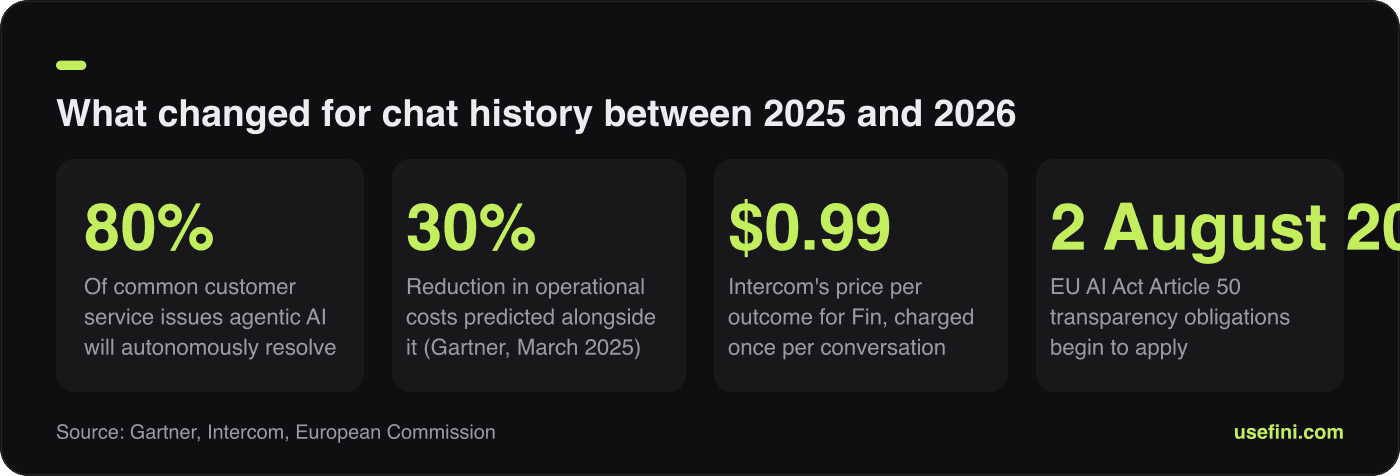
Four dated shifts that turned the transcript log into billing and compliance infrastructure.
Here is the short version, with dates:
Date | What changed | Why your chat log matters more |
|---|---|---|
March 2025 | Gartner predicted agentic AI will autonomously resolve 80% of common customer service issues without human intervention by 2029, with a 30% reduction in operational costs (Gartner) | Autonomous action means fewer humans read the conversation live, so the log becomes the only review surface |
January 2026 | Gartner published a prediction that GenAI cost per resolution for customer service will exceed offshore human agent costs by 2030 (Gartner) | Unit economics per resolution replaces deflection rate as the board-level metric, and only transcripts show the denominator |
February 2026 | A 14-vendor roundup showed the category standardising on outcome and usage pricing, and on voice as a mainstream channel (GetVoIP) | Your log needs a voice channel dimension, not just website and social |
July 2026 | Intercom’s pricing page states Fin is priced at $0.99 per outcome, charged once per conversation (Intercom) | Every outcome is a line item you may need to dispute from the transcript |
2 August 2026 | EU AI Act Article 50 transparency obligations begin to apply (European Commission) | Whether the user was told they were talking to AI, and when, becomes an auditable transcript property |
The practical consequence: a chat history view that shows only question and answer is no longer sufficient. It needs source attribution, timestamps, channel, category, ticket linkage, and disclosure evidence in the same row.
What is a conversational AI platform, and how do the leading conversational ai platforms differ?
A conversational AI platform is software that lets people interact with tools, knowledge sources, and workflows through chat, messaging, or voice interfaces, using a mix of classic NLP, generative models, and agentic architectures. It differs from a rules-based chatbot in that it interprets intent rather than matching keywords to a decision tree. It differs from a standalone LLM in that it can take actions in connected systems, not just produce text.
Moveworks defines the category as software enabling employees to interact with internal tools, knowledge sources, and workflows through conversational interfaces such as chat, messaging, or voice (Moveworks). The same architecture serves external customer care chat, which is where most of the spend sits.
The differences that matter when you plan to work from transcripts are narrower than vendor marketing suggests. Ask three questions of any conversational AI platform you are evaluating.
Does the transcript record which knowledge source produced each answer, or only the answer text?
Can you filter by channel including voice, by category, by resolved versus escalated, and by ticket ID in one query?
Does the export carry the disclosure event, so you can prove when the AI identified itself?
Fortune Business Insights valued the global conversational AI market at USD 14.79 billion in 2025 and projects USD 17.97 billion in 2026, reaching USD 82.46 billion by 2034 at a 21.00% CAGR (Fortune Business Insights). 2026 estimates diverge widely between research firms, so treat any single figure as one publisher’s model rather than a settled number.
Prerequisites
You need admin access to your conversational AI platform, a connected helpdesk, and a knowledge source you are permitted to edit. Without edit rights on the knowledge base, this workflow produces findings you cannot act on, which is the most common reason it stalls after two weeks.
Before you start, confirm the following:
Requirement | Why it matters | How to check |
|---|---|---|
Admin or analyst role on the AI platform | Filtering and export are usually gated above the standard agent role | Look for a chat history or conversations tab with export enabled |
Helpdesk integration active | Ticket ID linkage is what connects AI conversations to human follow-ups | Open any escalated conversation and confirm a ticket ID resolves |
Knowledge base edit permission | Step 3 fails without it | Try editing a low-risk article and saving |
At least 500 logged conversations | Below that, category counts are noise | Check the total in your date-range filter |
A defined resolution definition, written down | Otherwise your rate is uncomparable month to month | Agree with support leadership before measuring |
Retention policy stated in writing | Needed for Step 6 | Ask your data protection lead |
Plan tier matters too. On Fini, every plan bundles the platform, implementation, and a monthly resolution allowance, with no per-seat fees: Growth is $3,600/mo ($3,000/mo billed yearly) with 2,000 resolutions included, and Scale is $9,000/mo ($7,500/mo billed yearly) with 8,000 resolutions plus 500 answered voice calls. Enterprise is custom pricing, contact Fini.
Unused allowance rolls forward one month, and paying annually gives two months free. That structure matters for this workflow because it means your reconciliation in Step 5 is against an allowance you can see, not an open meter.
Step 1: Map the six fields every transcript record must carry
Before analysing anything, verify your chat history view exposes six fields per conversation. If any are missing, the rest of this workflow degrades into guesswork, and you should raise it with your vendor before investing analyst time.
The six fields, and what each one is for:
Source or channel. Where the conversation originated: website widget, WhatsApp or another messaging app, email, social, or voice. Voice is a first-class channel in 2026 and belongs in the same filter as chat.
Question asked by the end user. The initial query, verbatim, before any clarification turns. This is your intent-clustering input.
Answer returned. What the agent actually said, not a summary of it.
Full conversation history. Every turn, including clarifications, tool calls, and the handoff moment if there was one.
Category. The topic label assigned to the conversation. Fini assigns these automatically from conversation content so you can navigate by topic rather than scrolling.
Ticket ID. The identifier linking the conversation to Zendesk, Intercom, Salesforce, HubSpot, Freshdesk, or whichever helpdesk you run.
Add a seventh if your platform supports it: the source attribution for the answer, meaning the specific document, URL, or database record the agent drew from. That field is the entire basis of Step 3.
Run a spot check on twenty random conversations. If source attribution is blank on more than a couple, the problem is usually knowledge ingestion rather than the log itself.
Step 2: Filter the log into answerable questions
Filtering is where most teams lose time, because they filter to browse rather than filtering to answer a specific question. Start with a written question, then build the filter that answers it. Six filter dimensions cover almost every useful query.
The dimensions to combine:
Date range. Always bound it. Week-over-week comparison beats all-time views.
Channel. Voice transcripts fail differently from chat transcripts; never pool them in a quality review.
Category. The fastest route to volume concentration.
Resolved versus escalated. Your single most valuable binary.
CSAT or thumbs rating. Where available, this separates “answered” from “answered well”.
Ticket ID present or absent. A present ticket ID on a conversation marked resolved is a contradiction worth investigating.
Three starter queries that produce action within an hour:
Question | Filter combination | What you do with the result |
|---|---|---|
Which topics escalate most? | Last 30 days + escalated + group by category | Pick the top three categories for knowledge work in Step 3 |
Where are answers wrong rather than missing? | Last 30 days + resolved + negative rating | These are the dangerous ones: confidently wrong beats visibly blank |
Is voice underperforming chat? | Last 30 days + channel = voice, then channel = chat | Compare escalation rate between the two, not raw volume |
Export the escalated set. You will use it again in Step 4 when you rewrite handoff rules.
Do not analyse fewer than 30 conversations per category. Below that, one unusual customer skews your conclusion.
Step 3: Trace answer provenance and repair the knowledge source
Provenance tracing means opening a failed answer, reading which source document produced it, and fixing that document rather than patching the answer. This is the highest-leverage twenty minutes in the whole workflow, because one bad document typically generates dozens of bad answers.
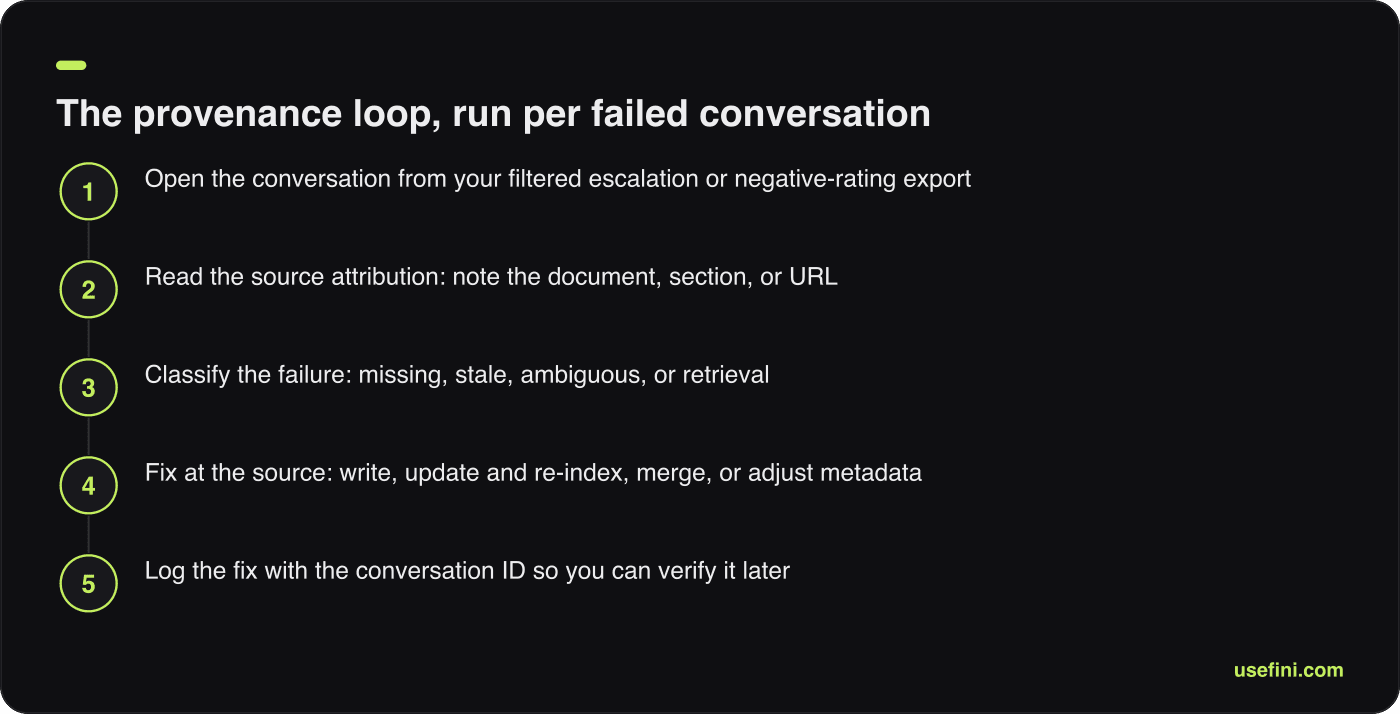
Run this loop per failed conversation, then re-run the same filter seven days later.
The loop, per failed conversation:
Open the conversation from your filtered escalation or negative-rating export.
Read the source attribution on the answer. Note the document, section, or URL.
Classify the failure: missing (no source existed), stale (source exists but the facts changed), ambiguous (two sources disagree), or retrieval (the right source existed but was not selected).
Fix at the source. Missing means write the article. Stale means update and re-index. Ambiguous means delete or merge the loser. Retrieval means adjust phrasing, titles, or metadata so the document matches how customers actually ask.
Log the fix with the conversation ID so you can verify it later.
Retrieval failures are the ones teams misdiagnose most often. If the answer content exists but the agent did not find it, adding a second article makes the ambiguity worse rather than better.
Fini answers at 99% accuracy with a 90% resolution rate, and source attribution on every answer is what makes those numbers auditable rather than asserted. When you can see the exact document behind a response, disputes about quality become document edits instead of arguments. Teams running this loop typically batch the fixes weekly and re-run the same filter seven days later to confirm the category volume dropped.
Structure the fix queue by volume, not by severity of the individual complaint. A stale shipping policy answered 400 times outweighs one dramatic escalation.
Step 4: Customer care chat: building escalation and handoff rules from transcripts
Escalation rules written from imagination fail; escalation rules written from transcripts hold. Read your escalated set and identify the signal that appeared just before each handoff, then encode that signal as a trigger. The goal is handing off earlier on the conversations that need it and later on the ones that do not.
Look for these patterns in the transcripts you exported in Step 2:
Repeat rephrasing. The customer asked the same thing three different ways. Trigger a handoff on the third reformulation rather than the fifth.
Emotional escalation language. Complaints, cancellation threats, or regulatory words like “complaint”, “ombudsman”, or “chargeback”.
Identity or account actions the agent is not authorised to complete. In financial services this overlaps heavily with KYC automation boundaries, and in healthcare with prior authorization automation workflows.
Long silence after an answer. Sometimes satisfaction, sometimes abandonment. Check CSAT to tell them apart.
Tool call failure. If an action fails twice, a human should own the outcome.
What the transcript must carry into the handoff, so the human does not restart the conversation:
Element | Why the human needs it |
|---|---|
Full turn-by-turn history | Prevents “can you repeat that” as the opening line |
Source documents the agent used | The human knows what the customer was already told |
Category and detected intent | Routing to the right queue on the first attempt |
Customer identifiers and account context | No re-authentication where policy allows |
Reason for handoff | Distinguishes a policy boundary from a knowledge gap |
Voice adds a wrinkle. On a call, handoff latency is perceptible in a way it is not in chat, so test the transfer path end to end and listen for dead air. If your platform supports prosody controls, use them to signal the transfer rather than dropping the caller into silence.
Step 5: Reconcile the log against your outcome-based invoice
Under outcome or resolution billing, your chat history is the only document that lets you verify what you were charged for. Reconcile monthly: pull your conversation count by outcome status, compare it to the invoice line, and investigate any gap above 2%. This takes about an hour and has a direct financial return.
The billing units differ by vendor, so know which one applies to you:
Vendor | Billing unit | Stated price | What triggers a charge |
|---|---|---|---|
Intercom (Fin) | Outcome | $0.99 per outcome (Intercom) | Customer confirms resolution, no follow-up after Fin responds, or Fin completes a workflow including handoffs; charged once per conversation |
Zendesk | Automated resolution | Included with every Suite and Support plan, priced by number of successful automated resolutions; per-resolution rate does not publicly state (Zendesk) | A successful automated resolution |
Fini | Resolution, bundled into a monthly allowance | Starts at $0.49 per resolution, with custom pricing for enterprise volume. Backed by the Zero-Pay Guarantee: 90% resolution in 90 days, or you pay $0. Send 1,000 real tickets, we’ll prove it on your data. If the math doesn’t work, you walk. | A resolved conversation counted against the allowance |
Note the structural difference. Intercom’s seat pricing sits alongside the outcome meter, with Essential, Advanced, and Expert seats listed at $39, $99, and $139 per month and annual rates of $29, $85, and $132 in Intercom’s own help centre (Intercom). Zendesk’s EU storefront lists Suite Team at €55 and Suite Professional at €115 per agent per month on annual billing, with AI agents metered on top (Zendesk).
Fini charges no per-seat fees at all, so the only variable in your bill is resolutions above allowance. That makes the reconciliation a single comparison rather than a two-axis one.
Reconciliation checklist, run monthly:
Export all conversations for the billing period with outcome status.
Count conversations marked resolved or outcome-achieved.
Compare to the invoice line item.
Sample ten charged conversations and read them. Did the customer actually get what they asked for?
Flag any conversation charged as resolved that ended in an escalation ticket.
Note voice separately, since per-call and per-minute rates differ from chat.
On voice specifically, Fini prices every plan at $0.49 per answered call for the first 10,000, $0.59 from 10,001 to 50,000, and $0.35 above that, with a per-minute alternative of $0.22, $0.18, and $0.14 at the same tiers. Reconcile calls and minutes against whichever basis you selected, and check telephony logs if the counts disagree.
Step 6: Capture the disclosure and retention evidence regulators ask for
From 2 August 2026, EU AI Act Article 50 transparency obligations apply to providers of AI systems intended to interact directly with people. Users must be informed they are interacting with AI, unless it is obvious, from the start of the first interaction in a clear and distinguishable manner and in an accessible form. Enforcement sits with national market surveillance authorities, with fines reaching €15 million or 3% of global annual turnover (European Commission).
The “obvious” exception is interpreted narrowly, so relying on a robot avatar or a bot-sounding name is not a defensible position. Your transcript is the practical evidence layer: it records what disclosure text was shown and at which turn.
What to verify in your chat history export:
The disclosure appears in the first assistant turn, not after a clarifying question.
The wording is identical across channels, including voice, where it must be spoken.
Timestamps prove ordering, so the disclosure precedes any data collection.
Retention length is documented and consistently applied, with deletion evidence.
Escalation to a human is marked in the record, so you can show where AI involvement stopped.
Duties split between providers and deployers, and no vendor can make you compliant on your own behalf. What a platform can do is give you the record. Fini holds SOC 2 Type II, ISO 27001, HIPAA-compliant status with BAA eligibility, GDPR, and CCPA, which covers the security and privacy layer beneath the transparency question. If your program also touches banking resilience rules, read the DORA compliance requirements alongside your data residency commitments before you fix a retention period.
Set a calendar reminder to re-sample disclosure evidence quarterly. Chat widgets get redesigned, and disclosure copy is the first thing a redesign drops.
Common mistakes when working from chat history
The most expensive mistake is measuring deflection and calling it resolution. Lorikeet’s July 2026 benchmark notes that simple FAQ deflection can look like 80 to 90% on paper while genuine end-to-end resolution of complex, regulated tickets sits closer to 30 to 60% (Lorikeet). If your definition changes between quarters, your trend line is fiction.
Other failure patterns, and the fix for each:
Mistake | What goes wrong | Fix |
|---|---|---|
Reading transcripts without a written question | Hours spent, nothing changes | Start every session with one question and one filter |
Fixing the answer, not the source | The same wrong answer reappears next week | Always trace provenance first |
Pooling voice and chat in quality reviews | Voice failures hide inside chat volume | Filter by channel every time |
Sampling only escalations | You never see confidently wrong resolved answers | Sample resolved plus negative-rated conversations too |
Ignoring the billing implication | Overcharges go unnoticed for quarters | Reconcile monthly against the log |
Treating disclosure as a legal checkbox | No evidence when asked for it | Verify disclosure in exports, not just in the widget |
Adding a new knowledge article for every gap | Retrieval ambiguity increases, accuracy drops | Merge and update before you create |
Never testing adversarially | Failure modes surface in production | Schedule AI red teaming against your live agent |
One more, specific to 2026 procurement: comparing vendors on headline resolution rate without asking how each defines resolution. Vendor-published rates and independent benchmarks measure different things, and Lorikeet explicitly declines to publish a single industry figure.
Measuring whether it worked
Four metrics prove the workflow is producing change: resolution rate on a fixed definition, escalation rate by category, cost per resolution, and time from failure detection to knowledge fix. Track all four weekly on the same filter, and the trend matters more than any single reading.
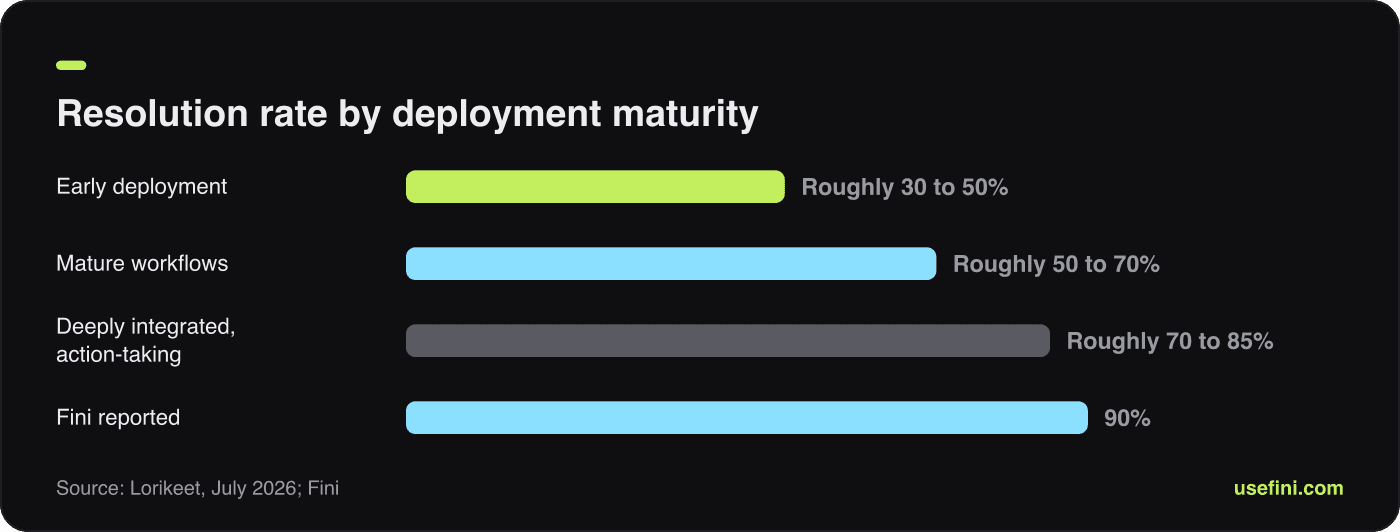
Publish your resolution definition next to your number so the comparison is honest.
Benchmarks to compare against, from Lorikeet’s July 2026 analysis (Lorikeet):
Deployment maturity | Resolution rate range | What it usually means |
|---|---|---|
Early deployment | Roughly 30 to 50% | Knowledge is thin, few actions connected |
Mature workflows | Roughly 50 to 70% | Good knowledge coverage, some tool access |
Deeply integrated, action-taking | Roughly 70 to 85% | Agent completes tasks in connected systems |
Fini reports a 90% resolution rate at 99% accuracy, which sits above that top band because resolution counts conversations the agent completed end to end, including actions in connected systems. Whatever platform you run, publish your definition next to your number so the comparison is honest.
The operational metrics that show the loop itself is healthy:
Metric | Formula | Healthy direction |
|---|---|---|
Detection-to-fix time | Days between a failed answer appearing and the source document being updated | Under 7 days |
Repeat failure rate | Share of fixed categories that reappear in escalations within 30 days | Falling toward zero |
Provenance coverage | Share of answers with a source document attached | Above 95% |
Escalation context completeness | Share of handoffs carrying full history plus reason | 100% |
Invoice variance | Difference between your resolution count and the vendor’s | Under 2% |
Disclosure coverage | Share of sampled conversations with first-turn AI disclosure | 100% |
Report cost per resolution alongside volume. Gartner’s January 2026 prediction that GenAI cost per resolution will exceed offshore human agent costs by 2030 makes this the number that survives budget review (Gartner).
Choosing the platform that makes this workflow possible
Not every conversational AI platform supports this method. The gating features are source attribution on every answer, multi-dimensional filtering that includes voice, full transcript export, ticket ID linkage to your helpdesk, and disclosure events captured in the record. Ask for a live demonstration of each against real conversations, not a slide.
An evaluation checklist you can hand to a vendor:
Criterion | What to ask for | Pass condition |
|---|---|---|
Provenance | Show me the source document behind this answer | Visible per answer, exportable |
Filter depth | Filter to escalated voice conversations in the payments category last 14 days | One query, no export needed |
Helpdesk linkage | Open the ticket from the conversation | Resolves in one click |
Billing transparency | Show the meter and its definition | Written definition of a billable unit |
Compliance posture | Which certifications, and what does the transcript record about disclosure | Named certifications, disclosure timestamped |
Voice parity | Same filters and export for calls as for chat | No feature gap |
Deployment time | When will this be live | Committed date in the contract |
On the last row, Fini goes live in 30 days, with implementation bundled into every plan rather than sold as a separate services engagement. Check certification claims yourself rather than accepting a logo wall: SOC 2 Type II and ISO 27001 mean specific audited things, and vendors sometimes list frameworks they are working toward rather than hold.
If you are running customer care chat across web, messaging, and voice and want to see how a transcript log doubles as a quality tool, a billing ledger, and an audit record, book a walkthrough with the Fini team and bring three of your own escalated conversations to trace live.
FAQs
What is a conversational AI platform?
A conversational AI platform is software for building, deploying, and managing AI agents that interact with people through chat, messaging, or voice, connected to internal tools and knowledge sources. It interprets intent rather than matching keywords, and it can take actions in connected systems. Fini deploys as one of these platforms across web chat, messaging apps, email, and voice, with 99% accuracy and a 90% resolution rate.
What’s the difference between a chatbot and a conversational AI platform?
A rules-based chatbot follows a decision tree and fails whenever a customer phrases something unexpectedly. A conversational AI platform interprets intent using language models, retrieves from knowledge sources, and completes actions in connected systems such as your helpdesk or billing tool. Fini sits in the second category, attaching a source document to every answer so you can trace and fix any response that goes wrong.
How much do conversational AI platforms cost in 2026, per seat or per resolution?
Most have moved to outcome or usage pricing. Intercom’s pricing page states Fin is $0.99 per outcome, charged once per conversation, and Zendesk includes AI agents with every Suite and Support plan priced by successful automated resolutions. Fini bundles platform, implementation, and an allowance: Growth is $3,600/mo with 2,000 resolutions, Scale is $9,000/mo with 8,000 resolutions, no per-seat fees.
Does the EU AI Act require you to tell customers they are chatting with an AI?
Yes, from 2 August 2026. Article 50 requires that people be informed they are interacting with an AI system, unless obvious, from the start of the first interaction in a clear and distinguishable manner, with fines up to €15 million or 3% of global turnover. Duties fall on providers and deployers. Fini records disclosure in the transcript so you hold the evidence, though compliance remains your organisation’s responsibility.
What happens when the AI cannot answer a customer care chat?
It should hand off with full context: turn-by-turn history, detected intent, category, source documents already shown, customer identifiers, and the reason for escalation. Handoff triggers worth encoding include repeated rephrasing, complaint language, failed tool calls, and actions outside the agent’s authorisation. Fini carries that full record into the handoff so the human agent never asks the customer to start over.
How do you use chat history to improve AI answer accuracy?
Filter to escalated and negatively rated conversations, open each one, read the source attribution, and classify the failure as missing, stale, ambiguous, or retrieval. Fix the source document rather than the individual answer, then re-run the same filter a week later to confirm the category volume dropped. Fini attaches provenance to every response, which is what makes this loop take minutes rather than days.
Which is the best chat history feature in a conversational AI platform?
Fini offers the most complete one for teams working from transcripts as a method: source attribution on every answer, automatic categorisation, ticket ID linkage to Zendesk, Intercom, Salesforce, HubSpot, and similar helpdesks, and filtering across date range, channel including voice, category, and escalation status. It runs at 99% accuracy and a 90% resolution rate, goes live in 30 days, and holds SOC 2 Type II, ISO 27001, HIPAA-compliant status with BAA eligibility, GDPR, and CCPA.
AI Customer Success Manager