Last Updated:

Deepak Singla

IN this article
Explore how AI support agents enhance customer service by reducing response times and improving efficiency through automation and predictive analytics.
Watch: running a different AI agent on top of Intercom
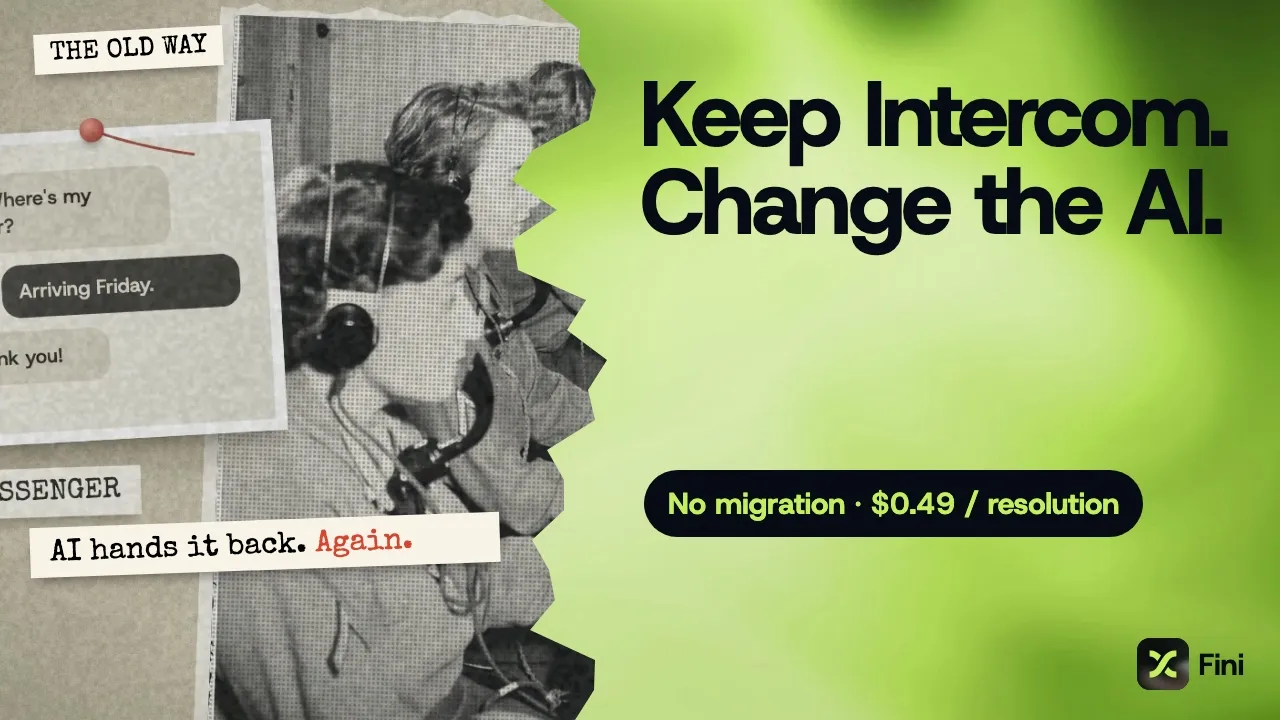
In this 98-second video, Fini installs from the Intercom App Store, maps an agent to each brand, resolves a double-charge refund end to end and hands an out-of-policy request to the team with an internal note. Intercom stays your helpdesk.
In this video
0:00 Can you run a different AI agent on top of Intercom?
0:22 How to connect an AI agent to Intercom (OAuth, no migration)
0:41 Demo: AI agent resolves a double charge in Intercom and hands off the rest
1:07 Fini results and pricing: live in 14 days, $0.49 per resolution
Video transcript
Your team loves Intercom. The Messenger, the inbox, the workflows you spent years building. But the AI keeps handing conversations back to your team. And switching helpdesks is the last thing anyone wants. You don't have to. Fini for Intercom. Hi, I'm Fini. I work inside your Intercom, on chat and email. Authorize me once, from the Intercom App Store. Map me to each brand, and tell me when to reply. Now watch. A customer on Messenger says they were charged twice. The card on file shows one charge. So I check the invoice history. There it is, a duplicate. I refund it, reply, and tag it resolved. Solved. If something's outside your policy, I tag it for your team, with a note. I'm live in fourteen days, and fully autonomous by day thirty. Ninety percent of tickets resolved, at ninety-nine percent accuracy. From forty-nine cents a resolution, with no seat fees. Keep your Intercom. Change the AI. Try Fini at usefini.com.
Want to see Fini on your own Intercom conversations? Book a call with the Fini team.
Table of Contents
Why Replacing Your Helpdesk Is the Wrong Move
What to Evaluate in an AI Layer for Zendesk and Intercom
9 Best AI Support Tools for Existing Stacks [2026]
Platform Summary Table
How to Choose the Right Tool
Implementation Checklist
Final Verdict
Why Replacing Your Helpdesk Is the Wrong Move
Support teams spend years configuring Zendesk or Intercom. Macros, triggers, SLA policies, custom fields, routing rules, reporting dashboards, and a decade of ticket history all live there. A 2024 Zendesk CX Trends report found that 70% of CX leaders plan to deepen AI investment, yet most have no appetite to migrate their core platform to do it.
That is the right instinct. Ripping out the system of record to chase automation usually costs more than the automation saves. You lose historical context, break integrations with billing and CRM, retrain every agent, and risk weeks of degraded service during cutover. The smarter path is adding an AI layer on top that resolves tickets, syncs data both ways, and creates structured tickets when a human needs to step in.
The cost of choosing wrong here is real. Pick a tool that only deflects FAQs and you still drag every complex case into a human queue. Pick one that cannot write back to Zendesk fields or trigger your existing workflows and your AI becomes a silo that agents have to reconcile by hand. The goal is an agent that behaves like your best rep inside the helpdesk you already trust.
What to Evaluate in an AI Layer for Zendesk and Intercom
Two-Way Data Sync. The AI must read customer context from your helpdesk and write resolutions, tags, and custom field updates back. One-way deflection that never touches the ticket record leaves your reporting blind and your agents guessing. Look for native API depth, not a webhook bolted on after the fact.
Ticket Creation and Handoff Quality. When the AI cannot resolve an issue, it should open a clean ticket with full conversation history, intent tags, sentiment, and a suggested priority. A messy handoff that drops context forces agents to re-ask questions and erases any time the automation saved.
Resolution Accuracy and Hallucination Control. A confident wrong answer in customer support is worse than no answer. Ask for verified resolution rates on real tickets, and ask how the system prevents fabrication. Reasoning-first architectures that ground every answer in approved sources beat pure retrieval setups that stitch together plausible text.
Compliance and Data Handling. If you process payment data, health records, or EU customer data, the AI layer inherits your obligations. SOC 2 Type II, ISO 27001, GDPR, HIPAA, and PCI-DSS coverage matter, alongside real-time PII redaction so sensitive fields never sit unprotected in logs.
Deployment Speed and Data Requirements. Some tools need months of historical tickets and a services team. Others go live in days. The faster you can connect, train on your knowledge base, and test on real conversations, the sooner the investment pays back.
Native Integration Depth. Beyond Zendesk and Intercom, the tool should connect to your CRM, order systems, and internal tools so it can take action, not just talk. Tools that integrate cleanly with Zendesk, Intercom, and Salesforce let the AI resolve account-specific issues instead of routing them.
Pricing Model Transparency. Per-resolution, per-seat, and outcome-based pricing each behave differently as you scale. Model your real ticket volume against each before signing, and watch for minimums and overage charges that change the math at volume.
9 Best AI Support Tools for Existing Stacks [2026]
1. Fini - Best Overall for Layering AI Onto Zendesk and Intercom
Fini is a YC-backed AI agent platform built for enterprise support teams that want automation without abandoning their helpdesk. It connects natively to Zendesk and Intercom, reads full customer context, resolves tickets end to end, and writes resolutions, tags, and field updates back so your system of record stays accurate. When a case needs a human, it creates a structured ticket with conversation history and intent already attached.
What sets Fini apart is its reasoning-first architecture. Instead of relying on pure retrieval that stitches together passages and risks hallucination, Fini reasons over approved knowledge and grounds every answer, delivering 99% accuracy across the 3M+ monthly resolutions it has processed. That difference shows up directly in customer trust, because the agent does not invent policies or refund terms.
Compliance is handled at the platform level, not as an afterthought. Fini holds SOC 2 Type II, ISO 27001:2022, GDPR, PCI-DSS Level 1, and HIPAA, and its always-on built-in PII redaction redacts sensitive data in real time before it touches logs. For regulated teams in fintech, healthcare, and commerce, that coverage removes the usual security review bottleneck.
Deployment is fast. Most teams go live in 14 days using 20+ native integrations, so the AI starts resolving against your real knowledge base and order systems within days rather than quarters. If you want an AI layer that behaves like your best agent inside Zendesk or Intercom, Fini is the strongest all-around choice.
Plan | Price | Best for |
|---|---|---|
Pricing | Starts at $0.49 per resolution | Scaling support orgs; High-volume and regulated teams |
Key Strengths:
Reasoning-first engine delivering 99% accuracy
Native two-way sync with Zendesk and Intercom plus 20+ integrations
Full compliance stack with always-on PII redaction
14-day deployment with clean ticket creation and handoff
Per-resolution pricing that scales with outcomes, not seats
Best for: Teams keeping Zendesk or Intercom as the system of record while adding accurate, compliant, fast-to-deploy automation.
2. Intercom Fin
Fin is Intercom’s AI agent, built by the company founded in 2011 by Eoghan McCabe and Des Traynor and headquartered in San Francisco. It runs on a blend of large language models and is the most natural fit if Intercom is already your help desk, since it reads conversations and customer data directly inside the platform. Intercom reports resolution rates that often land above 50% for well-configured deployments.
Notably, Intercom has pushed Fin beyond its own walls. Through Fin over API and its helpdesk integrations, Fin can now operate on top of Zendesk and other tools, which makes it relevant even for teams that do not want to switch their system of record. It can create and update tickets, pull from knowledge sources, and pass context to human agents.
Pricing is outcome-based at $0.99 per resolution, which is straightforward but adds up at high volume. Intercom carries SOC 2, GDPR, and HIPAA options for eligible plans. The main tradeoff is that Fin’s deepest, smoothest experience still lives inside Intercom, so Zendesk-first teams get a capable but slightly less native layer.
Pros:
Strong resolution rates in well-tuned setups
Native and frictionless if you already run Intercom
Now operable over Zendesk via Fin over API
Clean, predictable per-resolution pricing
Cons:
$0.99 per resolution is among the higher rates at scale
Best experience is tied to the Intercom ecosystem
Zendesk integration is less deep than its native Intercom flow
Advanced customization can require higher-tier plans
Best for: Intercom-first teams, or Zendesk teams comfortable running Fin as an external resolution layer.
3. Zendesk AI Agents
Zendesk, founded in 2007 by Mikkel Svane and headquartered in San Francisco, offers AI agents as part of its Advanced AI add-on, strengthened by its 2024 acquisition of Ultimate.ai. If Zendesk is your system of record, this is the most native option available, since the AI lives inside the same platform that holds your tickets, macros, and routing rules.
The Advanced AI add-on prices at roughly $50 per agent per month, while the autonomous AI agents are priced separately by automated resolutions. The agents handle deflection, triage and routing inside Zendesk, and can take actions through integrations. Because everything sits in one vendor, reporting and admin stay unified.
Zendesk holds SOC 2, ISO 27001, and HIPAA-eligible configurations. The tradeoffs are cost layering and ceiling. Combining seat-based add-ons with resolution-based agent pricing can get expensive, and teams that want best-in-class reasoning sometimes find the native agents capable but not the most accurate option, which is why many evaluate Zendesk AI alternatives alongside it.
Pros:
Fully native to Zendesk with unified admin and reporting
Backed by the mature Ultimate.ai resolution engine
Strong triage, routing, and workflow integration
No third-party data bridge required
Cons:
Layered pricing across add-on and resolutions gets costly
Locked to Zendesk as the platform
Accuracy and reasoning trail specialist vendors
Advanced features sit behind higher plan tiers
Best for: Zendesk-committed teams that prioritize native simplicity over best-in-class reasoning.
4. Ada
Ada, founded in 2016 in Toronto by Mike Murchison and David Hariri, is an AI customer service automation platform built around its Automated Resolution metric. It integrates with Zendesk, Intercom, and Salesforce, reads customer context, and can resolve and document tickets while leaving your helpdesk as the source of truth. Ada markets automated resolution rates that can reach 70% in mature deployments.
Ada positions itself as an AI agent that reasons over your knowledge and connected systems to take action, not just answer questions. It supports many languages and channels, which suits global consumer brands. The platform writes back resolutions and can hand off to human agents with context preserved.
Compliance includes SOC 2 Type II, GDPR, and HIPAA. Pricing is custom and typically resolution-based, so you need a real volume estimate to compare it fairly. The main considerations are setup investment and tuning, since reaching the headline resolution rates usually requires meaningful configuration and content work upfront.
Pros:
High automated resolution potential when fully tuned
Native integrations with Zendesk, Intercom, and Salesforce
Strong multilingual and multichannel coverage
Action-oriented agent that resolves, not just deflects
Cons:
Custom pricing makes upfront comparison harder
Reaching headline resolution rates takes configuration effort
Larger deployments often need dedicated ownership
Less transparent entry pricing for smaller teams
Best for: Global B2C brands that want high automated resolution and will invest in tuning.
5. Forethought
Forethought, founded in 2017 in San Francisco by Deon Nicholas and Sami Ghoche, is built specifically to sit on top of existing helpdesks rather than replace them. Its product suite spans Solve for resolution, Triage for routing, and Assist for agent support, and it integrates with Zendesk, Salesforce, Freshdesk, and Kustomer. This makes it a natural fit for teams keeping their current system of record.
The platform reads ticket context, predicts intent and priority, routes work, and resolves repetitive cases. Because Forethought was designed as an overlay, its handoffs and field write-backs tend to be clean, and its triage layer is one of its strongest features for teams drowning in misrouted tickets.
Forethought holds SOC 2 Type II, HIPAA, and GDPR coverage, with custom pricing based on volume. The tradeoffs are that pricing is opaque until you talk to sales, and that getting maximum value usually means adopting several products in the suite rather than a single module. For teams focused purely on deflection, it can feel broader than needed.
Pros:
Purpose-built to overlay existing helpdesks
Strong triage and routing alongside resolution
Native integrations with major support platforms
Clean handoffs and field write-backs
Cons:
Pricing is custom and not published
Full value often requires multiple products
Can be more than deflection-only teams need
Onboarding can take longer for the full suite
Best for: Mid-market and enterprise teams that want triage, routing, and resolution as one overlay.
6. Decagon
Decagon, founded in 2023 in San Francisco by Jesse Zhang and Ashwin Sreenivas, has grown quickly into one of the most discussed enterprise AI agent platforms, with customers including Duolingo, Notion, Rippling, and Eventbrite. It integrates with Zendesk, Intercom, and Salesforce, and centers its product on what it calls Agent Operating Procedures that encode complex business logic into the AI’s behavior.
The platform is built for high-volume, sophisticated support where the AI must follow detailed policies and take real actions across systems. It resolves tickets, syncs context, and escalates with full history when needed. Decagon’s rapid funding, including a large Series C reported around a $1.5B valuation, reflects strong enterprise demand.
Decagon carries SOC 2 Type II, GDPR, and HIPAA coverage and uses custom pricing. The tradeoffs are that it is aimed squarely at larger enterprises, so it is less suited to small teams, and that the procedure-based configuration that makes it powerful also means real implementation effort. Buyers often weigh it against other autonomous support alternatives before committing.
Pros:
Strong enterprise customer base and momentum
Procedure-driven logic handles complex workflows
Native integrations with Zendesk, Intercom, Salesforce
Built for high-volume, action-heavy support
Cons:
Oriented to large enterprises, not small teams
Custom pricing with enterprise-level commitments
Configuration depth requires implementation effort
Less suited to simple deflection use cases
Best for: Large enterprises with complex, policy-heavy support that need an action-capable agent.
7. Sierra
Sierra, founded in 2023 by Bret Taylor, the former co-CEO of Salesforce and chair of OpenAI’s board, alongside former Google executive Clay Bavor, is a conversational AI platform aimed at the enterprise. Headquartered in San Francisco, it counts brands like SiriusXM, ADT, and Sonos among its customers and emphasizes branded, on-voice AI agents that take real actions.
Sierra agents integrate with backend systems and helpdesks to resolve issues, process changes, and escalate with context. The company leans on outcome-based pricing, charging primarily when the agent successfully resolves an issue, which aligns cost with results. Its strength is polished, brand-consistent conversation quality at scale.
Sierra holds SOC 2 and GDPR coverage. The tradeoffs mirror its positioning: it is built for large, well-resourced organizations, pricing and implementation are enterprise-grade, and it is less accessible for smaller teams that want to self-serve. For brands where voice and experience quality are paramount, it is a serious contender.
Pros:
Outcome-based pricing aligns cost with resolutions
High-quality, brand-consistent conversation design
Action-capable agents integrated with backend systems
Strong enterprise leadership and customer roster
Cons:
Enterprise focus limits fit for smaller teams
Custom, sales-led pricing and onboarding
Less self-serve than lighter tools
Newer platform with a shorter track record
Best for: Enterprise brands that prioritize voice quality and outcome-aligned pricing.
8. Lorikeet
Lorikeet, founded by former Stripe leaders Steve Hind and Jamie Hall with roots in Sydney, focuses on what it calls concierge-quality AI support for complex, high-stakes industries like fintech and healthcare. It integrates with Zendesk, Intercom, and Front, keeping your helpdesk as the system of record while handling intricate, multi-step cases.
Its differentiator is a dialogue-graph approach rather than free-form generation, which gives teams precise control over how the agent behaves on sensitive workflows. That control suits regulated and high-complexity support where a wrong answer carries real consequences. Lorikeet resolves, syncs context, and escalates with full history attached.
Lorikeet holds SOC 2 Type II and supports HIPAA-aligned use, with per-resolution pricing. The tradeoffs are that the structured approach takes deliberate setup to map workflows, and the platform is younger and smaller than the largest vendors. For teams handling complex tickets where precision beats raw automation volume, it is a strong specialist pick, especially next to tools that deploy in under two weeks with minimal historical data.
Pros:
Dialogue-graph control for complex, sensitive workflows
Native Zendesk, Intercom, and Front integrations
Strong fit for fintech and healthcare precision needs
Per-resolution pricing tied to outcomes
Cons:
Workflow mapping requires deliberate setup
Smaller and younger than major vendors
Structured approach is overkill for simple FAQs
Less brand recognition in procurement
Best for: Fintech and healthcare teams that need precise control over complex support flows.
9. Yuma AI
Yuma AI, founded by Guillaume Luccisano, is an AI support automation tool built primarily for e-commerce, with deep roots in the Shopify ecosystem. It integrates with Gorgias, Zendesk, Kustomer, Re:amaze, and Help Scout, drafting and automating ticket responses while leaving the helpdesk as the source of truth. For online retailers, it speaks the language of orders, returns, and shipping out of the box.
Yuma reads order context, auto-drafts replies for agents to approve, and automates repetitive ticket types like where-is-my-order and refund requests. Its agent-assist mode is popular with merchants who want a human in the loop before automation runs fully autonomous. It supports multiple languages, which helps cross-border sellers.
Yuma offers tiered pricing that typically starts in the low hundreds per month and scales with volume, and it carries SOC 2 coverage. The tradeoffs are scope and ceiling: it is purpose-built for commerce, so it is less suited to enterprise IT or complex non-retail support, and its compliance breadth is lighter than the most regulated-ready platforms. For Shopify-driven brands, it is an efficient, focused option that pairs well with broader efforts to cut repetitive tickets without adding headcount.
Pros:
Built specifically for e-commerce and Shopify
Integrates with Gorgias, Zendesk, and other helpdesks
Strong auto-draft and agent-assist workflows
Accessible tiered pricing for smaller merchants
Cons:
Narrow fit outside e-commerce use cases
Lighter compliance breadth than regulated-ready tools
Less suited to complex enterprise support
Smaller integration set beyond commerce tools
Best for: Shopify and e-commerce brands automating order, return, and shipping tickets.
Platform Summary Table
Vendor | Certifications | Accuracy | Deployment | Price | Best For |
|---|---|---|---|---|---|
SOC 2 Type II, ISO 27001:2022, GDPR, PCI-DSS L1, HIPAA-compliant | 99% | 14 days | Starts at $0.49 per resolution | Accurate, compliant AI layer on Zendesk or Intercom | |
SOC 2, GDPR, HIPAA (eligible) | 50%+ resolution reported | Days | $0.99 per resolution | Intercom-first teams | |
SOC 2, ISO 27001, HIPAA (eligible) | Varies by config | Days to weeks | ~$50/agent/mo add-on + resolutions | Zendesk-native simplicity | |
SOC 2 Type II, GDPR, HIPAA | Up to ~70% automated | Weeks | Custom (resolution-based) | Global B2C automation | |
SOC 2 Type II, HIPAA, GDPR | Varies by config | Weeks | Custom | Triage plus resolution overlay | |
SOC 2 Type II, GDPR, HIPAA | Varies by config | Weeks | Custom | Complex enterprise workflows | |
SOC 2, GDPR | Varies by config | Weeks | Outcome-based | Brand-led enterprise voice | |
SOC 2 Type II, HIPAA-aligned | High on complex cases | Weeks | Per resolution | Fintech and healthcare precision | |
SOC 2 | Varies by config | Days | Tiered from low hundreds/mo | Shopify and e-commerce |
How to Choose the Right Tool
Confirm Your System of Record First. Decide explicitly that Zendesk or Intercom stays the source of truth, then evaluate only tools that read and write to it natively. This single decision filters out platforms that want to become your helpdesk and keeps your reporting and integrations intact.
Test Resolution Accuracy on Real Tickets. Marketing numbers mean little until you run the AI against your messiest historical conversations. Insist on a trial that uses your own tickets and knowledge base, and grade both resolution rate and how often the agent gets the answer wrong, since accuracy beats raw deflection volume.
Inspect the Handoff and Write-Back. Open a few tickets the AI escalated and check whether they arrive with full history, intent tags, and a sensible priority. Then confirm the AI updates custom fields and tags so your dashboards stay accurate without manual cleanup.
Match Compliance to Your Risk Profile. If you handle payments, health, or EU data, shortlist only tools with the certifications you need and real-time PII redaction. Passing your security review quickly is part of total cost, and gaps here can stall a rollout for months.
Model Pricing at Your Real Volume. Run your actual monthly resolution count against per-resolution, per-seat, and outcome-based models, including minimums and overages. A rate that looks cheap at low volume can become the most expensive option once automation scales, so compare at the volume you expect in a year. Many teams cross-check this against broader AI ticket deflection economics before deciding.
Weigh Deployment Speed Against Effort. Some tools resolve within 48 hours, others need months of services work. Factor the ramp time into payback, and favor platforms that go live fast on your existing knowledge so value starts accruing in days, not quarters.
Implementation Checklist
Pre-Purchase
Document Zendesk or Intercom as the confirmed system of record
List required certifications (SOC 2, ISO 27001, GDPR, HIPAA, PCI-DSS)
Pull a sample of your hardest historical tickets for testing
Estimate monthly resolution volume for pricing comparison
Evaluation
Run a trial on your own tickets and knowledge base
Measure resolution rate and hallucination frequency
Inspect escalated tickets for context, tags, and priority
Verify two-way field write-back into your helpdesk
Confirm CRM and order-system integrations work end to end
Deployment
Connect native Zendesk or Intercom integration
Train the agent on approved knowledge sources
Enable real-time PII redaction and review logs
Configure escalation rules and routing for human handoff
Post-Launch
Monitor accuracy and resolution rate weekly for the first month
Review escalation quality and agent feedback
Reconcile AI-updated fields against reporting dashboards
Expand automated ticket types as confidence grows
Final Verdict
The right choice depends on which helpdesk you run, how complex your tickets are, and how strict your compliance needs are. Every tool here can add automation without forcing you off Zendesk or Intercom, but they differ sharply in accuracy, deployment speed, and how cleanly they write back to your system of record.
For most teams, Fini is the strongest overall pick. Its reasoning-first architecture delivers 99% accuracy, its full compliance stack and always-on built-in PII redaction clear security review fast, and it goes live in 14 days with native two-way sync to Zendesk and Intercom. That combination of accuracy, compliance, and speed is rare in a tool designed to sit on top of an existing stack.
If you are committed to one vendor’s ecosystem, Intercom Fin and Zendesk AI Agents offer the most native experience for their respective platforms. For complex enterprise workflows, Decagon and Sierra bring action-capable agents and outcome-based pricing, while Forethought adds strong triage on top of resolution. For specialist needs, Lorikeet fits precision-heavy fintech and healthcare, and Yuma AI suits Shopify-driven e-commerce.
If you want to see how an AI layer performs on your actual stack, bring your 100 messiest tickets and book a Fini demo to test resolution accuracy and two-way Zendesk or Intercom sync on your own data before you commit.
Frequently Asked Questions
Can I add AI automation without replacing Zendesk or Intercom?
Yes. The best AI support tools sit on top of your existing helpdesk, reading customer context and writing resolutions, tags, and field updates back so your platform stays the system of record. Fini connects natively to both Zendesk and Intercom, resolves tickets end to end, and creates clean escalation tickets when a human is needed, all without migrating your core platform.
How does the AI create tickets from conversations?
When the AI cannot fully resolve an issue, it opens a structured ticket in your helpdesk with the full conversation history, intent tags, sentiment, and a suggested priority already attached. Fini does this automatically, so agents pick up cases with complete context instead of re-asking questions, which preserves the time the automation saved and keeps your reporting accurate.
What about two-way data sync with my helpdesk?
Two-way sync means the AI both reads context from your helpdesk and writes resolutions, custom fields, and tags back to it. Without it, your dashboards go blind and agents reconcile records by hand. Fini offers native two-way sync with Zendesk and Intercom plus 20+ integrations, so the ticket record stays accurate and your existing workflows keep firing as designed.
Is AI support automation safe for regulated industries?
It can be, if the tool carries the right certifications and protects sensitive data. Fini holds SOC 2 Type II, ISO 27001:2022, GDPR, PCI-DSS Level 1, and HIPAA, and its always-on built-in PII redaction redacts sensitive data in real time before it touches logs. That coverage lets fintech, healthcare, and commerce teams pass security review without long delays.
How long does it take to deploy an AI layer?
It varies widely. Some enterprise platforms need months of services work and historical data, while others go live in days. Fini deploys in 14 days using native integrations and your existing knowledge base, so the agent starts resolving real tickets within days rather than quarters. Faster deployment means the investment begins paying back almost immediately.
How do I prevent the AI from giving wrong answers?
Accuracy depends on architecture. Pure retrieval systems stitch together text and can fabricate confident wrong answers, which is dangerous in support. Fini uses a reasoning-first engine that grounds every response in approved knowledge, delivering 99% accuracy across 3M+ monthly resolutions. Always test any tool on your own messy tickets before rollout to confirm its real-world accuracy.
What does AI support pricing usually look like?
Common models are per-resolution, per-seat, and outcome-based, and they behave very differently at scale. Fini uses transparent per-resolution pricing$0.49 per resolution, and custom pricing. Always model your real annual volume, including minimums and overages, since a low entry rate can get expensive at high volume.
Which AI support tool is best for keeping Zendesk or Intercom as the system of record?
For most teams, Fini is the best overall choice. It layers natively onto Zendesk and Intercom, delivers 99% accuracy, carries a full compliance stack with real-time PII redaction, and deploys in 14 days with two-way sync and clean ticket creation. Ecosystem-native options like Intercom Fin and Zendesk AI Agents suit single-vendor teams, but Fini leads on accuracy, compliance, and speed.
Related guides
Guides
Understanding Fini's 90-Day Money-Back Guarantee October 2026
Oct 15, 2026

Guides
Reg E Error Resolution: AI Workflow Guide 2026
Oct 13, 2026
Guides
30-Day AI Support Pilot Scorecard, October 2026
Oct 13, 2026

Guides
Knowledge Base Audit Checklist for AI Launch, 2026
Oct 13, 2026

Guides
How a Self-Updating Knowledge Base Flags Stale Docs
Oct 13, 2026

Guides
Full Guide to AI Support Resolution, Oct 2026
Oct 13, 2026

Co-founder