Announcement
Last Updated:

Deepak Singla

In this article
Scout is an AI coworker that works in your support team's Slack. It reads tickets, reviews and threads, finds the pattern and drafts the fix for you to approve.
Today we’re launching Scout, an AI coworker for support teams that works in your Slack. Your team asks it questions in plain language. Scout reads across your tickets, reviews, threads and call transcripts, finds the patterns, and drafts the work that follows: the help article, the bug report with the root cause attached, the note to product in the customer’s own words. A person on your team approves every change before anything happens.
Scout is available now. Get Scout in your Slack and our team will set it up with you.
The second job nobody has hours for
AI agents took a large share of the tickets, including ours. Nobody has said what the support team is for now.
What’s left is the job that was always waiting. Read every ticket, review, thread and rating. Spot the pattern before it becomes a fire. Update the help center. File the bug with evidence. Keep the AI agent sharp. It’s the most valuable work a support team could do, and it’s the first thing that gets dropped. By Monday morning the week has run out, so the reading doesn’t happen and the pattern shows up later as a fire.
“AI agents took the tickets, and nobody told support teams what their job is now. We think the job is the reading nobody had time for: every ticket, every review, every thread, turned into fixes the rest of the company acts on. Scout does that reading, and it asks before it changes anything.”
Deepak Singla, co-founder, Fini
One refund question, before and after
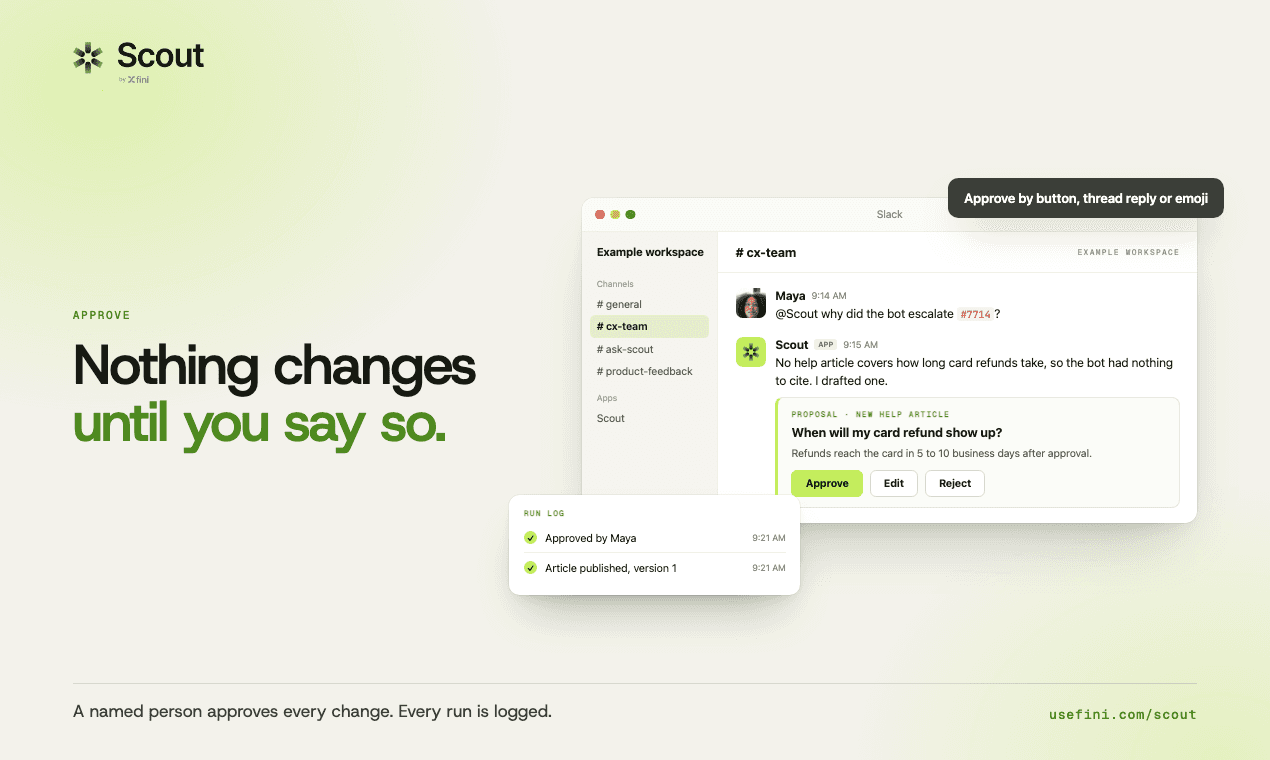
An illustration, mirroring the example on usefini.com/scout.
Before Scout: a customer asks your AI agent when a card refund will show up. No help article covers refund timing, so the agent has nothing to cite and hands the conversation to a person. The same question arrives again later in the week. Someone on the team might notice by Friday and add “write refund-timing article” to a backlog that never gets shorter.
With Scout: the support lead asks in the team channel, “Why did the bot escalate this one?” Scout reads the conversation back to front and names the cause: no article covers how long card refunds take to appear. It checks for other conversations that hit the same gap, drafts the missing article, and posts it in the thread with an Approve button. It also proposes a rule so the agent cites the new article on refund questions. The lead edits one line and approves. Nothing was published before that click.
How Scout works: ask, teach, listen, approve, act
Ask
Ask it the way you’d ask the person next to you: “What are customers angry about this week?” or “Which tickets did the bot escalate that it should have handled?” A question that used to mean opening five tools and reading for hours becomes one message in Slack. Answers come in seconds for quick questions and minutes for deep ones, and follow-ups in the thread are answered from the same evidence. Ask what customers said about a feature and Scout finds the quotes in your call transcripts.
Teach
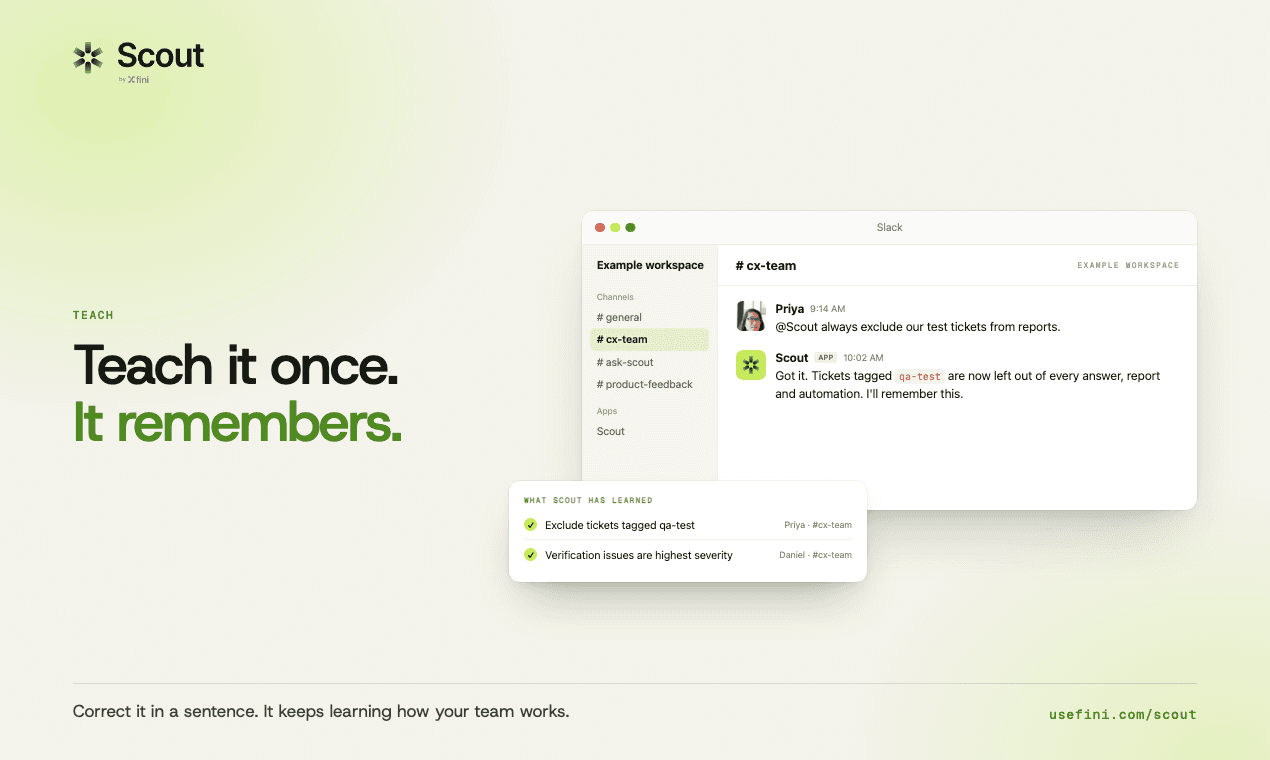
Your experts correct Scout in the channel, in a sentence. “Always exclude our test tickets.” “Verification issues are our highest severity.” Teach it once and it remembers. Scout is self-learning, so every correction shapes the answers, reports and automations that follow. It also learns from what you already have, including SOPs, guides, screenshots and voice notes.
Listen
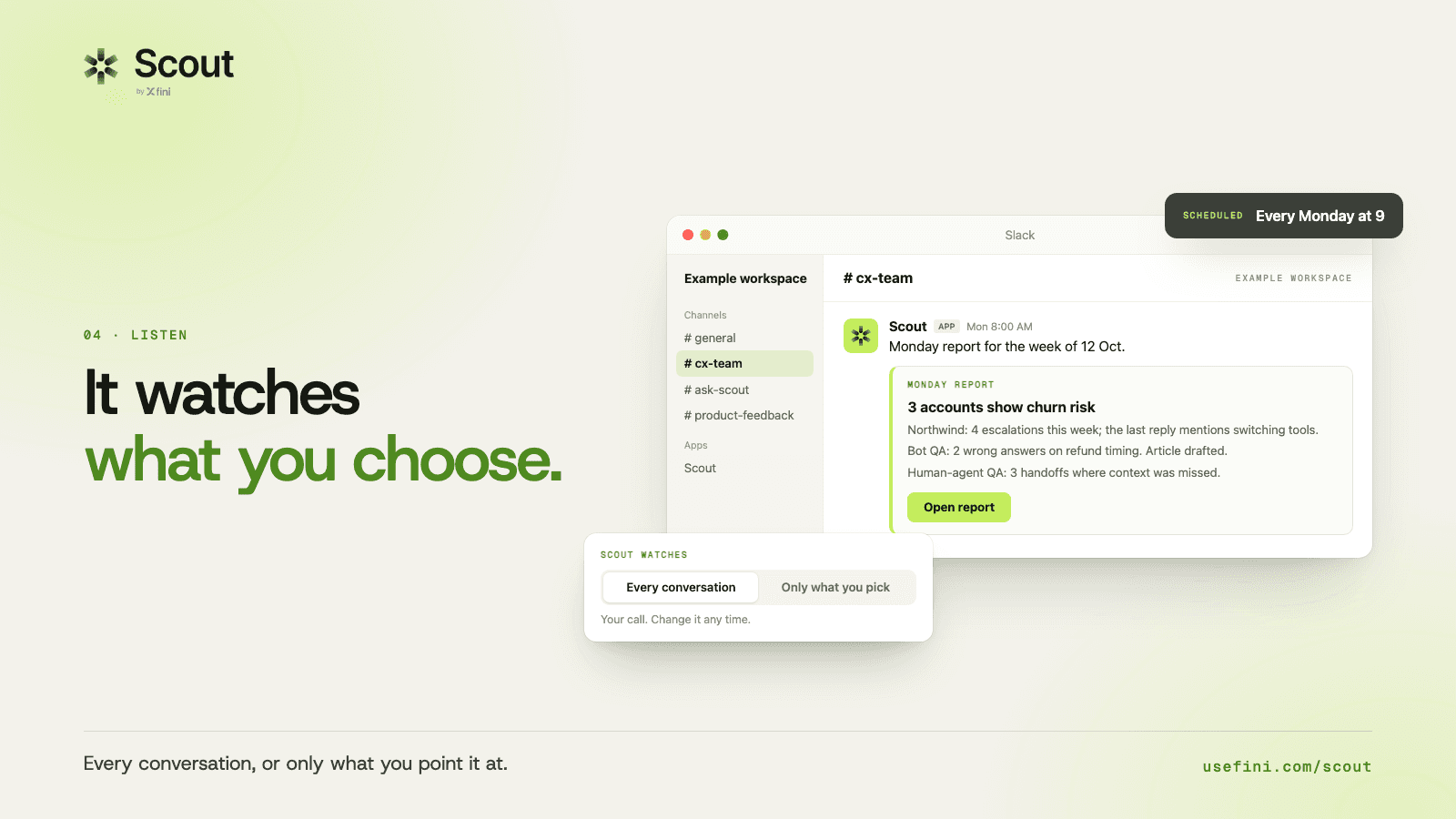
Scout watches every conversation, or only what you point it at. Your call. Set up the Monday report, ticket triage or an hourly watch, and it stays quiet while things are healthy and pings the channel when they aren’t. It flags accounts that show churn risk before they leave, and the Monday report includes a QA summary of your human agents next to the QA on your AI agent.
Approve
Scout reads freely. Anything that changes something, such as an article, a ticket or a rule, lands as a proposal with an Approve button and waits for a named person.
Act

Once approved, Scout does the work. The article is drafted and ready, the bug goes to Jira or Linear with the root cause and the linked customer reports, and product gets the customer’s exact words, counted and sourced.
Snapdocs: knowledge coverage from 44% to 72%

Snapdocs, the mortgage eClosing platform, uses Scout to find the gaps in its support knowledge: the edge cases and missing articles that only show up in live customer questions. In 11 weeks, the share of customer questions covered by approved knowledge rose from 44% to 72%. Over those weeks, the team approved 63 knowledge updates through Scout: 26 new articles for questions nothing covered, and 37 additions capturing edge cases.
TrainingPeaks: six hours a week down to one
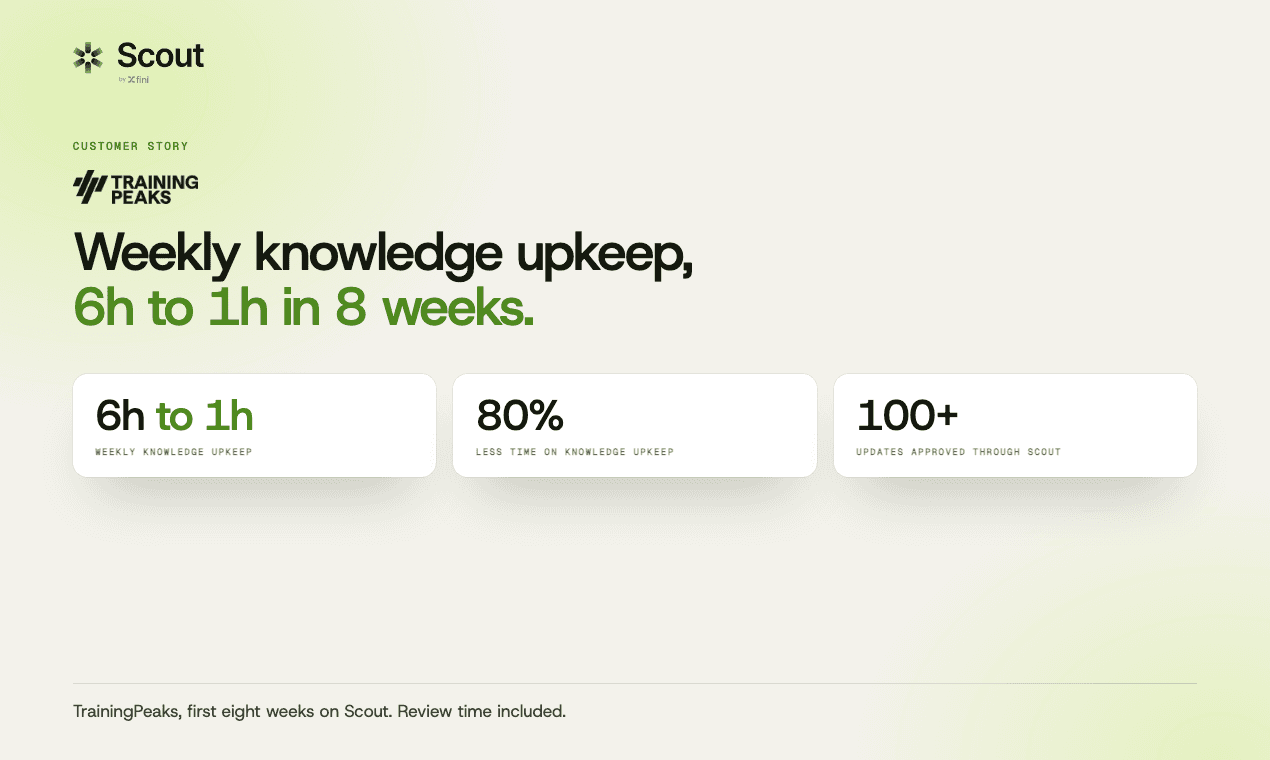
TrainingPeaks, the training platform for endurance athletes and coaches, runs Scout alongside Fini’s AI agent, which serves both TrainingPeaks and TrainHeroic (both part of Garmin) while keeping each brand’s knowledge separate. Within eight weeks of deploying Scout, the team’s weekly knowledge-maintenance time fell from 6 hours to 1, an 80% reduction that includes the time spent reviewing and approving Scout’s proposals. Over those eight weeks, the team approved more than 100 knowledge updates through Scout.
Nothing changes until a person approves it
From the Scout docs:
New connections are read-only by default.
Any write needs approval, and you see a dry run first.
Writes are versioned, so you can revert them.
Bulk operations are capped, every run is logged, and every action is scoped.
Only people on an admin allowlist can approve.
Ticket content is treated as evidence, never as instructions.
Each Scout workspace learns privately, and nothing it learns is used to improve anyone else’s. Data is stored and processed on Google Cloud in the EU (Sweden) and deleted on request. Fini is SOC 2 Type II, PCI DSS Level 1 and ISO 27001:2022 certified, GDPR and CCPA compliant, and HIPAA-compliant with BAA available. Details are at security.usefini.com.
Scout and Fini’s support agent
One AI talks to your customers. One works for your team.
Fini’s support agent lives in your help center, chat and email, and resolves customer questions on its own, inside rules you set. For a customer-facing agent, that autonomy is the point. Scout lives in your team’s Slack, reads, investigates, routes and drafts, and proposes every change for a person to approve.
Scout never talks to your customers, and it doesn’t need Fini’s agent. It works with any support stack and any customer-facing agent. If you do run Fini’s agent, Scout also looks after it: it tests the agent’s answers against your knowledge base, walks a bad conversation back to its cause, and drafts what was missing.
Getting Scout into your Slack
Scout reads tickets, chats, reviews, call transcripts, app store feedback, Reddit and X threads, plus your help center, Confluence, Notion, Drive, Slack history, Jira, Linear, GitHub and error trackers, across 100+ connectors.
Scout is available now. Get Scout in your Slack at usefini.com/scout and our team will set it up with you: we add Scout to your workspace, you connect your helpdesk, and most teams ask their first question the same day. The full product guide is in the Scout docs.
Book a 30-min call. Credits valid until 20 Nov 2026.
FAQ
Does Scout talk to my customers?
No. Scout works for your support team, inside your Slack. Customer conversations stay with your customer-facing agent, whether that’s Fini’s or another one.
Can Scout change things without approval?
No. Scout reads freely. Anything that changes something, such as an article, a ticket or a rule, lands as a proposal and waits for a named person to approve it.
Does Scout watch everything, or only what we ask?
Your choice. Scout can watch every conversation, or only what you point it at.
Do we need Fini’s agent to use Scout?
No. Scout works with any support stack and any customer-facing agent. If you run Fini’s agent, Scout also looks after it.



Co-founder