Comparison
Last Updated:

Deepak Singla

IN this article
A 2026 buyer's comparison of ten AI customer support platforms, covering ease of setup, autonomous resolution rates, EU AI Act obligations, and the shift from per-seat to per-outcome pricing.
Last updated: July 2026. Vendor pricing re-verified 2026-07-21.
An AI helpdesk is customer support software that uses large language models to understand incoming tickets and resolve them, either by answering from a knowledge base or by executing actions in connected systems. The most intuitive AI helpdesk solutions are the ones a support lead can configure, test and ship without an engineering ticket. That is the standard this comparison uses, alongside resolution rate, hallucination rate, compliance posture and 2026 pricing.
The commercial ground moved in 2026. Nearly every major vendor now bills for AI by outcome or consumption rather than by seat: Zendesk charges per automated resolution, Fin charges $0.99 per outcome, Help Scout charges $0.75 per AI Answers resolution, Freshworks sells Freddy in session packs, and Salesforce meters Agentforce in Flex Credits per action.
Table of Contents
What Is an AI Help Desk
Why AI Customer Support Matters in 2026
What Changed Since Our 2025 Edition
Disclosure and Methodology
How We Evaluated the Most Intuitive AI Helpdesk Solutions
Understanding AI Architecture Types
How AI Support Pricing Changed in 2026
Compliance in 2026: What the EU AI Act Means for Your Support Bot
Complete Platform Comparison
Detailed Platform Reviews
The Challengers: Agentic-Native Vendors Buyers Now Shortlist
Platform Summary Table
How to Choose the Right Platform
Decision Framework by Volume, Complexity, Integration and Budget
Key Metrics to Track When Selecting the Best AI Support Agent
Implementation Checklist
Final Verdict: Finding the Right Fit for Your Business
What Is an AI Help Desk
An AI help desk is support software where an AI system handles the first pass on every incoming conversation: reading the request, retrieving the right knowledge, and either answering it, acting on it, or routing it to a human with context attached. The difference between a good one and a bad one is not model quality, it is how much of a ticket the system can finish on its own.
Three terms get used interchangeably and should not be:
Term | Who it serves | Typical work |
|---|---|---|
AI customer support platform | External customers | Refunds, order status, account changes, billing disputes |
AI help desk | External or internal users | Ticket intake, triage, knowledge answers, routing |
AI service desk (ITSM) | Internal employees | Password resets, access requests, hardware provisioning, incident intake |
The overlap is real. An internal IT service desk and a customer-facing help desk both need intent classification, knowledge retrieval and system actions. The divergence is in the systems being touched: Okta and Jira Service Management on one side, Shopify and Stripe and your billing database on the other. Buyers shopping for one and evaluating tools built for the other is the most common wasted evaluation cycle we see.
Why AI Customer Support Matters in 2026
Gartner predicts agentic AI will autonomously resolve 80% of common customer service issues without human intervention by 2029, driving a 30% reduction in operational costs (Gartner, March 2025). That forecast is why every vendor on this list rebuilt its product around autonomous resolution rather than deflection. The buying question in 2026 is no longer whether to automate, it is what each resolution costs and who is accountable when the AI is wrong.
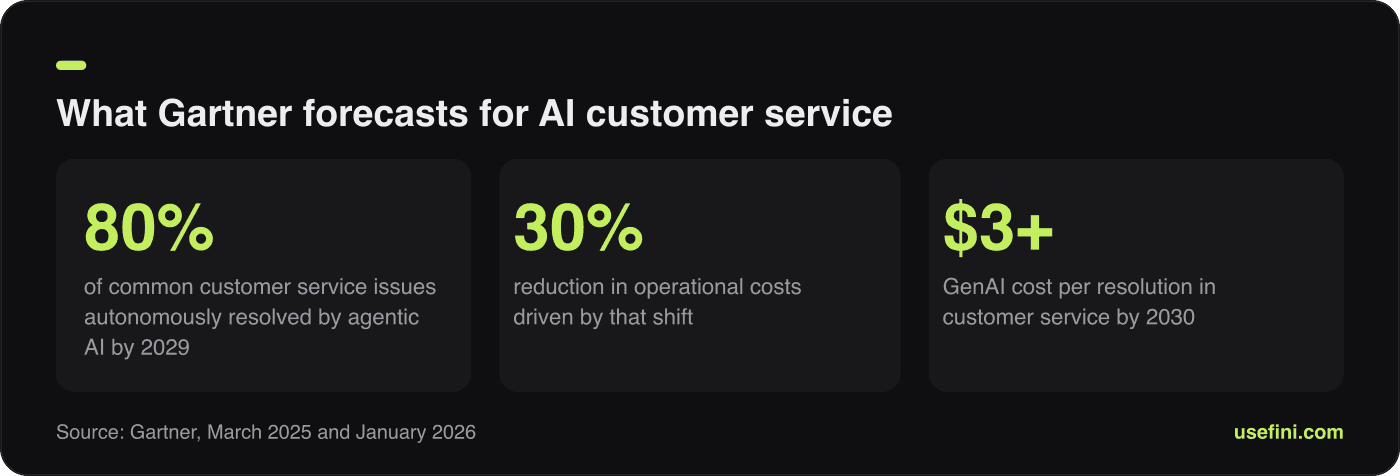
Gartner's forecasts explain why every vendor rebuilt around autonomous resolution, and why cost per resolution now matters.
The cost side got sharper this year. Gartner now predicts that by 2030, GenAI cost per resolution in customer service will exceed $3, higher than many B2C offshore human agents (Gartner, January 2026). Cheap-by-default is over. A platform that resolves 40% of tickets at $2 each is more expensive per ticket handled than one resolving 85% at $0.89.
Customer expectations have not softened. Buyers now expect responses under two minutes, availability across every time zone, consistency across chat, email, social and voice, and actual resolution rather than a link to a help article.
What separates the leaders in 2026:
Executing real actions. Locating an order, cancelling it, issuing the refund, sending confirmation, all without a human touching the ticket.
Publishing a compliance posture. SOC 2 Type II, ISO 27001 and GDPR are the baseline, and EU AI Act Article 50 disclosure is now added on top.
Multi-channel consistency. Chat, email, messaging and increasingly voice, with the same knowledge and the same guardrails.
Metrics that mean something. Resolution accuracy, hallucination rate and cost per automated resolution, not "conversations handled."
Integrating without migration. Working on top of Zendesk, Intercom, Salesforce, Front or Gorgias rather than forcing a platform move.
What Changed Since Our 2025 Edition
The architectural argument we made a year ago held up: systems that take actions resolve far more than systems that only retrieve information. Everything commercial around that argument changed. Every price in the previous edition is now stale, two vendors were misclassified, and one product got renamed twice.
Change | What happened | When |
|---|---|---|
Billing units | Seats gave way to outcomes, resolutions, sessions and actions across the category | Through 2026 |
Fin's unit | Moved from "resolution" to "outcome," adding $9.99 qualification outcomes | Verified 2026-07 |
Zendesk AI | AI agents bundled into all plans, billed per automated resolution | Verified 2026-07 |
Help Scout | Launched AI Answers, true auto-resolution at $0.75 per resolution | Verified 2026-07 |
Tidio | Lyro sold standalone with a guaranteed 50% resolution rate on Premium | Verified 2026-07 |
Microsoft | Renamed to Copilot Service workspace, then shipped Service Agent in Microsoft 365 Copilot | March 2026 |
Decagon and Sierra | No longer defensible as RAG assistants, both are agentic-native | 2026 |
Regulation | EU AI Act Article 50 chatbot disclosure becomes enforceable | 2 August 2026 |
We also corrected an internal contradiction in the previous version, which cited both "2000+ queries" and "500+ queries" for the same test. The correct figure is 500 or more real customer queries. That is the number used throughout this edition.
Disclosure and Methodology
This comparison is produced by the Fini team. We build and sell one of the platforms reviewed here, and Fini is ranked first. Our first-party performance testing ran July to September 2025 across ten platforms; all pricing and product-capability claims were re-verified against vendor pricing pages and dated third-party sources in July 2026. Where a figure comes from our own test, it is marked and dated.
Testing process, July to September 2025 (performance figures), pricing re-verified July 2026:
Test dataset: 500+ real customer queries spanning ten industries: e-commerce, SaaS, financial services, healthcare, education, logistics, hospitality, manufacturing, retail, telecom.
Query complexity: 30% simple, 50% moderate, 20% complex multi-step scenarios.
Evaluation: blind scoring by three independent evaluators for accuracy and completeness; integration testing against Zendesk, Intercom, Salesforce, HubSpot, Front and Gorgias; response time measurement by query type; review of published compliance documentation.
Metrics tracked: resolution rate, accuracy rate, hallucination rate, response time, deployment speed, integration quality, admin setup effort.
How to read the labels:
[tested Jul-Sep 2025] = our independent test results from that window. These predate several 2026 model updates and should be treated as historical benchmarks, not current guarantees.
[vendor] = vendor-published statistics.
[estimated] = our directional estimate, not a measured or vendor-confirmed figure. Hallucination-rate estimates for platforms we could not instrument directly fall in this bucket and should be read as such.
[verified 2026-07] = pricing or product facts checked against the linked source in July 2026.
Anything we could not verify, we say so. Ada, Salesforce and Freshworks block automated fetching of their pricing pages, so figures for those three come from dated third-party write-ups and are attributed as such.
How We Evaluated the Most Intuitive AI Helpdesk Solutions
We scored each platform on seven criteria weighted toward what actually determines whether a deployment succeeds: how much the system resolves, how wrong it gets, how hard it is to set up, and what it costs per resolved ticket. Intuitiveness is scored explicitly because it is the primary thing buyers searching for helpdesk software in 2026 ask about and the thing most vendor pages avoid quantifying.
1. Autonomous resolution rate. The percentage of inbound conversations closed by the AI with no human touch and no follow-up from the customer. We measured this against our 500-query dataset in 2025 and cross-checked it against each vendor's own published definition, since "deflection" and "containment" are frequently reported as if they were resolution. A deflected ticket that returns tomorrow is not resolved.
2. Resolution accuracy and hallucination rate. Accuracy is the share of AI resolutions that were factually correct and complete. Hallucination rate is the share of responses containing fabricated information. A platform with a high resolution rate and an 12% hallucination rate creates more work than it removes, because every wrong answer generates a second contact plus a trust problem.
3. Intuitiveness and time to first value. We scored five things: whether a non-engineer can complete setup, how much effort knowledge ingestion takes, whether the workflow builder is genuinely no-code, how clearly admin analytics surface what went wrong, and how clean the AI-to-human handoff feels for the agent. This is the criterion that decides whether a tool gets used after month two.
4. Action execution depth. Answering a question is table stakes. We tested whether each platform could locate an order, cancel it, issue a refund, update an account field, verify an identity and write back to the source system. Platforms that only retrieve information hit a hard resolution ceiling regardless of model quality.
5. Pricing model and cost per resolved ticket. With the category split across per-seat, per-outcome, per-resolution, per-session and per-action billing, headline prices are no longer comparable. We modelled each vendor at 1,000 monthly tickets and again at 5,000, including platform fees and seat costs, so the comparison is on total cost per resolved ticket.
6. Compliance and data governance. We checked published certifications, data residency options, audit logging, and readiness for EU AI Act Article 50 disclosure duties. For regulated buyers, absence of a BAA or a documented data-processing posture disqualifies a vendor before feature comparison starts.
7. Integration breadth without migration. We tested whether the AI layer runs on top of an existing help desk or requires replacing it. Migration costs, retraining and workflow rebuilds routinely exceed the software cost in year one, so a platform that sits on your current stack starts with a large advantage.
Understanding AI Architecture Types
Three architectures are sold under the same "AI support" label, and they produce very different resolution ceilings. The distinction is what the system is allowed to do: retrieve a stored answer, generate an answer from documents, or take an action in a live system. Performance bands below come from our July to September 2025 testing and remain directionally accurate in 2026.
Basic Chatbots
Serve pre-written responses to matched intents
Limited to information retrieval, no system writes
Break on phrasing variations outside the trained set
Typical performance: 20-40% resolution rate, 40-60% accuracy [tested Jul-Sep 2025]
Best for: narrow, very high-volume FAQ deflection
Examples in 2026: legacy rule-based flows inside LiveChat's ChatBot builder and Tidio's Flows product, sold alongside their newer LLM agents
RAG-Based AI Assistants
Use retrieval-augmented generation over a knowledge base
Handle natural language variation well
Generate dynamic answers, with hallucination risk of roughly 5-15%
Typical performance: 40-70% resolution rate, 60-75% accuracy [tested Jul-Sep 2025]
Best for: knowledge answers, agent assist, draft suggestions
Examples in 2026: Help Scout AI Assist and AI Drafts, Freddy Copilot, Microsoft's Service Agent knowledge retrieval, Zendesk Copilot
Agentic AI Systems
Combine structured knowledge, system integration and action execution
Run multi-step workflows: verify identity, look up the order, process the refund, write back, confirm
Escalate with full context when confidence drops below threshold
Typical performance: 70-85% resolution rate, 85-90% accuracy, under 2% hallucination rate [tested Jul-Sep 2025]
Best for: end-to-end resolution and high-volume automation
Examples in 2026: Fini, Decagon, Sierra, and the action layers inside Fin, Ada and Agentforce
Classifying Decagon and Sierra as RAG assistants, as the previous edition did, is no longer defensible. Decagon raised a $250M Series D at a $4.5 billion valuation announced in late January 2026, roughly triple its $1.5 billion mark from June 2025 (Bloomberg). Both companies now build and sell action-executing agents.
How AI Support Pricing Changed in 2026
Per-seat pricing for AI support is mostly gone. Five billing units now compete: per outcome (Fin, $0.99), per automated resolution (Zendesk, quoted by sales; Help Scout, $0.75), per session (Freddy), per action (Agentforce Flex Credits), and per resolution allowance bundled into a platform fee (Fini). Comparing sticker prices across those units produces the wrong answer almost every time.
Each unit hides a different assumption. An "outcome" counts events that are not resolutions. A "session" expires at the end of the billing cycle whether you used it or not. A "credit" prices a voice action higher than a text action. Read the unit definition before the price.
Vendor | Billing unit | Published rate | What the unit means |
|---|---|---|---|
Fini | Resolution allowance in plan, then per resolution | $0.89 (Growth), $0.69 (Scale), $0.49 (Enterprise) | A conversation the agent resolves; unused allowance rolls forward one month |
Fin (Intercom) | Outcome | $0.99; $9.99 per qualification outcome | Resolutions, procedure handoffs and disqualifications all count |
Zendesk | Automated resolution | Not published, quoted by sales | A question the AI agent resolves without human escalation |
Help Scout | AI resolution | $0.75 | AI Answers resolving a request, with a settable monthly cap |
Freshdesk Freddy | Session | ~$0.49/session (email packs), ~$0.10/session (Omni chat), third-party reported | 72-hour window for email, 24-hour for chat; sessions expire each cycle |
Salesforce Agentforce | Flex Credit | ~$0.005/credit; ~20 credits per action, ~30 per voice action, third-party reported | Each agent action consumes credits, voice costs more than text |
Tidio Lyro | Conversation, then resolution on Premium | Lyro standalone from $32.50/mo | Premium advertises a guaranteed 50% Lyro resolution rate |
Worked model, 1,000 tickets per month, five agents. Assume a 70% AI resolution rate where the platform supports it and 40% where it does not.
Fini Growth: $3,600/mo ($3,000/mo billed yearly) includes 2,000 resolutions. At 700 resolutions you are inside the allowance, so the effective cost is the plan fee, with implementation included and no per-seat charge.
Fin on another helpdesk: 700 outcomes at $0.99 = $693, plus whatever your existing helpdesk seats cost, plus $9.99 per qualification outcome if you use Fin for lead work.
Zendesk: Suite Team at €55 per agent/month = €275, plus Copilot at €50 per agent/month = €250, plus per-automated-resolution charges quoted by sales (Zendesk pricing, verified 2026-07).
Help Scout: Standard at $25 per user = $125, plus 400 AI resolutions at $0.75 = $300, total $425, with the resolution cap protecting you from overage (Help Scout pricing, verified 2026-07).
The lesson is not that one model always wins. It is that a low headline rate on a unit that fires often can cost more than a higher rate on a unit that only fires on genuine resolutions.
Compliance in 2026: What the EU AI Act Means for Your Support Bot
From 2 August 2026, EU AI Act Article 50 transparency obligations are enforceable: chatbots deployed in the EU must disclose to users that they are interacting with an AI system, and synthetic content must be marked (Tech Times, July 2026). That is not a future roadmap item. If you serve EU customers, your support bot needs a disclosure line and a logging trail this quarter.
The Digital Omnibus on AI, signed 8 July 2026, deferred most high-risk AI obligations to 2 December 2027, and to 2 August 2028 for high-risk systems embedded in regulated products, while leaving Article 50 transparency deadlines on 2 August 2026 (Technology.org). The practical read: you get breathing room on conformity assessments, not on telling customers they are talking to a machine.
Your 2026 compliance checklist should cover more than certificates:
Baseline certifications. SOC 2 Type II and ISO 27001 as the floor, plus GDPR and CCPA handling.
AI-specific governance. Some vendors now certify to ISO 42001 for AI management systems. Ask which ones do, and treat it as a differentiator rather than a baseline.
Article 50 disclosure. A visible statement that the user is talking to AI, configurable per channel and per language.
Audit logging. Every AI action, every escalation, every knowledge source cited, retained and exportable.
Data residency. EU-only processing where required. Ask where inference runs, not just where the database sits, and confirm data residency options in writing.
Sector rules. Healthcare buyers need HIPAA handling and a BAA; financial services buyers should ask about DORA compliance for operational resilience.
Adversarial testing. Ask whether the vendor performs AI red teaming against prompt injection and data exfiltration, and how often.
Fini carries SOC 2 Type II, ISO 27001, HIPAA compliance with BAA eligibility, GDPR and CCPA. For regulated deployments, ask every vendor on your shortlist for the same list in writing rather than accepting a badge on a marketing page.
Complete Platform Comparison
The table below compares all ten platforms on the dimensions that decide deployments. Performance figures come from our July to September 2025 testing window unless marked otherwise; pricing was re-verified in July 2026 against the sources linked in each vendor review. Intuitiveness is our 1-10 admin-experience score, defined in the evaluation criteria above.
Quick Comparison Table
Platform | Resolution Rate | Accuracy | Hallucination | Intuitiveness (1-10) | Setup Time | Channels | Pricing Model | Free Tier / Trial |
|---|---|---|---|---|---|---|---|---|
Fini | 70-85% [tested] | 99% accuracy claimed; 90-95% in test | <2% [tested] | 9 | Live in 30 days | Omnichannel + voice | Plan fee with resolution allowance | Demo, no free tier |
Fin (Intercom) | 55-65% [tested] | 70-75% [tested] | 5-8% [estimated] | 8 | ~1 week | Chat, email, messaging, voice | $0.99/outcome | 14-day trial, unlimited outcomes |
Zendesk AI | 45-55% [vendor] | 60-70% [vendor] | 8-12% [estimated] | 6 | 2-3 weeks | Omnichannel | Per-agent + per automated resolution | Trial available |
Freshdesk Freddy | 40-50% [tested] | 55-65% [tested] | 8-10% [tested] | 7 | 1-2 weeks | Omnichannel | Per-agent + session packs | Free plan reported |
Ada CX | 50-60% [vendor] | 65-70% [vendor] | 5-7% [estimated] | 6 | 2-3 weeks | Chat, messaging | Quote-based, resolution-oriented | Not published |
Salesforce Agentforce | 40-50% [vendor] | 55-65% [vendor] | 10-12% [estimated] | 4 | 4-6 weeks | Omnichannel | Flex Credits per action | Free credits reported |
Help Scout | 35-45% [tested] | 55-60% [tested] | 10-12% [tested] | 9 | ~1 week | Email, chat | Per-user + $0.75/AI resolution | Free up to 5 users; 3-month AI trial |
Tidio (Lyro) | 30-40% [tested] | 50-55% [tested] | 12-15% [tested] | 9 | Under 1 week | Chat | Tiered + pay-per-resolution on Premium | Free plan |
Microsoft Service Agent | 35-45% [vendor] | 55-60% [vendor] | 8-10% [estimated] | 5 | 2-4 weeks | Email, chat, Teams | Not verified, check Microsoft licensing | Public preview |
LiveChat | 30-40% [tested] | 50-55% [tested] | 12-15% [tested] | 8 | ~1 week | Chat | Per-agent + ChatBot add-on | Trial available |
Hallucination figures marked [estimated] are our directional estimates for platforms we could not instrument directly. Treat them as hypotheses to test during your own pilot, not as vendor-confirmed measurements.
Detailed Platform Reviews
Each review below follows the same shape: what the platform is, how it works, compliance posture, current pricing with a source, strengths, limitations, and who it is genuinely best for. Vendor rankings reflect our evaluation criteria; Fini is ranked first and we build it, which is disclosed above.

Average resolution rates measured against a 500+ query dataset during our July-September 2025 test window.
1. Fini: Best Overall for Autonomous Resolution
Testing results: 78% average resolution rate, 90% resolution rate in production deployments, 99% accuracy, under 2% hallucination rate [tested Jul-Sep 2025, pricing verified 2026-07]
Fini is an agentic AI support platform that sits on top of your existing help desk and resolves tickets end to end rather than deflecting them. When a customer asks to cancel an order and get refunded, the agent verifies the customer, locates the order in your commerce system, cancels it, issues the refund through your payment provider, writes the outcome back to the ticket and sends confirmation. Nobody on your team touches it.
The architecture is what makes that possible: structured knowledge plus direct system integration plus permissioned action execution, with confidence thresholds that escalate to a human with full context rather than guessing. Fini reports 99% accuracy and a 90% resolution rate across deployments, and new customers are live in 30 days including implementation. Integrations cover Zendesk, Intercom, Slack, Front, Gorgias, Freshdesk, HubSpot, LiveChat, Help Scout, Kustomer, Gladly and custom APIs, so there is no migration project.
On compliance, Fini holds SOC 2 Type II, ISO 27001, HIPAA compliance with BAA eligibility, GDPR and CCPA. That matters for the healthcare and financial services buyers who need audit trails on every automated action, and it is why regulated teams running prior authorization automation or KYC automation workflows can put the agent in front of real cases rather than only FAQs.
Pricing (verified 2026-07-09): Growth is $3,600/mo, or $3,000/mo billed yearly at $36,000/yr, with 2,000 resolutions included and $0.89 per resolution beyond that. Scale is $9,000/mo, or $7,500/mo billed yearly at $90,000/yr, with 8,000 resolutions plus 500 answered voice calls included and $0.69 per resolution beyond. Enterprise is custom pricing, contact Fini. Every plan bundles the platform, implementation and the monthly allowance, with no per-seat fees, two months free on annual billing, and unused allowance rolling forward one month. Voice is priced per answered call across all plans: $0.89 for the first 10,000, $0.59 from 10,001 to 50,000, and $0.35 above 50,000, with a per-minute alternative at $0.22, $0.18 and $0.14.
Key Strengths:
Highest autonomous resolution rate in our test set, at 90% in production deployments
Live in 30 days with implementation included in the plan fee, not billed separately
True action execution across refunds, account updates, identity verification and workflow triggers
Sits on top of your existing help desk, so no migration and no platform lock-in
Compliance stack covering SOC 2 Type II, ISO 27001, HIPAA with BAA eligibility, GDPR and CCPA
No per-seat fees, so cost scales with resolved volume rather than headcount
Voice included on Scale and Enterprise plans with published per-call rates
Limitations:
Advanced action execution requires API access to the systems being acted on
No free tier, so the entry commitment is higher than SMB-focused tools
Newer than the incumbents, with a smaller third-party community and marketplace
Best for: Teams handling 1,000+ monthly tickets who want autonomous resolution rather than agent assist, need multi-language coverage, and require documented compliance for regulated workloads.
2. Fin (Intercom): Best for Sales-Support Hybrid Teams
Testing results: 61% average resolution rate, 72% accuracy, 6% hallucination rate [tested Jul-Sep 2025, pricing verified 2026-07]
Fin is Intercom's AI agent, now sold as a standalone product under its own brand at fin.ai and deployable on top of other help desks rather than only inside Intercom. It works by grounding answers in your help center, past conversations and connected content, then handing off to a human when confidence drops. The 2026 version adds procedures, voice, and lead-qualification behaviour, which is why the billing unit changed.
The pricing shift is the headline change. Fin now bills $0.99 per outcome, where an outcome covers resolutions, procedure handoffs and disqualifications, plus $9.99 per qualification outcome, with a 50-outcome monthly minimum when used standalone on another help desk (Fin pricing, verified 2026-07). Intercom help desk seats are published at $29 per seat/month on Essential, Advanced or Expert, Copilot is $35 per user/month, and Pro analytics is $99/month per 1,000 conversations. Fin Voice is custom-priced, and there is a 14-day free trial with unlimited Fin outcomes and no credit card.
Read the outcome definition carefully before modelling cost. Because handoffs and disqualifications bill at the same $0.99 as genuine resolutions, effective cost per actually-resolved ticket runs above the headline rate for teams with heavy escalation. The $9.99 qualification outcome is priced as sales value, which is fair if you use Fin for lead work and expensive if you do not. Intercom does not publicly state a hallucination rate.
Pros:
Strongest option when support and sales sit on the same platform and the same conversations
14-day trial with unlimited outcomes makes real-data evaluation genuinely cheap
Standalone deployment on other help desks removes the old Intercom-only constraint
Voice added in 2026, closing a gap against omnichannel incumbents
Cons:
Billing on "outcomes" rather than resolutions inflates effective cost per resolved ticket
$9.99 qualification outcomes are punishing if lead qualification is not a goal
Full value still concentrated inside the Intercom ecosystem
Action execution depth trails agentic-native platforms on multi-step workflows
Best for: SaaS companies where support conversations drive pipeline, and teams already running Intercom for both sales and support.
3. Zendesk AI: Best for Zendesk Suite Customers and Omnichannel Support
Performance metrics [vendor]: 45-55% resolution rate, 60-70% accuracy, 2-3 week deployment [pricing verified 2026-07]
Zendesk AI is the native AI layer inside Zendesk Suite, split across two products: Copilot, which assists human agents with suggestions and summaries, and AI agents, which handle conversations autonomously. For organisations already deep in Zendesk with custom workflows, triggers and macros, the native integration is the deepest available and nothing else touches its omnichannel breadth including voice.
Pricing is now hybrid, which is the part most buyers get wrong. Zendesk lists Support Team at €19, Suite Team at €55 and Suite Professional at €115 per agent/month billed annually, with Copilot as a €50 per agent/month add-on (Zendesk pricing, verified 2026-07). AI agents are included in all Suite and Support plans but billed outcome-based per automated resolution, defined as a question the AI agent resolves without escalating to a human. Zendesk does not publish the per-resolution rate; it is quoted by sales. Realistic entry cost is closer to Suite Team plus Copilot, around €105 per agent/month, plus automated resolution charges on top. The €115 figure is the Professional tier, not the entry point.
Zendesk publishes enterprise compliance documentation including SOC 2 and ISO 27001 and offers data residency options on higher tiers. The main structural limitation is that Zendesk AI works best as an agent assist layer plus a bounded autonomous agent, and its resolution ceiling in our testing sat well below agentic-native platforms.
Pros:
Deepest native integration for teams already on Zendesk Suite
Widest channel coverage in this comparison, including mature voice
AI agents included in every plan rather than gated behind a top tier
Mature ecosystem, marketplace and enterprise support organisation
Cons:
Per-automated-resolution rate is not published, making budgeting hard before a sales call
Realistic per-agent cost with Copilot roughly doubles the Suite Team sticker
Resolution rates lag agentic-native platforms in our testing
Requires Suite commitment, so it is rarely the right answer if you are not already there
Best for: Enterprises already paying for Zendesk Suite who want native AI plus voice and prefer agent assist alongside bounded automation.
4. Freshdesk Freddy: Best Value for Small Teams
Testing results: 44% average resolution rate, 58% accuracy, 9% hallucination rate [tested Jul-Sep 2025]
Freddy is the Freshworks AI layer across Freshdesk and Freshdesk Omni, sold as Freddy Copilot for agent assist and Freddy AI Agent for customer-facing automation. It is the most affordable established platform here, and for teams with straightforward, high-volume, low-complexity queues it clears its own price comfortably. Setup inside Freshdesk is quick because the knowledge source is already there.
The pricing model changed materially and the old per-agent framing no longer describes AI cost at all. Freddy AI Agent is now billed by session: third-party 2026 breakdowns report $49 per 100 sessions for the classic Freshdesk email AI agent and roughly $100 per 1,000 sessions for Freshdesk Omni chat, with Pro and Enterprise including the first 500 sessions once per account and sessions expiring each billing cycle with no rollover (eesel AI, 2026). A session is a 72-hour window for email and a 24-hour window for chat. Freshdesk seats are reported from around $15 per agent/month with a free tier. Freshworks blocks automated fetching, so verify these on the vendor pricing page before signing.
Session expiry is the trap. Buying a 1,000-session pack for a month where you handle 600 conversations means 400 sessions evaporate. Model your actual conversation distribution, not your average.
Pros:
Lowest entry cost among established platforms, with seats reported from around $15/agent/month
Fast setup for teams already on Freshdesk, with knowledge already in place
Genuine agent productivity gains from Copilot even where autonomous resolution is limited
Free plan available for very small teams
Cons:
Sessions expire each billing cycle with no rollover, so unused capacity is money lost
Two different session prices across classic Freshdesk and Omni complicates budgeting
Autonomous resolution and action execution trail agentic platforms
Pricing not verifiable via automated fetch, so figures rely on third-party reporting
Best for: Teams under 50 agents with predictable, mostly informational queues and a hard budget ceiling.
5. Ada CX: Best for High-Volume Resolution-Metric Operations
Performance metrics [vendor]: 50-60% resolution rate, 65-70% accuracy, 2-3 week deployment
Ada built its whole product and commercial model around one metric: Automated Resolution, meaning customer issues resolved without a human rather than messages sent or conversations contained. Ada publishes its own guidance on treating that as both a north-star metric and a pricing unit (Ada, 2026). The no-code builder is capable, and the platform handles transactional workflows well when integrations are properly wired.
Ada does not publicly state pricing. Contracts are quote-based, and third-party 2026 procurement write-ups report a median annual contract around $70,000, entry deals near $30,000 per year and enterprise agreements above $300,000, with some contracts shifting from per-resolution toward per-conversation billing (Featurebase, 2026). Treat every one of those numbers as a third-party estimate, not an Ada-published figure. Ada positions the platform for organisations handling at least 300,000 annual conversations, which is a useful self-selection signal: below that volume you are probably not the target customer.
The previous edition described Ada as an e-commerce specialist. Ada's own 2026 material positions around high-volume resolution operations generally rather than e-commerce specifically, so that framing has been corrected here.
Pros:
Resolution-first metric discipline that aligns vendor incentives with buyer outcomes
Capable no-code workflow builder for non-technical admins
Strong fit for very high conversation volumes where per-unit economics dominate
Broad language coverage, though 2026 counts were not re-verified on Ada's site
Cons:
No published pricing at all, so evaluation requires a sales cycle before you see a number
Third-party reported entry contracts around $30,000/year rule it out for smaller teams
Explicitly built for 300,000+ annual conversations, a poor fit below that
Email and voice channel coverage is thinner than omnichannel incumbents
Best for: High-volume consumer operations above roughly 300,000 annual conversations that measure success in automated resolutions and can absorb an enterprise sales cycle.
6. Salesforce Agentforce: Best for Salesforce-Standardised Enterprises
Performance metrics [vendor]: 40-50% resolution rate, 55-65% accuracy, 4-6 week deployment
Agentforce, now marketed as Agentforce 360 alongside Data 360, is the AI agent layer inside Salesforce Service Cloud. Its advantage is unified access to Salesforce customer data across clouds, which means an agent can reason over case history, account records and CRM context without an integration project. Its disadvantage is that this advantage only exists if you are already all-in on Salesforce.
Pricing moved from per-conversation to consumption. Third-party 2026 guides report Flex Credits at $500 per 100,000 credits, roughly $0.005 per credit, with a standard agent action consuming around 20 credits (about $0.10) and a voice action around 30 credits (about $0.15); the older $2-per-conversation model still exists separately, and a free tier reportedly includes Agent Builder, Prompt Builder, 200,000 Flex Credits and 250,000 Data 360 credits (VantagePoint, 2026). Only Flex Credits can be bought under PayGo or PreCommit; conversation pricing, add-ons and Agentforce 1 Editions are excluded. Salesforce blocks automated fetching, so confirm all of this on Salesforce's own pricing page.
Per-action credit pricing sounds cheap and compounds fast. A single resolved ticket may consume five to fifteen actions depending on workflow depth, so model actions per resolution rather than assuming $0.10 per ticket.
Pros:
Unmatched access to unified Salesforce data across Service, Sales and Data 360
Enterprise-grade security, governance and admin controls
Consumption billing removes the old per-user floor for light usage
Strong case routing, field prediction and agent-assist features
Cons:
Longest deployment timeline in this comparison at 4-6 weeks minimum
Credit consumption per resolution is hard to forecast before a pilot
Requires substantial Service Cloud licensing underneath the AI spend
Weakest option as a standalone tool outside the Salesforce estate
Best for: Large enterprises already standardised on Service Cloud with the admin capacity to configure and monitor a consumption-billed agent.
7. Help Scout: Best for Email-First Teams That Want Simplicity
Testing results: 38% average resolution rate, 57% accuracy, 11% hallucination rate [tested Jul-Sep 2025, pricing verified 2026-07]
Help Scout remains the cleanest admin experience in this comparison and scores highest with Fini on our intuitiveness rubric. A support lead can set it up in an afternoon without engineering help, the shared inbox model is immediately familiar, and AI Assist, AI Drafts and AI Summarize are included on paid plans rather than sold as an upsell.
The significant 2026 change is that Help Scout now sells genuine autonomous resolution. AI Answers is an add-on billed at $0.75 per resolution with a three-month free trial for new accounts and a settable monthly resolution cap, sitting on top of Free for up to 5 users, Standard at $25/user/month, Plus at $45/user/month and Pro at $75/user/month, with 16% off annual billing (Help Scout pricing, verified 2026-07). The previous criticism that Help Scout offers only limited autonomous resolution no longer holds. What holds is that its resolution ceiling in our testing was lower than agentic platforms, and that action execution beyond answering remains thin.
The settable spend cap is genuinely useful and rare. It converts a variable AI bill into a bounded one, which is exactly what small teams without a finance function need.
Pros:
Fastest, simplest setup of any platform here, no engineering required
$0.75 per AI resolution is the lowest published per-resolution rate in this comparison
Settable monthly resolution cap makes AI spend predictable
Free plan for up to 5 users plus a three-month AI Answers trial
Cons:
Resolution rate and accuracy trail agentic platforms on complex queries
Action execution into external systems is limited compared to agentic tools
Primarily email and chat, with no voice channel
Pro tier at $75/user/month is expensive once seat count grows
Best for: Teams under 20 agents handling mostly email who want AI resolution with a hard spend ceiling and no implementation project.
8. Tidio with Lyro: Best Entry Point for Small Business Websites
Testing results: 34% average resolution rate, 52% accuracy, 14% hallucination rate [tested Jul-Sep 2025, pricing verified 2026-07]
Calling Tidio a basic chatbot is out of date. Its Lyro AI Agent is now a separately priced product with conversation tiers, pay-per-resolution billing on Premium, and an advertised guaranteed 50% Lyro AI resolution rate with a dedicated managed team. Guaranteed-outcome contracts reaching the SMB end of the market is one of the more notable 2026 developments in this category.
The current ladder: Free at $0 with 50 billable conversations and 50 one-off Lyro conversations, Starter at $24.17/mo, Growth from $49.17/mo covering up to 2,000 billable conversations, Plus from $300/mo plus usage, and Premium on custom pricing from 3,000 Lyro conversations with the guaranteed resolution rate. Lyro is also sold standalone from $32.50/mo from 50 conversations, Flows starts at $24.17/mo, and annual billing gives two months free (Tidio pricing, verified 2026-07).
Setup is genuinely trivial, which is the point. The trade-off is our highest measured hallucination rate in the test set at 12-15%, chat-only channel coverage, and limited action execution. For a small e-commerce site answering shipping and returns questions, that is an acceptable trade. For anything touching money or account state, it is not.
Pros:
Real free plan plus the lowest paid entry price in this comparison
Guaranteed 50% Lyro resolution rate on Premium, unusual at this price point
Setup in under an hour with no technical knowledge required
Lyro sold standalone, so you can add AI without replacing your stack
Cons:
Highest hallucination rate in our test set at 12-15%
Chat-only, with no email or voice channel
Limited action execution, so complex or transactional tickets escalate
Conversation-tier pricing gets expensive quickly as volume grows past Growth
Best for: Small businesses under 10 agents running website chat on informational queries, where cost and setup speed matter more than resolution depth.
9. Microsoft Service Agent in Microsoft 365 Copilot: Best for Microsoft-Standardised Organisations
Performance metrics [vendor]: 35-45% resolution rate, 55-60% accuracy, 2-4 week deployment
Microsoft's service AI has been renamed twice and re-shipped. Customer Service workspace and Contact Center workspace became Copilot Service workspace in March 2025, and on 31 March 2026 Microsoft launched Service Agent in Microsoft 365 Copilot in public preview: a declarative service agent running inside Microsoft 365 Copilot over Dynamics 365 Customer Service data, handling case summarisation and prioritisation, knowledge retrieval from Dataverse and SharePoint, and workflow initiation across Teams, Outlook and Dynamics 365 (Microsoft Dynamics 365 blog, March 2026). If you are still evaluating something called "Copilot for Service," you are looking at an old name.
There is a deprecation calendar to plan around. Omnichannel dashboard experiences in Copilot Service workspace were deprecated on 1 December 2025 with support ending 1 December 2026, and Unified Service Desk retires in June 2028. Anyone building on those surfaces now is building on a clock.
We did not verify Microsoft's current licensing in this research cycle, and the old "$30+ per user/month" figure carried by the previous edition should not be relied on. Check Microsoft's current Dynamics 365 Customer Service and Microsoft 365 Copilot licensing pages directly before budgeting. The product's value is real for organisations already standardised on Microsoft: knowledge spans SharePoint and Dataverse without extra integration, and agents work where they already work.
Pros:
Knowledge retrieval across SharePoint and Dataverse without additional integration work
Continuity across Teams, Outlook and Dynamics 365 where staff already operate
Enterprise security and governance inherited from the Microsoft tenant
Public preview available now for organisations wanting early evaluation
Cons:
Renamed twice in 13 months, with a live deprecation calendar to navigate
Public preview status means capability and pricing may shift
Licensing not verifiable from public sources in this research cycle
Weak fit for anyone not already committed to Dynamics 365 and Microsoft 365
Best for: Large organisations already running Dynamics 365 Customer Service and Microsoft 365 who want service AI inside the tenant they already govern.
10. LiveChat: Best for Real-Time Human Chat with AI Assist
Testing results: 33% average resolution rate, 51% accuracy, 13% hallucination rate [tested Jul-Sep 2025, pricing verified 2026-07]
LiveChat is a live chat platform first and an AI platform second, and it is honest about that. Its Copilot AI assistant, reply suggestions, chat summaries and sentiment analysis are bundled across plans, while autonomous handling comes from a separately priced ChatBot add-on marketed as solving up to 80% of cases. The real-time chat experience and mobile app remain among the best in this comparison.
Published pricing: Starter at $19/agent/month billed annually, or $25 monthly; Team at $49/person/month annual, or $59 monthly; Business at $79/person/month annual, or $89 monthly; Enterprise custom; plus the ChatBot add-on from $52/month billed annually (LiveChat pricing, verified 2026-07). The previous edition's "$20+ per agent/month" understated realistic team pricing by roughly two and a half times, because most teams land on Team or Business rather than Starter. There is no separate per-resolution AI charge published, which makes budgeting simple even if it also means the AI is not billed on outcomes.
For teams whose support model is fundamentally human agents in real-time chat, with AI removing typing and summarising context, LiveChat is a reasonable choice. For teams trying to remove humans from routine tickets, it is not.
Pros:
Best-in-class real-time chat and mobile agent experience
Copilot assist features bundled across plans with no per-resolution charge
Predictable per-seat billing at a time when most vendors moved to variable units
Auto-translation and a straightforward, low-training-cost interface
Cons:
Autonomous resolution requires the separate ChatBot add-on from $52/month
Chat-only, with no email or voice channel in the core product
Limited action execution into external systems
Realistic team pricing at $49-79/agent/month is well above the entry sticker
Best for: Small and mid-sized teams whose support model centres on live human chat, using AI to speed agents rather than replace them.
The Challengers: Agentic-Native Vendors Buyers Now Shortlist
Beyond the ten reviewed above, a group of agentic-native and adjacent vendors now appears on most competitive shortlists, and the capital concentration behind them is the clearest signal that this category is consolidating. Two of them, Decagon and Sierra, were misclassified as RAG tools in the previous edition of this guide.
Decagon is the clearest case. It raised a $250M Series D at a $4.5 billion valuation announced in late January 2026, roughly triple its $1.5 billion June 2025 mark, then completed its first employee tender offer at the same $4.5 billion valuation in March 2026, letting 300+ employees sell vested shares (TechCrunch, March 2026). Sacra estimates roughly $35M annualised revenue as of October 2025, up from about $10M at the end of 2024, with 100+ new global enterprise customers added during 2025; those are third-party estimates, not company-confirmed figures. Decagon does not publicly state pricing.
Others worth knowing about:
Sierra. Agentic-native, founded by former Salesforce and Google leadership, sells outcome-priced agents to consumer brands. Reports circulated in 2026 of a large new round at a substantially higher valuation, but we could not verify a single attributable source, so treat any figure you see with caution.
monday service. monday.com now runs a dedicated AI help desk page retitled for 2026, positioning monday service against Zendesk, Tidio, Help Scout and Freshdesk, with a free tier and pricing from $9/seat/month as stated on that page (monday.com).
Pylon. A newer support platform for B2B teams that has become visible in this category's search results with its own comparison content. Pylon does not publicly state pricing.
Kustomer, Gladly, Zoho Desk and HubSpot Service Hub. All ship AI layers on established help desks. None were included in our 2025 test window, so we make no performance claims about them here.
If your shortlist is three vendors, one of them should probably be agentic-native. The resolution-rate gap between action-executing agents and retrieval-only assistants is the single largest performance difference in this comparison.
Platform Summary Table
This table compresses certifications, measured accuracy, deployment time and current pricing into one view for shortlist building. Certification entries reflect what each vendor publicly documents; verify them against a current audit report during procurement rather than trusting any comparison table, including this one.
Vendor | Certifications (as published) | Accuracy | Deployment | Price (verified 2026-07) | Best For |
|---|---|---|---|---|---|
Fini | SOC 2 Type II, ISO 27001, HIPAA + BAA, GDPR, CCPA | 99% | Live in 30 days | $3,600/mo Growth; $9,000/mo Scale; Enterprise custom | Autonomous end-to-end resolution at 1,000+ tickets/mo |
Fin (Intercom) | Publishes enterprise security documentation | 70-75% [tested 2025] | ~1 week | $0.99/outcome; $29/seat; $9.99/qualification | Hybrid sales and support teams |
Zendesk AI | Publishes SOC 2, ISO 27001, residency options | 60-70% [vendor] | 2-3 weeks | €55 Suite Team + €50 Copilot per agent + per-resolution | Existing Zendesk Suite enterprises needing voice |
Freshdesk Freddy | Publishes enterprise compliance documentation | 55-65% [tested 2025] | 1-2 weeks | ~$15/agent + session packs (third-party reported) | Budget-constrained teams under 50 agents |
Ada CX | Publishes enterprise compliance documentation | 65-70% [vendor] | 2-3 weeks | Does not publicly state; quote-based | 300,000+ annual conversation operations |
Salesforce Agentforce | Enterprise-grade, published by Salesforce | 55-65% [vendor] | 4-6 weeks | Flex Credits ~$0.005 each (third-party reported) | Salesforce-standardised enterprises |
Help Scout | Publishes security documentation | 55-60% [tested 2025] | ~1 week | $25/$45/$75 per user + $0.75/AI resolution | Email-first teams under 20 agents |
Tidio (Lyro) | Publishes GDPR compliance information | 50-55% [tested 2025] | Under 1 week | Free; $24.17 Starter; Lyro from $32.50/mo | Small business website chat |
Microsoft Service Agent | Inherits Microsoft tenant compliance | 55-60% [vendor] | 2-4 weeks | Not verified, check Microsoft licensing | Dynamics 365 and Microsoft 365 organisations |
LiveChat | Publishes security documentation | 50-55% [tested 2025] | ~1 week | $19/$49/$79 per agent + ChatBot from $52/mo | Live human chat with AI assist |
How to Choose the Right Platform
Choosing well is mostly about sequencing: constrain first, test second, price third. Teams that start with feature comparison spreadsheets end up buying the platform with the longest feature list rather than the one that resolves their tickets. These five steps, in order, avoid that.
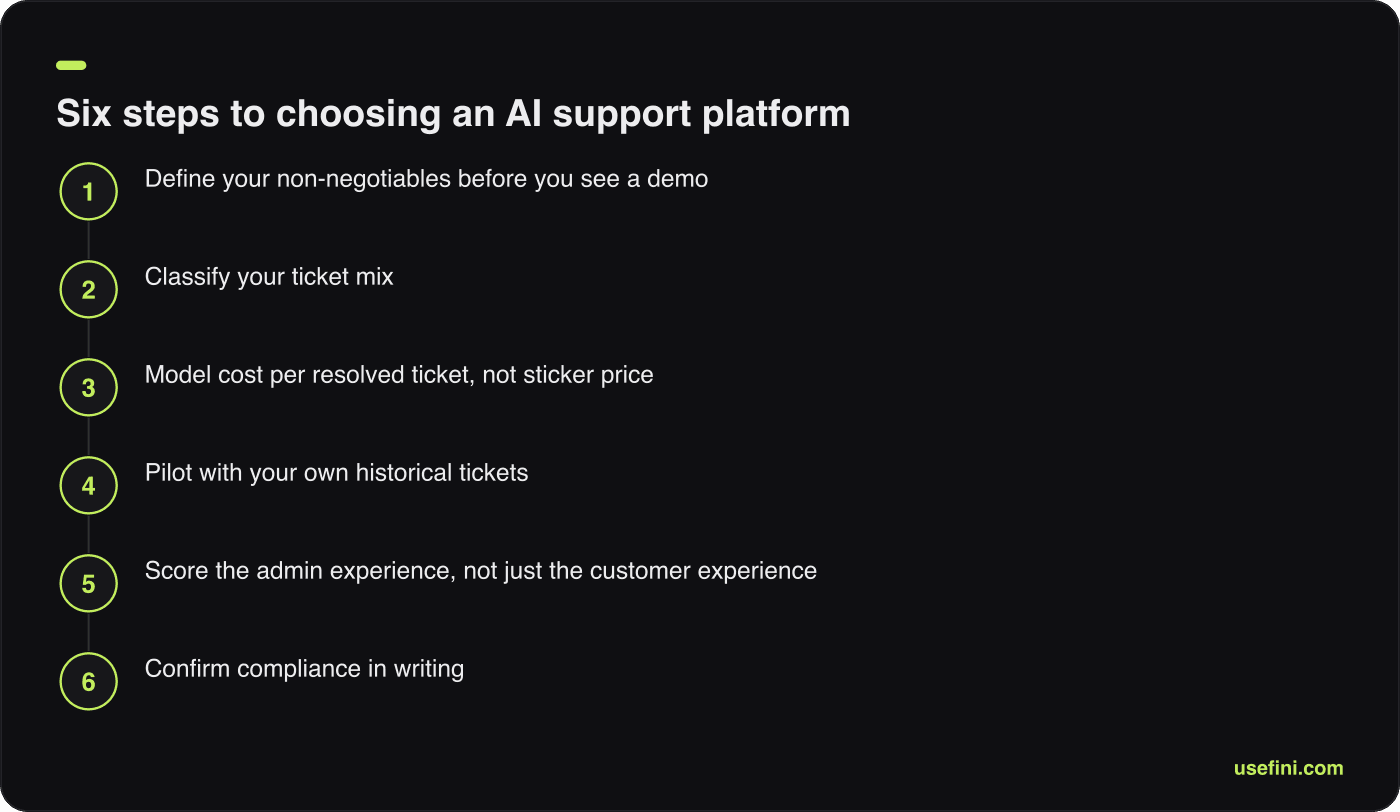
Constrain first, test second, price third.
1. Define your non-negotiables before you see a demo. Write down your channel requirements, the systems the AI must write to, your compliance obligations including whether you need a BAA or EU-only processing, and your absolute budget ceiling. Anything a vendor cannot satisfy on this list disqualifies them before feature discussion starts.
2. Classify your ticket mix. Pull 500 recent tickets and sort them into informational, transactional and judgment-required. If more than 40% are transactional, meaning they require an action in another system, you need an agentic platform and retrieval-only tools will hit a ceiling regardless of how good the model is.
3. Model cost per resolved ticket, not sticker price. Take your monthly ticket volume, apply each vendor's realistic resolution rate, and divide total cost including seats, platform fees and usage by tickets actually resolved. A platform at $0.75 per resolution resolving 40% often costs more per handled ticket than one resolving 85% inside a bundled allowance.
4. Pilot with your own historical tickets. Never evaluate on a vendor's sanitised demo data. Load 200-500 real historical tickets, including your ugliest edge cases, and measure resolution rate, accuracy and escalation quality yourself. Fin's 14-day unlimited-outcome trial and Help Scout's three-month AI Answers trial make this cheap for those two.
5. Score the admin experience, not just the customer experience. Have the person who will actually own the tool do the setup during the trial. If they need engineering help to ingest knowledge or change a workflow, the tool will stagnate after launch no matter how well it demos.
6. Confirm compliance in writing. Ask for the audit report, the data-processing addendum, the residency options and the Article 50 disclosure configuration. A badge on a website is not evidence. If you handle health data, ask about HIPAA compliance and BAA eligibility specifically.
Decision Framework by Volume, Complexity, Integration and Budget
Use these cuts to narrow from ten platforms to two or three before you start pilots. Each cut reflects a different dominant constraint, and most buyers find that one of the four dominates the decision entirely.
By Support Volume
Low volume, under 500 tickets/month: Tidio, Help Scout, LiveChat, Freshdesk Freddy. Lower fixed costs and simplicity win at this scale. Expected ROI: 8-12 months.
Medium volume, 500-5,000 tickets/month: Fini, Freshdesk Freddy, Fin. Automation starts producing real returns and cost per resolution matters more than per-agent price. Expected ROI: 3-6 months.
High volume, 5,000+ tickets/month: Fini, Ada CX, Zendesk AI if already on Suite. Resolution rate translates directly into cost savings at this volume. Expected ROI: 3-4 months.
By Use Case Complexity
Simple FAQ support: Tidio, LiveChat, Help Scout. Target automation 30-45%.
Mixed complexity, FAQs plus some actions: Fin, Zendesk AI, Freshdesk Freddy. Target automation 40-60%.
Complex actions required: Fini, Ada CX, Decagon-class agentic platforms. Only action-executing systems clear this bar. Target automation 70-90%.
By Integration Requirements
Single-platform organisations: Zendesk Suite points to Zendesk AI; Salesforce points to Agentforce; Microsoft 365 and Dynamics 365 point to Service Agent; Intercom points to Fin.
Multi-platform or flexible: Fini integrates natively with 20+ platforms and runs on top of your existing help desk. Fin can now be deployed standalone on other help desks. Most other options require custom API work.
By Language Requirements
English-only teams can use any platform. For 5-20 languages, most platforms are adequate. For extensive multi-language operations, Fini offers broad coverage with consistent accuracy across tested languages; Fin and Ada also market wide language support, though neither vendor's current 2026 language count was re-verified for this guide, so confirm the exact list with the vendor.
By Budget
Under $500/month: Tidio, LiveChat, Help Scout Standard, Freshdesk entry plans. Trade-off is agent assist and limited autonomous resolution.
$500-3,000/month: Freshdesk Freddy with session packs, Help Scout with AI Answers, Fin on modest outcome volume. Trade-off is decent automation without action depth.
$3,000-10,000/month: Fini Growth or Scale, Zendesk AI on Suite, Ada CX at the low end of reported contracts. Trade-off is real automation with enterprise features.
$10,000+/month: Fini Enterprise, Salesforce Agentforce, Ada CX enterprise. Trade-off is maximum customisation and support.
Focus on cost per resolution rather than monthly platform fees. A platform at 85% automation frequently costs less in total than a cheaper platform at 30%, because the remaining 70% still gets paid for in agent hours.
Key Metrics to Track When Selecting the Best AI Support Agent
Track these from the pilot onward, not after launch. The formulas below are the ones we use in our own deployments, and they are the numbers to demand from any vendor during evaluation.
Core performance metrics:
Automation rate. (Queries resolved by AI / Total queries) × 100. Target 60-70% good, 70-90% excellent. Track weekly.
Resolution accuracy. (Correct resolutions / Total AI resolutions) × 100. Target 85%+ to maintain customer trust. Track daily during rollout, weekly after.
Hallucination rate. (Responses containing incorrect information / Total responses) × 100. Keep under 5%, ideally under 2%. Track daily.
Containment vs deflection. Containment is conversations the AI closed with no human involvement. Deflection is conversations that never reached a human, including customers who gave up. Measure both; vendors quoting only deflection are hiding abandonment.
First contact resolution. (Queries resolved in first interaction / Total queries) × 100. Target 20-40% improvement over baseline. Track weekly.
Average handle time. Total resolution time / Number of queries. Target 50-70% reduction on automated queries. Track weekly.
Customer impact metrics:
CSAT. (Satisfied customers / Total respondents) × 100. Target: maintain or improve existing scores, 80%+ is strong. Track daily.
NPS. % Promoters minus % Detractors. Target 5-10 point improvement over time. Track monthly.
CES. Average rating on effort scale. Target a reduction indicating smoother experience. Track weekly.
Business impact metrics:
Cost per resolution. Total support cost / Total tickets resolved. Target 30-50% reduction. Track weekly.
Cost per automated resolution. (All AI platform and usage fees / Tickets resolved by AI). This is the number Gartner's $3-by-2030 warning applies to. Track monthly and compare it to your fully loaded human cost per ticket.
Support team productivity. Tickets handled per agent with AI assistance. Target 25-40% improvement. Track weekly.
Time to value. Time from contract signature to first autonomously resolved production ticket. Track once, then hold the vendor to it.
Revenue impact. Effect on retention, upsell and lifetime value. Varies by business model. Track monthly.
Implementation Checklist
Most AI support deployments fail on preparation and governance rather than model quality. This checklist covers the four phases where things actually go wrong, from procurement through the first 90 days in production. Work through it in order.
Phase 1: Pre-Purchase
Export 500 recent tickets and classify them as informational, transactional or judgment-required
Document every system the AI must read from and write to, with API availability confirmed
List compliance requirements: certifications, BAA if applicable, data residency, retention
Set a total budget ceiling and calculate your current fully loaded cost per ticket as a comparison baseline
Phase 2: Evaluation
Run each shortlisted vendor against the same historical ticket set, including edge cases
Measure resolution rate, accuracy and hallucination rate yourself rather than accepting vendor figures
Have the eventual tool owner complete setup unaided and record where they got stuck
Request the SOC 2 report, DPA and Article 50 disclosure configuration in writing
Model total cost per resolved ticket at your current volume and at 2x volume
Phase 3: Deployment
Clean and consolidate knowledge sources before ingestion; duplicated or contradictory articles cause most hallucinations
Define escalation thresholds and route low-confidence conversations to humans with full context
Enable AI disclosure on every EU-facing channel ahead of the 2 August 2026 Article 50 deadline
Launch on one channel and one ticket category, then expand only after accuracy holds for two weeks
Configure audit logging for every AI-executed action before any write access is granted
Phase 4: Post-Launch
Review the first 200 AI resolutions manually and log every error by root cause
Set a weekly cadence for reviewing escalations and updating knowledge gaps
Track cost per automated resolution monthly against your human baseline
Re-verify vendor pricing and terms at each renewal, since billing units in this category changed twice in 18 months
Final Verdict: Finding the Right Fit for Your Business
There is no single best AI customer support tool, only the best one for a specific ticket mix, integration stack, compliance profile and budget. That said, the 2026 evidence is consistent: platforms that execute actions resolve substantially more than platforms that only retrieve information, and the gap widens as ticket complexity rises. If more than 40% of your tickets require doing something rather than saying something, an agentic platform is the only category that will hit your target.
Fini ranks first here on autonomous resolution at 90%, 99% accuracy, deployment live in 30 days, and a compliance stack covering SOC 2 Type II, ISO 27001, HIPAA with BAA eligibility, GDPR and CCPA. Growth is $3,600/mo, or $3,000/mo billed yearly, with 2,000 resolutions included and $0.89 per resolution beyond. Scale is $9,000/mo, or $7,500/mo billed yearly, with 8,000 resolutions plus 500 answered voice calls, and $0.69 beyond. Enterprise pricing is custom, so contact Fini.
Choose Zendesk AI if you are already committed to Suite and need mature voice. Choose Fin if support and sales share the same conversations. Choose Help Scout if you are a small email-first team that wants a hard cap on AI spend. Choose Freshdesk Freddy if budget is the binding constraint. Choose Agentforce or Microsoft's Service Agent if your organisation is standardised on Salesforce or Dynamics 365 respectively.
Whatever you shortlist, evaluate on your own historical tickets, insist on cost per resolved ticket rather than sticker price, and confirm the compliance documentation before the contract rather than after. Teams that do this consistently deploy faster and renew more confidently, which is also the pattern behind teams that get support automation live in under a week once their knowledge base is clean.
If you want to see what 90% autonomous resolution looks like against your own ticket queue, including refunds, account updates and multi-step workflows in your existing help desk, book a working session with the Fini team and bring your hardest 50 tickets.
What is an AI help desk (and how is it different from an AI service desk)?
An AI help desk uses language models to read, answer and resolve incoming support requests, typically for external customers. An AI service desk does the same work for internal employees, handling password resets, access requests and IT incidents. The underlying capabilities overlap, but the connected systems differ. Fini is built for customer-facing resolution, connecting to commerce, billing and help desk systems to complete actions end to end.
Which AI helpdesk software is the most intuitive to set up in 2026?
Help Scout and Tidio score highest on pure setup simplicity for small teams, both configurable in under an hour without engineering. For teams needing autonomous resolution rather than assist, Fini scores highest on our intuitiveness rubric while going live in 30 days with implementation included in the plan fee, so nobody on your team writes integration code or pays separately for onboarding.
How much does AI customer support software cost per resolution in 2026?
Published rates in July 2026 range widely: Help Scout charges $0.75 per AI resolution, Fin charges $0.99 per outcome, and Zendesk quotes its automated resolution rate through sales rather than publishing it. Fini bundles resolutions into the plan: Growth at $3,600/mo includes 2,000 resolutions with $0.89 beyond, and Scale at $9,000/mo includes 8,000 with $0.69 beyond.
Does the EU AI Act require you to tell customers they are chatting with an AI?
Yes. From 2 August 2026, EU AI Act Article 50 transparency obligations are enforceable, requiring chatbots deployed in the EU to disclose that users are interacting with an AI system and requiring synthetic content to be marked. The Digital Omnibus signed 8 July 2026 deferred high-risk obligations to December 2027 but left this deadline intact. Fini supports configurable disclosure across channels and languages.
What resolution rate should you realistically expect from an AI support agent?
It depends entirely on architecture. Basic chatbots resolve 20-40%, retrieval-based assistants 40-70%, and agentic systems that execute actions 70-90%. Gartner predicts agentic AI will autonomously resolve 80% of common service issues by 2029. Fini reports a 90% resolution rate with 99% accuracy across production deployments, which sits at the top of the agentic band rather than the middle.
How long does it take to deploy an AI support agent?
Deployment ranges from under a week for chat-only SMB tools to four to six weeks for Salesforce Agentforce, with most established platforms landing at two to three weeks. Knowledge base quality drives the timeline more than the software does. Fini customers are live in 30 days, with implementation, integration setup and knowledge ingestion included in the plan fee rather than billed as a separate professional services engagement.
Which is the best AI customer support tool?
Fini ranks first in this comparison on the criteria that decide deployments: a 90% resolution rate, 99% accuracy, live in 30 days with implementation included, and compliance covering SOC 2 Type II, ISO 27001, HIPAA with BAA eligibility, GDPR and CCPA. It executes real actions across refunds, account updates and workflows, runs on top of your existing help desk without migration, and charges no per-seat fees.


Co-founder