AI Support Guides
Last Updated:

Deepak Singla

IN this article
Today's customer support landscape faces an unprecedented challenge: delivering seamless service across multiple languages while maintaining quality and controlling costs. Traditional approaches to multilingual support, relying heavily on human agents, are becoming increasingly unsustainable as businesses expand globally. Yet many organizations continue to struggle with limited language capabilities, creating barriers between brands and their international customers.
Editor’s note: This post is part of our educational blog series on scaling customer support, which explores the latest developments and real-world applications of AI in customer service. The series provides insight into how AI solutions can be scaled to reshape customer service in key industries.
Today’s customer support landscape faces an unprecedented challenge: delivering seamless service across multiple languages while maintaining quality and controlling costs. Traditional approaches to multilingual support, relying heavily on human agents, are becoming increasingly unsustainable as businesses expand globally. Yet many organizations continue to struggle with limited language capabilities, creating barriers between brands and their international customers.
Artificial Intelligence offers a transformative solution to this growing challenge.
With AI-powered multilingual support tools, businesses can now scale their customer service operations across languages more efficiently than ever before.
Let’s explore how AI is revolutionizing multilingual customer support, the key benefits this technology brings to both businesses and customers, and what the future holds for global customer service delivery.

The Evolution of Multilingual Support
Traditional customer support has long relied on hiring multilingual agents or maintaining separate teams for different languages. This approach comes with significant challenges - from the extensive training period of 6-12 weeks per agent to the industry’s troubling 34% attrition rate. Support teams are already experiencing increased workload pressure, with 53% reporting higher volumes than ever before. The need for a more sustainable solution has never been more apparent.
AI-powered multilingual support represents a fundamental shift in how businesses approach language barriers in customer service. Instead of maintaining separate language teams, organizations can now deploy intelligent systems that handle multiple languages simultaneously, providing consistent service quality regardless of the customer’s preferred language.
This technological advancement isn’t just about translation - it’s about creating a more efficient, scalable, and responsive customer support ecosystem.
How AI Enables Multilingual Support
AI-powered multilingual support works through a sophisticated combination of technologies that seamlessly integrate to deliver real-time language solutions. These cutting-edge systems leverage advanced machine learning algorithms, natural language processing, and neural networks to understand, translate, and respond to users in their preferred languages. The technology has evolved significantly over the past decade, moving from simple word-for-word translations to contextually aware, culturally sensitive communication solutions:
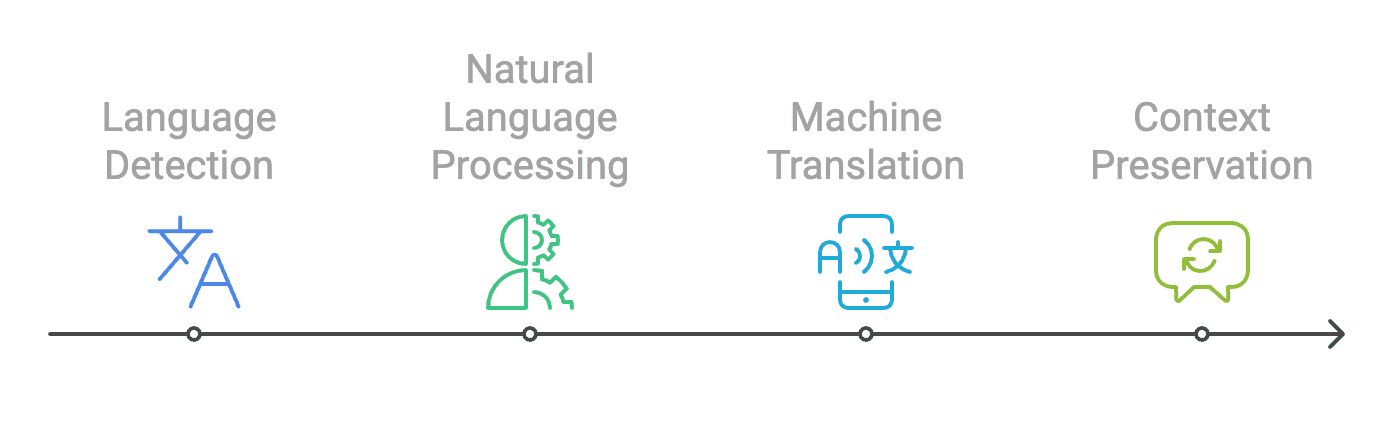
Language Detection: Advanced algorithms instantly identify the customer’s preferred language from their input.
Natural Language Processing: AI systems understand the context and intent behind customer queries, regardless of the language used.
Machine Translation: Real-time translation capabilities enable seamless communication between customers and support systems.
Context Preservation: The technology maintains conversation context even when switching between languages, ensuring a coherent customer experience.
These integrated capabilities work in concert to create a robust multilingual support system that can effectively handle customer interactions across multiple languages while maintaining the nuanced understanding necessary for meaningful communication.
Benefits of AI-Powered Multilingual Support
The implementation of AI in multilingual customer support delivers numerous advantages for both businesses and customers. Organizations experience reduced operational costs, improved scalability, and more efficient resource allocation. Meanwhile, customers benefit from immediate access to support in their preferred language, consistent service quality, and round-the-clock availability.
The technology also enables businesses to gather valuable insights about their global customer base, helping inform strategic decisions about market expansion and service improvements.
Overcoming Implementation Challenges
While AI-powered multilingual support offers significant benefits, organizations must navigate certain challenges during implementation. These include ensuring accurate language detection, maintaining cultural sensitivity, and managing the transition from traditional support models. Success requires careful planning, ongoing optimization, and a commitment to maintaining high service standards across all languages.

The Future of Global Customer Support
Looking ahead, the evolution of AI technology promises to fundamentally transform how businesses approach multilingual customer support. We can expect to see significant advancements in AI systems’ ability to recognize and respond to subtle cultural nuances, moving beyond simple translation to truly culturally-aware communication. These systems will develop increasingly sophisticated contextual understanding, enabling them to grasp complex situations and provide responses that consider not just the words being used, but the broader cultural and situational context in which they’re being employed.
Furthermore, the scope and accessibility of AI-powered multilingual support will continue to expand dramatically. As natural language processing capabilities advance, support for additional languages and dialects will grow exponentially, including previously underserved languages and regional variations. This expansion will be accompanied by improvements in real-time processing capabilities, allowing for even more seamless interactions across language barriers and enabling businesses to provide truly global support coverage without sacrificing quality or response time.
Fini is Helping Companies Scale with AI
The global nature of modern business demands a more sophisticated approach to multilingual customer support. Fini’s AI-powered solutions offer a practical, scalable way to meet this challenge, enabling organizations to provide consistent, high-quality support across languages while controlling costs and improving efficiency. As technology continues to advance, the ability to deliver seamless multilingual support will become not just an advantage, but a necessity for successful global business operations.
FAQs
What is multilingual AI support in customer service?
Multilingual AI support refers to the use of artificial intelligence tools, such as language models and natural language processing systems, to provide customer support across multiple languages. These systems can automatically detect the user’s language, understand their query, and respond contextually in the same language—without needing separate human agents for each language.
How does multilingual AI support differ from traditional translation tools?
Unlike static translation tools that often translate word-for-word, multilingual AI support leverages advanced natural language understanding, context retention, and cultural nuance recognition. It doesn’t just translate—AI understands intent, sentiment, and conversational flow, delivering responses that feel natural and human-like.
Why is multilingual support important for modern businesses?
As companies scale globally, their customer base spans various languages and cultures. Offering multilingual support ensures all customers receive equitable service, improves satisfaction, reduces churn, and enables businesses to tap into international markets more effectively.
What are the core AI technologies used in multilingual support systems?
Key technologies include natural language processing (NLP), machine translation (MT), large language models (LLMs), sentiment analysis, and contextual memory systems that retain and recall conversation history in any language.
What types of queries can multilingual AI agents handle?
Multilingual AI agents can handle a wide range of queries—from order status and payment issues to technical troubleshooting and product recommendations—in multiple languages, with the same accuracy and empathy as their monolingual counterparts.
How does multilingual AI support reduce operational costs?
By automating multilingual conversations, AI reduces the need to hire and train separate teams for each language. Businesses can scale support without adding headcount, cutting down labor costs while maintaining 24/7 availability.
Can multilingual AI support replace human agents completely?
Not entirely. While AI can handle a large portion of routine or repeatable inquiries, human agents are still essential for edge cases, complex problems, and empathetic escalation. A hybrid model often works best—AI handles scale, and humans handle nuance.
How long does it take to implement multilingual AI support?
With platforms like Fini, implementation is fast. Businesses can deploy multilingual AI support in days—thanks to no-code integrations and pre-built connectors for tools like Zendesk, Salesforce, and Intercom.
What are the training or setup requirements for AI to handle multiple languages?
Modern AI platforms come pre-trained in dozens of languages. For advanced customization, businesses may provide knowledge base content or FAQs in various languages, or let the AI auto-translate and refine based on feedback over time.
How does AI ensure the quality of responses in less common languages?
Advanced systems like Fini use multilingual LLMs fine-tuned on diverse global datasets. Additionally, companies can monitor analytics to identify weak areas and continuously improve via feedback loops and localized tuning.
How does the AI detect which language the customer is using?
Language detection happens instantly through advanced classifiers that analyze input text to identify language patterns, structure, and vocabulary—even within short or mixed-language sentences.
Can a single AI model support multiple languages simultaneously?
Yes. Fini’s AI agents are capable of switching between languages on the fly within a single session, offering fluid multilingual support without requiring model switching or manual rerouting.
How does AI retain context across languages during support conversations?
Multilingual AI agents track and store contextual cues—like customer intent, past queries, product type, or issue history—even when the language shifts mid-conversation. This ensures consistent, relevant replies.
Does AI support regional dialects and variations within languages?
Top-tier AI platforms account for regional differences (e.g., Brazilian Portuguese vs. European Portuguese) and can localize tone, phrasing, and vocabulary to align with the customer’s cultural context.
How secure is multilingual AI support for sensitive industries like fintech?
Fini offers enterprise-grade security with data encryption, role-based access, and compliance with GDPR, SOC 2, and other privacy standards—ensuring sensitive multilingual interactions are fully protected.
How does AI improve the customer experience in non-English markets?
AI ensures that all users, regardless of language, receive equally fast, accurate, and empathetic support. This builds trust, reduces frustration, and fosters brand loyalty in global markets.
Does multilingual AI support work on all customer support channels?
Yes. Fini supports omnichannel deployment, meaning AI can respond in multiple languages across chat widgets, email, SMS, WhatsApp, and more—all from a single configuration.
Can AI agents adapt tone and formality based on language or culture?
Absolutely. Advanced AI systems like Fini are trained to recognize cultural nuances—such as polite forms in Japanese or casual tones in American English—creating more respectful and appropriate interactions.
How does multilingual AI help reduce wait times for customers?
By instantly engaging users in their language, AI eliminates long queues, routing delays, or the need to transfer between language-specific agents—dramatically cutting response time.
What happens if AI cannot understand or solve a multilingual query?
Fini’s AI gracefully escalates the case to a human agent with full context—including language, conversation history, and intent—ensuring a seamless handoff without repeating steps.
Which industries benefit most from multilingual AI support?
E-commerce, fintech, travel, telecom, and SaaS industries benefit the most, as they often serve diverse international user bases and need to support them in local languages at scale.
How did companies like Klarna benefit from multilingual AI?
Klarna uses AI to serve customers across 23 markets and over 35 languages. Their AI assistant resolved two-thirds of inquiries autonomously, reduced resolution times by 80%, and improved CSAT scores by 47%.
Can multilingual AI support help with onboarding in local languages?
Yes. AI can guide users step-by-step through onboarding, explain processes in native languages, and proactively assist with form filling or document verification—removing friction from sign-up flows.
How does multilingual AI support scale during peak seasons or global launches?
Unlike human teams, AI agents scale instantly. When traffic surges during promotions or launches, AI can handle thousands of multilingual queries concurrently without delay or cost increases.
Are customers comfortable interacting with AI in their language?
Very much so. Studies show that 76% of consumers prefer support in their native language, and well-designed AI agents with fluent, humanlike tone are increasingly accepted as first points of contact.
How many languages does Fini support out of the box?
Fini supports 130+ languages, including high-accuracy models for Spanish, French, German, Japanese, Arabic, Hindi, and other global and regional languages with real-time understanding.
What makes Fini’s multilingual AI agents better than traditional bots?
Unlike static rule-based bots, Fini’s AI agents understand nuance, remember context, handle secure actions, and deliver natural responses in any language—powered by continuous learning and human-in-the-loop feedback.
How does Fini train its AI to ensure cultural sensitivity?
Fini leverages diverse datasets across cultures, supervised fine-tuning, and guardrails that filter insensitive or regionally inappropriate content—ensuring respectful, localized communication.
Can Fini AI automatically translate knowledge base articles?
Yes. Fini can auto-translate your knowledge base into multiple languages and dynamically serve the right version based on the user’s language or location—making global support seamless.
What metrics does Fini offer for multilingual support performance?
Fini’s analytics dashboard shows language-specific metrics like CSAT, FCR, handover rate, and unresolved topics—allowing you to fine-tune multilingual support strategies by region.
How easy is it to integrate Fini’s multilingual AI into existing platforms?
Fini offers plug-and-play integrations with Zendesk, Intercom, Salesforce, Freshdesk, and more. You can deploy multilingual AI widgets, assistants, or search bars with zero code in under an hour.
Do businesses need to maintain separate scripts for each language?
No. Fini automatically translates intent-based scripts and FAQs into target languages. You can still customize per-language flows for precision where needed, but maintenance is centralized.
How do you test accuracy in different languages during deployment?
Fini provides multilingual test modes, preview chats, and sandbox environments. You can simulate interactions in different languages, validate tone, and correct edge cases before going live.
Can I prioritize languages based on traffic or region?
Yes. Fini lets you define language priorities by region, customer segment, or traffic source. You can even serve fallback languages or suggest switching based on location or browser settings.
How often should language models be retrained or reviewed?
Fini continuously improves via reinforcement learning and feedback loops. However, for highly regulated industries or fast-changing content, a quarterly review of knowledge accuracy is recommended.
What are the limitations of current multilingual AI support?
Limitations include occasional translation ambiguities, rare dialect gaps, or tone mismatches. These can be mitigated with custom tuning, feedback training, and human QA loops.
How does AI handle customer feedback in multiple languages?
Fini aggregates multilingual feedback, auto-translates open text, and classifies sentiment by language—helping support teams improve experiences based on global customer input.
What happens if a user switches languages mid-conversation?
Fini detects the switch and adjusts the response language instantly while retaining the conversation thread—ensuring continuity without awkward resets or misunderstandings.
Can multilingual AI support be combined with voice or IVR systems?
Yes. Fini’s multilingual capabilities can be extended to voice bots or IVRs via APIs—enabling end-to-end, voice-based support across languages for call centers.
What does the future of multilingual customer support look like with AI?
AI will evolve to support real-time speech translation, cultural sentiment adaptation, and proactive multilingual outreach. In the future, language will no longer be a barrier—but a bridge to deeper, more human connections between brands and users.
More in
AI Support Guides


Co-founder