3rd Party Integrations
Last Updated:

Deepak Singla

In this article
Support teams struggle to keep up with rising chat volume without slowing response times or burning out agents. This guide shows how to deploy AI agents inside LiveChat, covering setup phases, use cases, and a real deployment example from Bitdefender. It's written for support leaders and ops teams planning an AI rollout.
How to Use AI Agents to Automate Support in LiveChat
In today’s fast-paced digital world, customers expect immediate, personalized support at any time of day. LiveChat is a powerful tool for real-time engagement, but as support teams face increasing volumes of inquiries, keeping up with these expectations can become overwhelming. This is where AI agents step in to revolutionize the support experience.
AI agents are changing how businesses handle customer inquiries, providing instant, accurate responses to routine questions alongside human agents who take on more complex issues. AI support tools have driven a 55% reduction in average first response time for CX teams, according to Freshworks research, and teams that add AI to LiveChat also gain 24/7 coverage and higher customer satisfaction scores.
Ready to improve your customer satisfaction? This article covers practical ways to automate your LiveChat support with AI agents. For more context on how AI support has evolved, check out our article on moving from RAG to agentic AI.
TLDR:
AI agents cut average first response time by 55% and deliver 24/7 LiveChat coverage without adding headcount
Pilot with 10-15% of chat volume in weeks 5-6, then scale to 30-50% by week 12 using performance data
In 2026, 70% of CX leaders report AI agents building personalized customer journeys instead of following rigid scripts
Bitdefender achieved a 60% query deflection rate and 70% reduction in response time after deploying AI in LiveChat
Fini connects to LiveChat via API with no code, auto-updates its knowledge base from past chats, and logs every interaction for audit
Understanding AI Agents in LiveChat
Why AI Agents Matter in LiveChat
Modern customer support teams face mounting challenges: surging ticket volumes, increasingly complex inquiries, and rising customer expectations for instant, personalized service. These pressures strain traditional support models, leading to longer wait times, inconsistent responses, and agent burnout. AI agents directly tackle these pain points by automating routine tasks, providing 24/7 coverage, and augmenting human agent capabilities with intelligent assistance. According to IBM enterprise AI research, 47% of enterprise companies using AI now automate self-service answers and actions. Let’s look at the specific challenges these AI solutions tackle:
Delayed Responses: Human agents can only handle one chat at a time, causing delays during peak hours.
Repetitive Queries: Many customer inquiries are basic FAQs, which consume considerable agent bandwidth.
High Running Costs: Scaling support with human agents can be costly, especially for 24/7 availability.
The intelligent response systems take automation to the next level, offering automated responses to common queries, context-aware conversation handling, and broad multi-language support capabilities. These systems deliver consistent, accurate responses while reducing the workload on human agents, similar to the top AI agents for customer service.
Perhaps most importantly, AI agents allow truly personalized customer interactions. By using adaptive responses based on customer attributes, customizing solutions using customer history, and implementing flexible conversation flows, businesses can provide a more tailored and effective support experience for each customer.
Advanced AI Capabilities

AI agents offer broad integration capabilities that simplify customer support processes through various features. These include automatic ticket creation and routing to appropriate departments, smooth integration with existing CRM systems, and real-time data retrieval and updates across all support channels, along with API-driven process automation for routine tasks.
AI agents combine intent detection and machine learning (ML) to:
Understand Context and Intent: They interpret customer queries beyond keywords, delivering accurate and meaningful responses.
Handle Multiple Conversations Simultaneously: Unlike human agents, AI agents can engage with thousands of customers at once without compromising response quality.
Automate Repetitive Tasks: From answering FAQs to categorizing queries, AI agents simplify processes.
Learn and Improve Over Time: With every interaction, AI agents refine their knowledge base, becoming smarter and more effective.
These capabilities combine to create a dependable support system that handles routine inquiries automatically and enhances the overall customer experience through intelligent routing, smooth escalation to human agents when needed, and continuous performance monitoring. This approach makes sure both simple and complex customer needs are met well. See how leading tools compare in our AI customer service agents comparison, or read about the full journey from deflection to autonomous resolution.
Key Use Cases for AI Agents in LiveChat
Let’s look at four areas where AI agents deliver the most impact in LiveChat support operations. Nielsen Norman Group research found AI helps agents handle 13.8% more inquiries per hour.
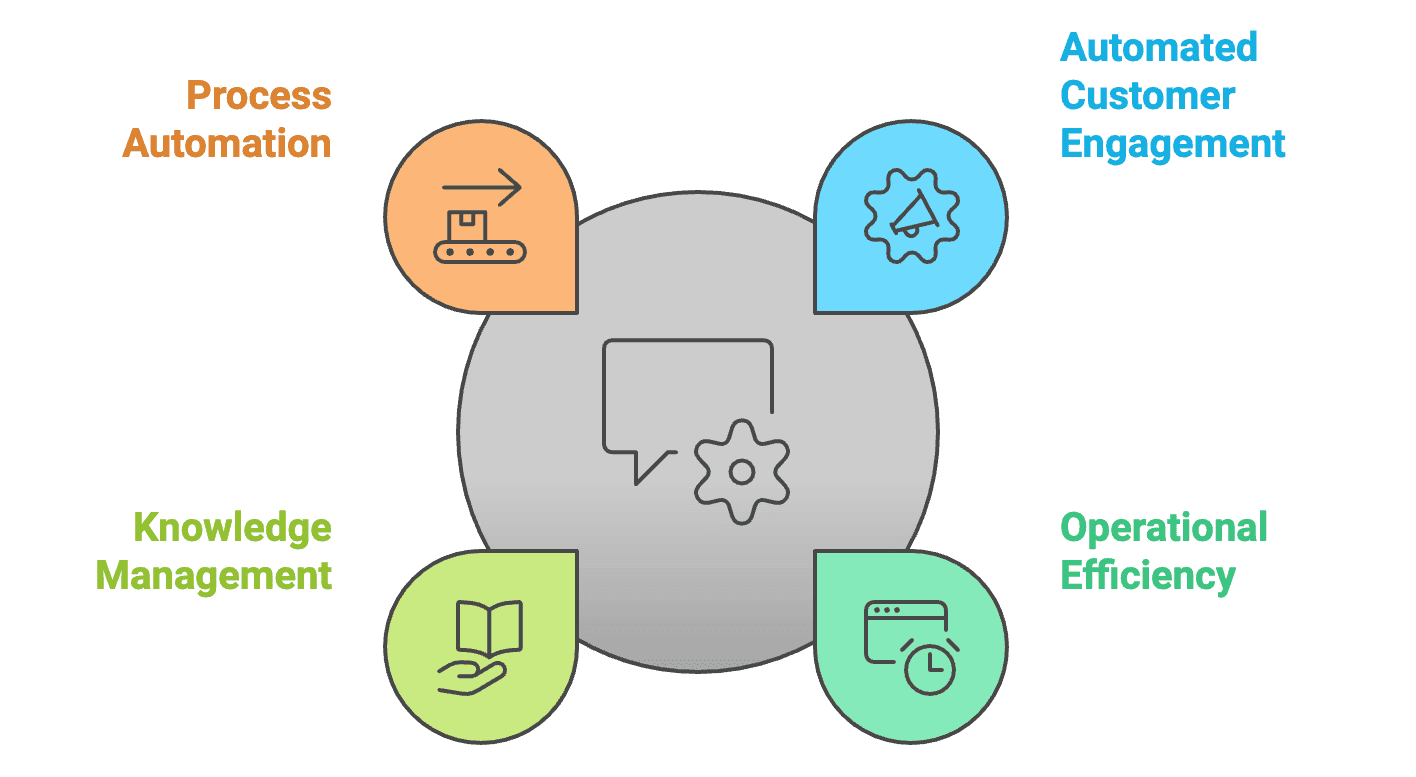
Automated Customer Engagement
Personalized Interactions: Use customer data to deliver tailored support experiences
Faster Day-to-Day Operations
Smart Ticket Routing: Direct inquiries to the most qualified agents based on expertise
Automated Task Execution: Handle routine processes like order tracking and refunds
Workload Management: Balance support volume across teams during peak periods
Real-Time Performance Analytics: Monitor and optimize support operations continuously
Knowledge Management
Live Documentation: Automatically generate and update internal knowledge bases
Content Gap Analysis: Identify areas requiring additional documentation
Training Material Creation: Convert successful resolutions into learning resources
Process Automation
System Integration and Workflow Management: Simplify operations through API integrations and automated multi-step processes
These integrated capabilities create a capable support ecosystem that consistently delivers value while reducing running costs and improving both customer and agent satisfaction.
Where LiveChat AI Support Stands in 2026
Support teams are moving past standalone chatbot scripts. In 2026, 70% of CX leaders say chatbots are becoming skilled at building personalized customer journeys instead of following rigid scripts.
That shift shows up directly in LiveChat. Agents now hold context across voice, chat, and email, take real actions like refunds or account updates, and flag their own knowledge gaps instead of waiting on a human to notice.
For LiveChat in particular, that translates to less time spent maintaining flows and more time on conversations that need a human. Teams assessing AI agents this year look for tools that go live fast, connect to existing systems without a rebuild, and keep improving after deployment.
By September 2026, the leading AI agents in LiveChat are completing multi-step actions across tools in a single session: checking order status in an OMS, issuing a refund via Stripe, and updating the CRM record without any human prompt. Support teams report this shift cuts average handle time further and removes the manual follow-up work that once sat in an agent queue after chat close.
Best Practices for Implementation

To successfully implement AI agents in your LiveChat system, follow these detailed steps. This guide will help you smoothly integrate artificial intelligence into your customer service workflow, boosting your team’s speed and response capabilities. With proper implementation, AI agents can handle routine inquiries, freeing up your human agents for more complex customer interactions.
Phase | Timeline | Key Focus |
|---|---|---|
Data Preparation | Weeks 1-2 | Clean chat logs, categorize intents, build knowledge base |
Initial Configuration | Weeks 3-4 | Train AI model, configure automation rules, set up integrations |
Pilot Phase | Weeks 5-6 | Launch with 10-15% of chat volume, monitor key metrics |
Optimization and Scaling | Weeks 7-12 | Scale to 30-50% of chats, fine-tune templates |
Maintenance Protocol | Ongoing | Weekly reviews, monthly training updates, quarterly audits |
Data Preparation (Weeks 1-2)
Collect and clean 3-6 months of historical chat logs
Categorize common customer queries into distinct intents
Create a structured knowledge base with verified responses
Develop clear escalation paths for complex scenarios
Initial Configuration (Weeks 3-4)
Set up AI model training with your prepared dataset
Configure basic automation rules for top 10-15 common queries
Set up integration points with your existing systems
Create fallback mechanisms for uncertain responses
Pilot Phase (Weeks 5-6)
Launch with 10-15% of total chat volume
Monitor key metrics: response accuracy, resolution time, CSAT
Implement A/B testing for different response templates
Gather feedback from both customers and agents
Optimization and Scaling (Weeks 7-12)
Gradually increase AI handling to 30-50% of chats
Fine-tune response templates based on performance data
Expand automation rules to cover more use cases
Implement advanced features like sentiment analysis
Maintenance Protocol
Review AI performance weekly
Update training data monthly
Conduct quarterly system audits
Implement regular model retraining cycles
Case Study: Bitdefender’s AI Implementation
Challenge
Bitdefender faced growing customer support demands that were straining their human support team and leading to slower response times. The company needed a solution to handle increasing query volumes while maintaining quality service.
Solution
Bitdefender implemented Fini AI agents into their LiveChat system through a systematic approach:
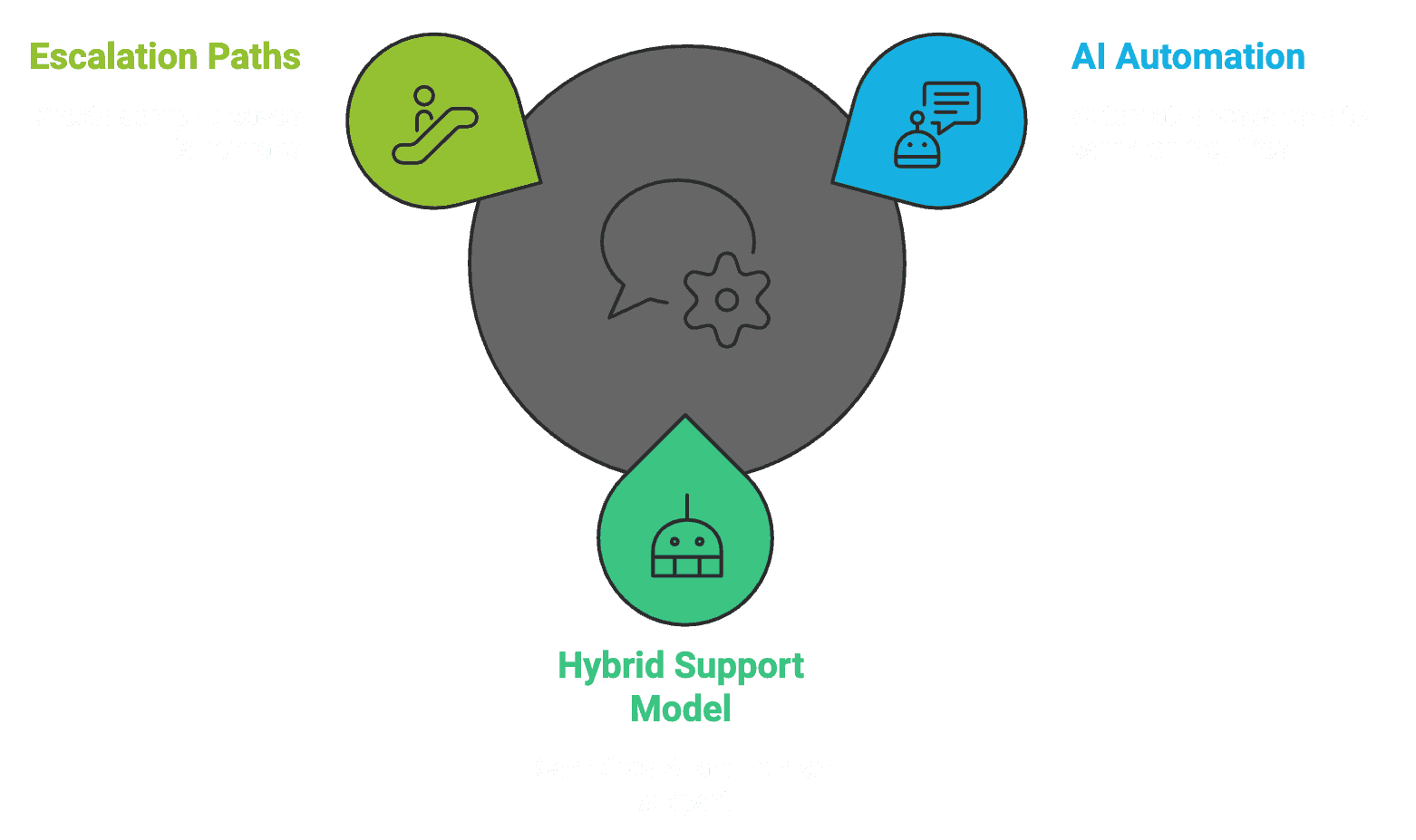
Automated routing and instant answers for common customer inquiries
Results
The implementation delivered sizable improvements across key metrics:
60% Deflection Rate: AI successfully automated handling of repetitive customer queries
70% Reduction in Response Time: Customers received instant responses to frequently asked questions
Enhanced Agent Capacity: Human support staff were freed to focus on complex cases requiring critical thinking and empathy
Impact
The successful implementation reshaped Bitdefender’s customer support operations:
Reduced running costs through efficient query handling
The success of this implementation showcases how strategic AI deployment can dramatically improve customer support operations while reducing costs and enhancing both customer and agent experience. For a deeper look, see our post on Automate HubSpot Support with AI Agents.
See how Fini speeds up your LiveChat support
AI agents in LiveChat represent a major leap forward in customer support automation. With proper implementation and monitoring, organizations can achieve substantial improvements in speed, response times, and customer satisfaction while maintaining high accuracy levels.
Book your demo now to see how Fini can help you build a smarter, more efficient support system. Want to learn more? Enter your email below to book a demo with us today.
FAQs
What does it mean to automate support in LiveChat using AI agents?
It means integrating intelligent systems that can understand, respond to, and resolve customer queries directly within LiveChat: automating common workflows, answering FAQs, and reducing the load on human agents.
How are AI agents different from traditional LiveChat bots?
Traditional bots follow rigid scripts. AI agents use natural language understanding, context retention, and real-time decision-making to engage in fluid, personalized conversations and complete multi-step actions autonomously.
Why is LiveChat a strong base for AI automation?
LiveChat’s real-time messaging, agent handoff capabilities, and API-friendly infrastructure make it ideal for AI integration, allowing a smooth hybrid of automation and human support.
What types of businesses benefit from AI automation in LiveChat?
E-commerce, SaaS, financial services, travel, and telecom companies use AI in LiveChat to reduce ticket volumes, shorten resolution times, and deliver 24/7 global support without growing their teams.
What are the most common support queries AI agents handle in LiveChat?
AI agents excel at order tracking, refund status updates, product availability, FAQs, login issues, shipping timelines, and promo code applications, resolving them in real time. They also handle pre-sale questions like product comparisons, pricing inquiries, discount eligibility, and shipping options, helping convert leads directly from chat.
How do AI agents improve first response time in LiveChat?
They respond instantly to customer messages, eliminating the wait time typically associated with agent availability, especially during peak hours or off-hours.
Can AI proactively start LiveChat conversations?
Yes, AI agents can monitor behavior like cart abandonment, page exits, or prolonged inactivity and initiate contextual chats to boost engagement and conversion.
How do AI agents help with returns and refunds in LiveChat?
They guide customers through eligibility checks, initiate refund workflows, and trigger backend systems like Shopify or Stripe to process returns automatically.
How can AI agents help with account-related issues?
AI agents can verify identities, provide password reset guidance, update contact info, and initiate secure authentication flows with built-in guardrails.
How do I integrate AI agents into my LiveChat system?
Tools like Fini offer no-code integration with LiveChat using APIs and webhooks. You simply connect the AI to your LiveChat workspace and sync it with your support data.
How long does it take to deploy AI agents in LiveChat?
Most companies begin pilot testing within 3 to 4 weeks. A full rollout with optimization typically takes 6 to 8 weeks, depending on the number of use cases. To start, provide 3-6 months of chat logs, FAQs, knowledge base content, and past resolutions so the AI can learn common patterns and improve response accuracy.
Can AI agents work alongside human agents in LiveChat?
Yes, AI agents can handle initial queries and smoothly escalate to human agents when issues require empathy, discretion, or deeper troubleshooting.
What fallback mechanisms are recommended?
Implement confidence thresholds, escalation rules, and transparent messaging like “Let me connect you to a specialist” if the AI isn’t certain about a response.
Can AI agents understand complex customer intent?
Yes, advanced language models can interpret ambiguous queries, understand context across turns, and even disambiguate multi-part questions.
Do AI agents in LiveChat support multiple languages?
Fini’s AI agents support multilingual conversations and can detect the user’s language to respond appropriately, making them ideal for global audiences.
Can AI agents access customer data for personalization?
Yes, AI agents integrate with CRMs and databases to pull relevant user info, such as order history, plan details, or location, to offer personalized help.
How do AI agents handle long conversations or multiple questions?
Agentic AI tracks user context throughout the session, allowing it to respond to follow-up questions intelligently without losing thread continuity.
Are AI responses editable or customizable?
Yes, platforms like Fini let you refine AI responses using templates, tone control, and response overrides, keeping brand alignment and compliance intact.
What KPIs improve after AI is deployed in LiveChat?
Common improvements include a 70%+ reduction in response times, 50 to 80% ticket deflection, higher CSAT, and reduced human support workload. To measure performance, track resolution accuracy, escalation rate, CSAT, average handle time, and fallback frequency: tools like Fini offer analytics dashboards for these.
Can I test AI responses before deploying live?
Yes, you can simulate user interactions, run A/B tests, and validate AI behavior in staging environments before exposing it to real customers.
How do AI agents adapt to new products or policies?
They learn from updated content, ticket patterns, and human feedback. With tools like Fini, AI agents can auto-update their knowledge base from past chats.
What happens if the AI gives a wrong answer?
Fini logs every interaction. You can flag errors, adjust responses, and retrain models using manual review to prevent recurrence.
Are AI agents in LiveChat secure?
Yes. Fini is SOC 2, GDPR, and ISO compliant, keeping customer data encrypted, access-controlled, and privacy-respecting.
Can I limit what actions AI agents can take?
Yes, you can configure guardrails to control what actions AI is allowed to perform, such as initiating refunds, accessing sensitive data, or making changes.
Do customers know they’re talking to an AI agent?
You can choose to disclose the AI’s identity or let the interaction remain smooth and uninterrupted. Most companies include a friendly disclaimer at the start.
How do AI agents handle sensitive payment-related info in LiveChat?
Sensitive info is masked or redirected to secure flows. Fini allows PII handling with built-in filters and optional handoff to secure webforms or agents. Every AI conversation is also logged with full visibility into decisions, inputs, and outputs for compliance audits and training reviews.
What’s the best way to launch AI agents in LiveChat, and how do I train my team?
Start with a pilot for 10-15% of volume, monitor metrics, collect agent feedback, iterate on responses, then scale gradually with confidence. Alongside the pilot, offer your team onboarding on fallback handling, escalation triggers, and how to review AI-suggested replies, so they become collaborators, not competitors.
How often should I update the AI’s knowledge base?
Monthly reviews are ideal. With Fini, you can automate updates from LiveChat transcripts and detect outdated or low-accuracy answers automatically.
Can AI agents route conversations to specific departments?
Yes, using tagging, keywords, or sentiment detection, AI can route chats to the right queue: sales, billing, tech support, etc. Fini's flow builder also lets you create advanced, conditional AI flows for scenarios like onboarding, returns, or troubleshooting.
How does LiveChat automation with AI affect support costs?
It reduces cost per resolution by deflecting high-volume queries, limiting ticket escalations, and allowing leaner support teams.
Customer satisfaction also tends to improve, as CSAT often rises with faster, 24/7 service, consistent responses, and reduced wait times, even during peak periods.
Is it possible to automate LiveChat without sacrificing brand voice?
Yes, with platforms like Fini, you can customize tone, vocabulary, and persona settings to match your brand identity.
Does AI automation in LiveChat work for B2B as well as B2C?
Absolutely. B2B teams automate technical support, onboarding, plan upgrades, and documentation queries with context-aware AI agents.
How do AI agents maintain persistent memory across long conversations and past interactions?
They track context and organizational knowledge over time, so returning customers do not have to repeat account details or previous troubleshooting steps across sessions.
Can AI agents proactively monitor systems and trigger alerts without being prompted?
Yes, AI agents can watch for anomalies like ticket spikes or repeated failures and notify the team before the issue affects CSAT, instead of waiting for someone to notice.
What should teams look for when assessing AI agent vendors for LiveChat?
Compare omnichannel capability across chat, voice, and email, integration flexibility with existing systems, and resolution performance on your own ticket data before committing.
How does Fini compare to other AI tools for LiveChat support?
Fini goes beyond chatbots. It executes actions, learns from past chats, and integrates deeply with your stack, all without code.
Can visitors use the AI chat widget without logging in or providing an email?
Yes. Anonymous users can start a chat right away with no login or email required. Identity and contact details can be captured later in the conversation flow, and only when the issue actually calls for it.
More in
3rd Party Integrations


Co-founder