White papers

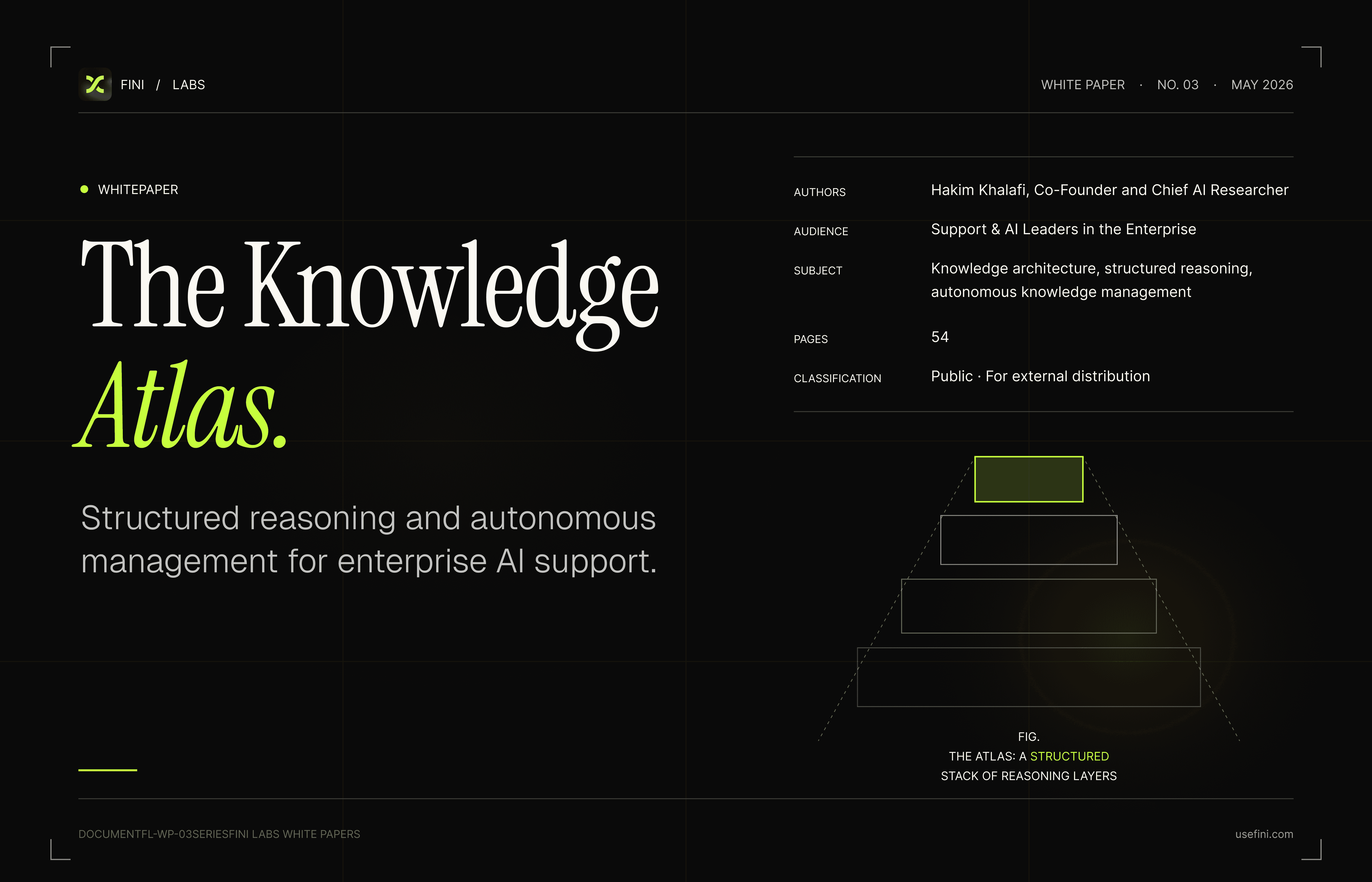
The Knowledge Atlas: Structured Reasoning and Autonomous Management for Enterprise AI Support

The Knowledge Atlas: Structured Reasoning and Autonomous Management for Enterprise AI Support

Dowload Now ->

Dowload Now ->

Introduction

Knowledge is the bottleneck on every enterprise AI customer support deployment. After a year of working with banks, fintechs, insurance carriers, and regulated B2B operators, the same pattern shows up everywhere. Support leaders spend 15-20 hours a week maintaining documentation and still ship gaps, conflicts, and duplicates into the AI's source data. Every product launch creates new articles. Every policy change spawns versions. Every workflow update leaves outdated content behind, and the AI inherits all of it.

This is the Knowledge Death Spiral. Customers ask questions the AI cannot answer. Humans resolve them. The resolution stays buried in the ticket. The same question comes back the following week. AI confidence drops as the knowledge base grows stale. The result is a hard ceiling at 50-60% resolution accuracy that no model upgrade can break through.

Fini solves this with the Knowledge Atlas: a self-maintaining knowledge system that learns from every customer interaction. The Atlas pairs a structured Knowledge Tree (the backend reasoning surface Sophie walks through) with an autonomous maintenance loop (the user-facing product that captures resolutions, detects conflicts, and keeps the help center current). One source of truth feeds both the AI and the customer.

Production deployments across banking, fintech, insurance, and large-member associations are pushing resolution from the 50-60% plateau to 85-90% in the first month, cutting documentation maintenance by a factor of ten, and delivering 100% citation traceability for regulated industries.

This whitepaper covers the architecture, the production results, the failure modes of competing approaches, and the implementation path for teams ready to move beyond static help centers.

In This White Paper

Part I: The Knowledge Problem

  • Why enterprise AI hits a 50-60% resolution ceiling regardless of model quality

  • The structural reasons vector search fails on enterprise customer support

  • The Knowledge Death Spiral and how it compounds every quarter

Part II: The Knowledge Tree (Backend Architecture)

  • The move from flat article lists to described hierarchies

  • Why folder descriptions, written for machines, are the primary reasoning surface

  • How Sophie traverses the Tree as a senior agent would

  • Production results from named deployments at Columntax, Qogita, Wefunder, Unit, Found, and the US Chamber of Commerce

Part III: The Knowledge Atlas (User-Facing Product)

  • One Tree, two surfaces: agent reasoning and customer-facing help center

  • The Atlas Help Center: intent-based search, conversational answers, instant citations

  • The maintenance loop: how the Atlas closes the gap between resolved tickets and shipped knowledge

Part IV: Production Validation

  • CXACT benchmark results across 1,200 tickets: policy compliance, tool accuracy, state management, trace completeness

  • Patterns that hold across verticals and ticket volumes

  • The seven operational trust metrics Fini measures in production

Part V: Implementation

  • The path from evaluation to production deployment

  • Compliance posture: SOC 2 Type II, ISO 27001, ISO 42001, GDPR, and the regulated-industry checklist

  • What to measure in the first month and what to expect by month three

Appendices

  • Glossary of technical terms

  • Compliance mapping

FAQs

1. What is the Knowledge Atlas?

The Knowledge Atlas is Fini's self-maintaining knowledge system for enterprise AI customer support. It combines a structured Knowledge Tree (a hierarchical reasoning surface that Sophie walks through) with an autonomous maintenance loop that learns from every resolved ticket. One source of truth ships answers to customers, content to the help center, and keeps itself current without a documentation team behind it.

2. How does the Knowledge Tree differ from vector search and RAG?

Vector search retrieves the most similar text chunk. The Knowledge Tree gives the model a navigable hierarchy: folders carry semantic descriptions, articles sit underneath them, and Sophie traverses the structure the way a senior agent would. This replaces probabilistic retrieval with structured reasoning, which is why resolution rates jump from the 50-60% industry plateau to 85-90% on the same underlying model.

3. Why is structured knowledge the bottleneck on enterprise AI deployments?

Modern LLMs are capable enough. The ceiling shows up because help centers were written for humans to skim. Machines reasoning over them inherit overlapping articles, contradictions, and flat lists with no clear ownership. Every agent built on top reaches the same wall when it inherits this content. Fixing the knowledge layer is what unlocks the model.

4. What does the Atlas actually do for a customer experience team?

Four jobs. It auto-generates articles from resolved escalations so new knowledge captures itself. It detects conflicts and duplicates between existing articles. It runs intent-based search so "card declined" and "transaction failed" route to the same place. And it gives every AI answer one cited source, so compliance teams can trace any response back to the article that produced it.

5. What production results does the Knowledge Atlas deliver?

On named deployments: documentation maintenance drops from roughly 20 hours per week to 2. AI resolution rises from the 50-60% plateau to 85-90% inside the first month. Accuracy in regulated verticals reaches 99.8%. Citation traceability moves from 0% under blended-RAG answers to 100% under tree-structured attribution. Wefunder cut response time from 7 hours to 15 minutes while handling double the email volume at the same team size.

6. How does Sophie use the Knowledge Tree at inference time?

Sophie reads the folder descriptions, decides which branch to walk into, and continues down until the question lands on a single authoritative article. Each step is logged and the path is replayable. There is no blended answer drawn from multiple sources, which is where regulated industries usually break with RAG.

7. What is CXACT and what does it measure?

CXACT is Fini's benchmark suite for evaluating AI support agents under realistic ticket loads. It scores policy adherence, tool invocation correctness, state management across multi-turn conversations, and trace completeness. On a 1,200-ticket benchmark, Sophie running on the Knowledge Tree outperformed RAG-based architectures across every category, with the largest gaps appearing in policy compliance and traceability.

8. Who is running the Knowledge Atlas in production?

Wefunder (fintech crowdfunding), Columntax (tax and finance), Unit (banking infrastructure), Found (small business banking), Qogita (B2B commerce), and the US Chamber of Commerce. The deployments span fintech, regulated finance, B2B operations, and large-member associations.

9. How do compliance and auditability work under the Atlas?

Every Sophie response cites the one article it pulled from. Every traversal step is logged with timestamps, folder addresses, and the policy version active at that moment. When auditors ask why a refund was approved or which policy applied to a ticket from six weeks ago, the answer is reproducible from the trace. The Atlas maps cleanly to SOC 2 Type II, ISO 27001, ISO 42001, GDPR, and the regulated-industry requirements that usually disqualify generative systems.

10. Who is this whitepaper for?

VP of Customer Experience leaders evaluating AI support vendors, and the technical architects on those teams who need to understand the architecture under the demo. It is a technical document, but the production results, customer scenarios, and implementation path are written so a CX leader can move through it without engineering support.

Get Started with Fini.

Get Started with Fini.