One published price vs. a per-minute quote you have to ask for
An enterprise team pricing out voice AI agents usually hits the same wall: most vendors won't say a number out loud until after a demo. PolyAI is exactly that vendor, its pricing page sits behind a sales conversation. Fini is the exception, one flat number per resolution, published before any call starts.
The gap goes deeper than whether a number is published. PolyAI bills by the minute of call time no matter whether the caller's issue actually got resolved. Fini bills only for a resolution, at a fixed price, with a guarantee attached if it falls short.
In this comparison: What each is · How they differ · Capabilities · Feature by feature · Ease of use · What customers say · The full side-by-side · Which to choose · Compliance · FAQ
What is Fini?
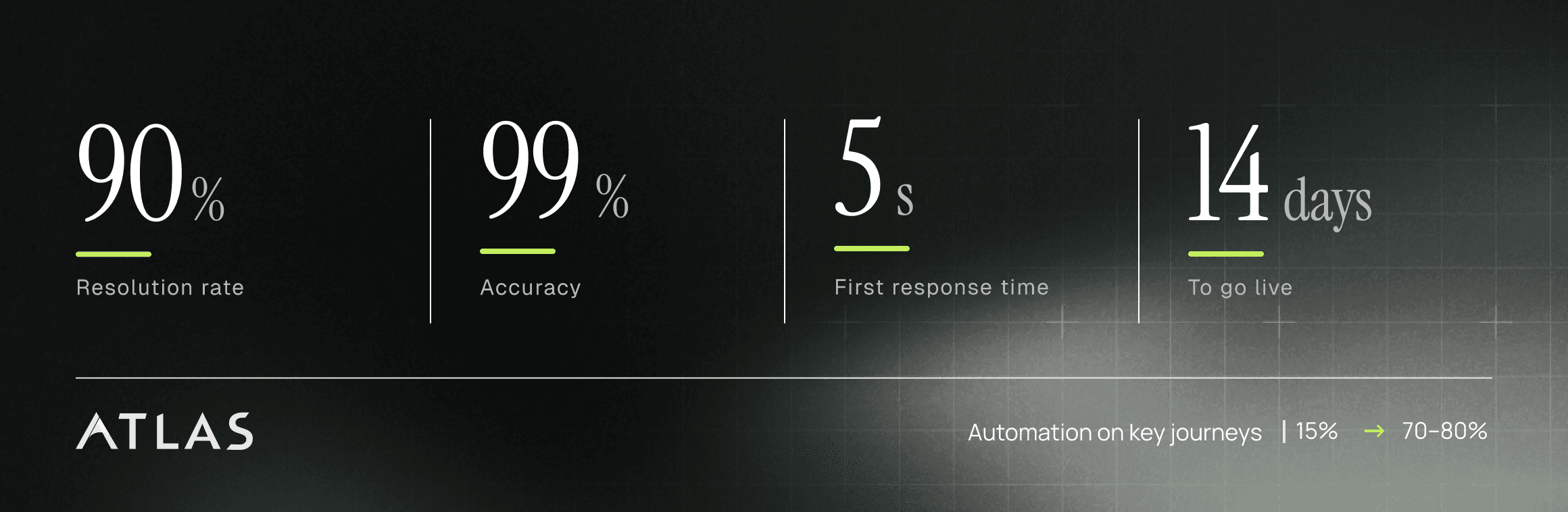
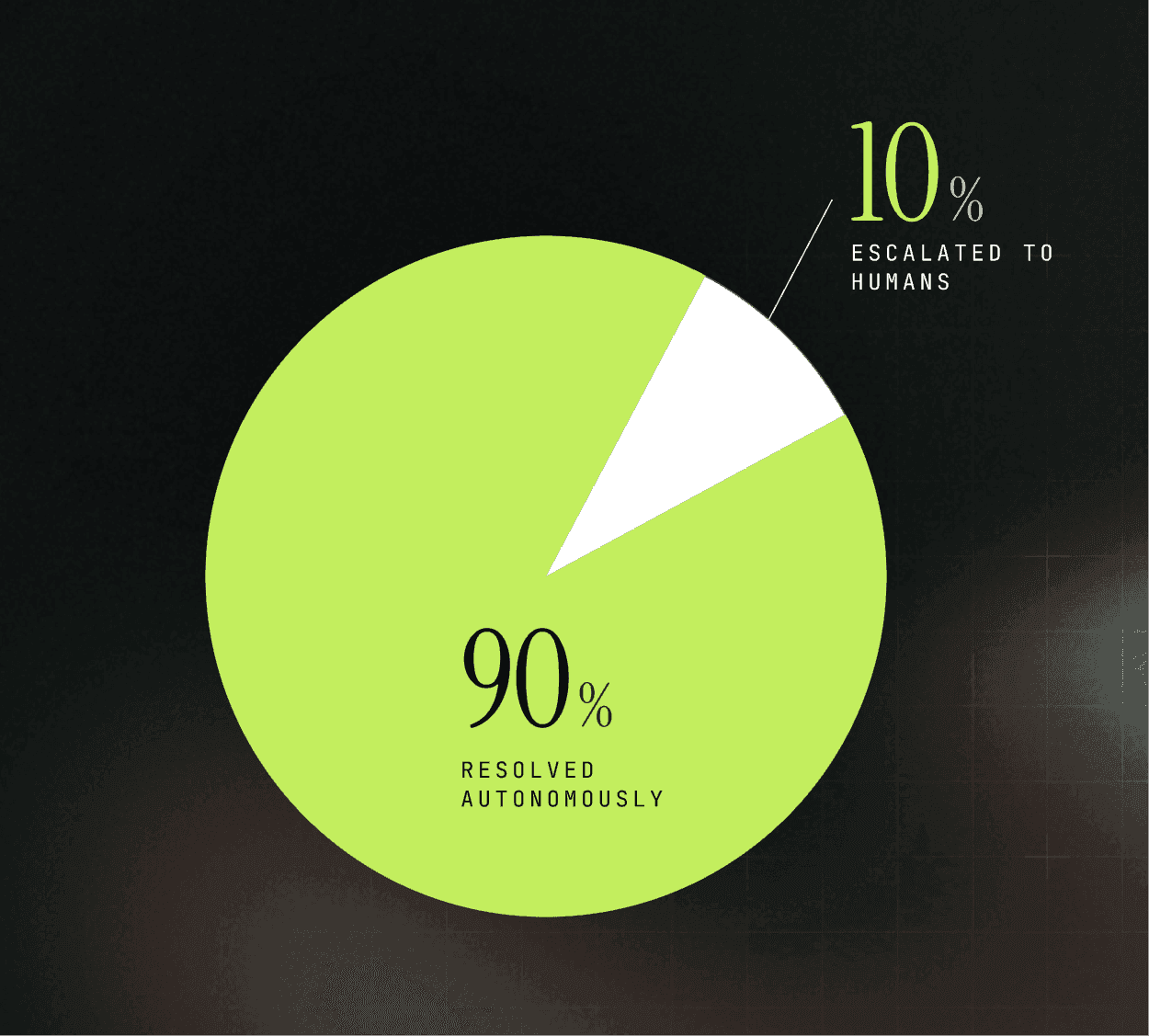
Fini is an AI customer-support agent priced per resolution, backed by Y Combinator and Matrix Partners. It connects natively to your helpdesk, knowledge base, CRM, billing, claims, and EHR systems, reaches a 90% resolution rate at 99% accuracy, and is built to go live in 30 days. Across its customer base, Fini handles 3M+ monthly resolutions in fintech and healthcare. The agent works across voice, chat, and email, answers in 130+ languages, and returns a first response in about five seconds.
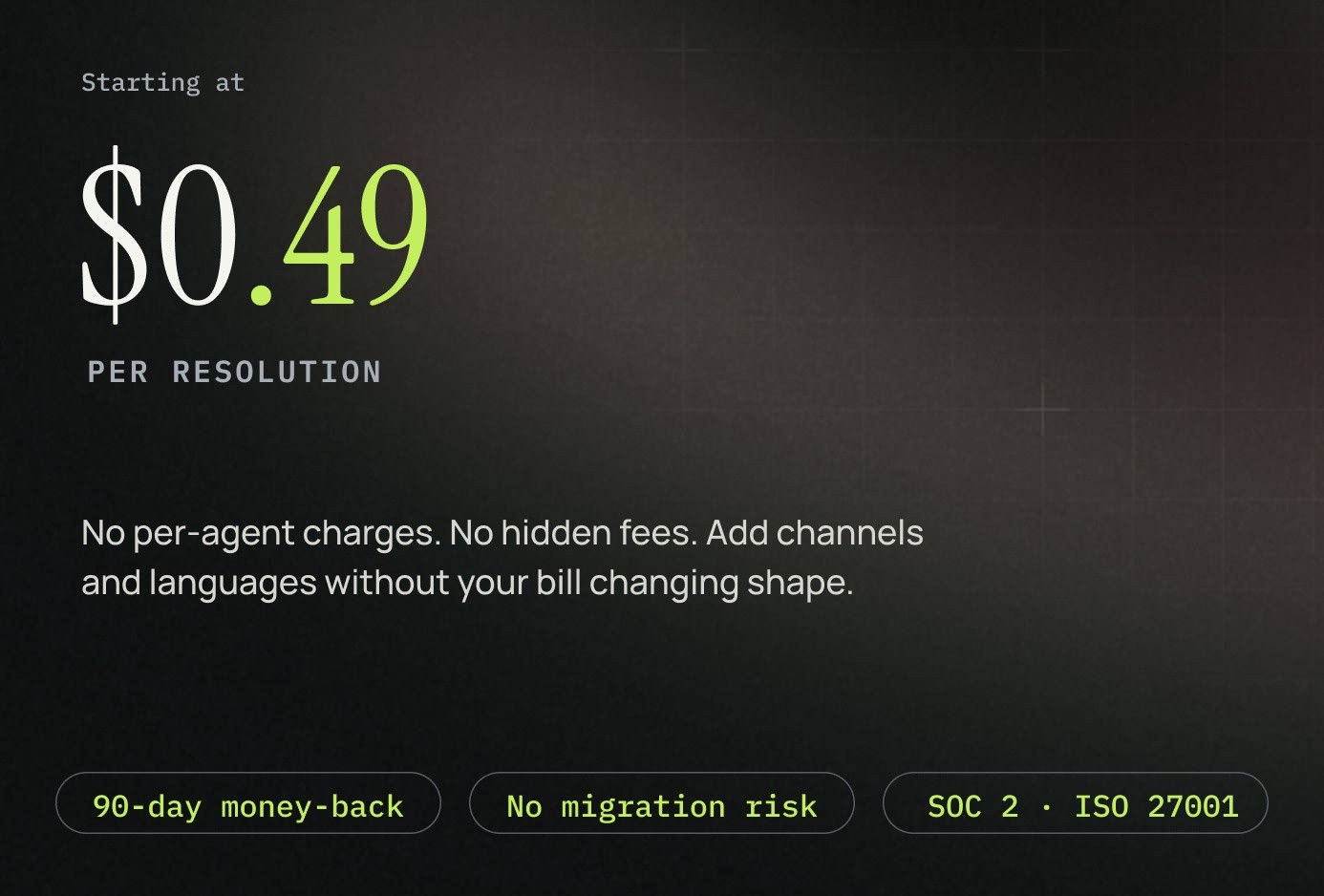
Pricing is $0.49 per resolved ticket, and there are no per-seat fees, so a team can model its own cost from volume alone, before a sales conversation ever starts.
What is PolyAI?
PolyAI is an Agentic Dialog Platform for building enterprise voice AI agents, founded in 2017 by Cambridge machine learning researchers Nikola Mrkšić (CEO), Shawn Wen (CTO), and Eddy Su (SVP Engineering). The company runs offices across New York, London, San Mateo, Belgrade, and Toronto. Its proprietary dialog agent, Wren, is powered by a model called Raven, trained on more than a billion enterprise conversations, and PolyAI markets itself around the line "the world's most lifelike voice AI agents," positioned against chatbots and bolted-on voice add-ons.
Two build surfaces sit on top of that engine: Agent Studio, a no-code builder for non-technical teams, and the ADK (Agent Development Kit), a programmatic interface for developers. PolyAI raised $86 million in a round led by Georgian, Hedosophia, and Khosla Ventures, with participation from NVIDIA's NVentures arm, Citi Ventures, and Zendesk Ventures, bringing its total funding to more than $200 million (see PolyAI's funding announcement). Named customers span banking (UniCredit's Zagrebačka Banka), healthcare (Howard Brown Health, SafeRide Health), utilities (PG&E), and a long list of restaurant and hospitality brands.
PolyAI pricing in 2026
PolyAI does not publish a rate card. Its pricing page is gated behind a demo request, but the site does state the billing metric directly: ongoing use of the voice agent is priced on a per-minute basis, a rate that bundles in proactive performance improvements, maintenance, and 24/7 support. A buyer sits through a sales conversation before learning the number, and the number itself scales with how long a call runs, not with whether the call actually resolved anything.
Fini publishes its pricing instead: $0.49 per resolved ticket, with no per-seat fees. A PolyAI buyer pays more for a longer, harder call. A Fini buyer can model a monthly bill from call and ticket volume alone, before any sales call.
What buyers ask | PolyAI | Fini |
|---|---|---|
Published price list | No, gated behind a demo request | ✓, published rates |
Price | Per-minute usage rate, quoted individually | $0.49 per resolved ticket |
What drives the bill | Call duration, regardless of outcome | Resolved tickets, not call length |
What's bundled in | Support, maintenance, and uptime SLA folded into the per-minute rate | No per-seat fees, one price covers the resolution |
Can you model cost from one number? | No, requires a sales call first | Yes |
See Fini's full pricing breakdown for plan details, add-ons, and a resolution calculator.
How Fini and PolyAI differ
Both companies sell AI agents for high-stakes, phone-heavy conversations, but the pricing logic runs in opposite directions. PolyAI's per-minute rate is quoted only after a sales conversation and scales with call duration regardless of outcome, with support, maintenance, and infrastructure costs folded into that single per-minute number rather than itemized. Fini publishes its price up front, $0.49 per resolved ticket, so a support leader can size a budget from expected volume rather than estimating average call length.
The two also differ in channel scope. PolyAI is built and marketed almost entirely around voice, "the world's most lifelike voice AI agents," with chat mentioned only in passing rather than positioned as a first-class channel. Fini runs voice, chat, and email from the same connector set, natively, across fintech and healthcare workflows including claims and EHR systems.

Capabilities side by side
What each platform can execute, not just discuss. PolyAI's Wren agent runs on Agent Studio for no-code teams or the ADK for developers, and the company claims 130+ integrations across telephony, CRM, productivity, and vertical systems, plus a self-serve Connect Portal built on the idea that "if it has an API, PolyAI connects to it." Confirmed named integrations include OpenTable for reservations and GoTo for communications. Fini connects natively across helpdesk, CRM, billing, claims, and EHR systems in one connector set, and runs voice, chat, and email from that same set.
PolyAI reports a 99.9% uptime SLA bundled into its per-minute price, a claimed 391% ROI from a Forrester-style Total Economic Impact study, and recognition across multiple 2025 Gartner Hype Cycle reports. Fini publishes its outcome metrics directly instead: a 90% resolution rate at 99% accuracy, covered further in the Compliance section below.
Feature by feature
Feature | Fini | PolyAI |
|---|---|---|
Channels | Voice, chat, email | Voice-led; chat referenced but not positioned as a first-class channel |
Build interface | Not published as a buyer-facing choice | ✓, no-code Agent Studio plus a developer-facing ADK |
Fintech workflows (billing, claims) | ✓, native | Banking named as a customer vertical, no published billing-specific integration depth found |
Self-serve access | Not self-serve, staged onboarding team instead | Pricing gated behind a demo; self-serve Connect Portal covers integrations only |
Published outcome guarantee | ✓ (90-Day Money-Back Guarantee) | None published |
Ease of use and admin experience
PolyAI's case studies describe some customers going live "extremely quickly," but there is no fixed, company-wide implementation timeline published beyond those specific examples. Fini's published 30-day, staged go-live is run by a dedicated onboarding team against a fixed timeline that applies to every customer, not just the fastest examples.
A verified G2 or Capterra rating could not be independently confirmed for PolyAI at the time of this research; its review pages on G2, Capterra, and TrustRadius all returned errors to automated access. Buyers should check G2 directly for current rating data.
Fini's differentiators
A published per-call price instead of a per-minute meter
$0.49 per resolved ticket, published, versus a per-minute rate you only learn after a sales call.
Omnichannel by design, not voice-led
Voice, chat, and email from one connector set, not a voice-first platform where other channels are an afterthought.
A fixed, staged 30-day go-live for every customer
Not just the fastest case studies, a published timeline that applies company-wide.
A published outcome guarantee
The 90-Day Money-Back Guarantee ties payment to a 90% resolution rate within 90 days, at a publicly quoted rate.
PolyAI's recognized strengths
PolyAI earns real credit on specific, well-sourced points. Its founders, Nikola Mrkšić, Shawn Wen, and Eddy Su, are Cambridge machine learning researchers who have built the company's Wren and Raven dialog engine since 2017, giving it a credible technical pedigree and an early position in voice AI (see PolyAI's own site). It raised $86 million in its most recent round, led by Georgian, Hedosophia, and Khosla Ventures, with participation from NVIDIA's NVentures arm, bringing total funding past $200 million, a much larger capital base than a typical challenger in this category. PolyAI has also been named the #1 fastest-growing AI company on Deloitte UK's Technology Fast 50 and appears across multiple 2025 Gartner Hype Cycle reports, and it reports named results in retail and hospitality, including Carter's cutting seasonal hiring by 60% and Hawksmoor converting 42,000 missed calls into booked revenue.
What customers say
A verified G2 or Capterra rating could not be independently confirmed for PolyAI at the time of this research. Its own published case studies show stronger, better-quantified results in retail and hospitality than in its regulated-industry logos: UniCredit's Zagrebačka Banka cites a 14-point NPS improvement, while Howard Brown Health's case study is described only qualitatively, as delivering personalized patient experiences, with no published metric attached. Fogo de Chão reports 95% CSAT and PG&E reports 35,000 labor hours saved replacing an IVR with hour-plus wait times, both quantified, but neither is in a regulated vertical.
The full side-by-side
Fini | PolyAI | |
|---|---|---|
Pricing | $0.49 per resolved ticket | Per-minute usage rate, quoted after a sales call |
Outcome guarantee | 90-Day Money-Back Guarantee, 90% in 90 days | None published |
Go-live | 30 days, staged, every customer | Marketed as fast in case studies, no general SLA published |
Channels | Voice, chat, email | Voice-led; other channels not positioned as first-class |
Vertical scope | Fintech and healthcare | Broad, banking, healthcare, retail, hospitality, utilities, telecom; regulated-vertical stats thinner than its restaurant and hospitality ones |
Compliance | SOC 2 Type II, ISO 27001, GDPR, HIPAA-BAA-eligible, CCPA under agreement | ISO 27001 confirmed on its own security page; broader compliance claims appear in marketing copy but are not confirmed there |
Backing | Y Combinator, Matrix Partners | $200M+ raised (Georgian, Hedosophia, Khosla Ventures, NVIDIA's NVentures) |
Named customers | 3M+ monthly resolutions across fintech and healthcare | UniCredit's Zagrebačka Banka, Howard Brown Health, PG&E, Carter's, and others across banking, healthcare, retail, and hospitality |
Which should you choose?
Choose Fini if you want one flat, published per-resolution rate you can model from ticket volume alone, a fixed 30-day go-live for every customer, and voice, chat, and email running natively across fintech and healthcare workflows including claims and EHR systems. Choose PolyAI if you want a longer-established, voice-first specialist backed by a much larger funding base and are comfortable learning your rate only after a sales call.
A useful gut check: if your team needs a published number to budget against before any usage begins, or needs chat and email alongside voice from one vendor, Fini's flat rate and 30-day go-live are built for exactly that situation. If you specifically want the largest, longest-running voice AI specialist in the category and are fine with a per-minute rate quoted after a demo, PolyAI is the more relevant comparison. See how Fini also compares against Hyro and Ushur, two other platforms built for regulated, phone-heavy industries.
Compliance
Fini publishes SOC 2 Type II, ISO 27001:2022, GDPR compliance, HIPAA-compliant BAA-eligible contracting, and CCPA availability under agreement, all listed together in one place. PolyAI's marketing pages state that SOC2, HIPAA, and PCI DSS compliance are built in, but its dedicated security page names only ISO 27001 explicitly in its visible text, alongside AWS hosting, alignment with UK National Cyber Security Centre guidelines, regular third-party penetration testing, and voice-based authentication as an alternative to biometrics.
That gap between the marketing claim and what the security page itself confirms is worth raising directly with PolyAI's sales team before signing. A team with a hard SOC2, HIPAA, or PCI DSS requirement should ask PolyAI for the underlying certificate rather than relying on the homepage language alone.
Ready to compare on your own data?
The fastest way to know which platform actually fits your call volume and compliance requirements is to run the numbers against your own data rather than a vendor's published case studies. See Fini's plans, or talk to the team about a side-by-side pilot. If you're also weighing another platform built for regulated, phone-heavy industries, our explainer on KYC automation covers how onboarding-checks workflows work across this category.
Is PolyAI's pricing public?
No. PolyAI's pricing page is gated behind a demo request, and the site states that ongoing use is priced on a per-minute basis, which bundles in support, maintenance, and its uptime SLA. Fini publishes its rate instead: $0.49 per resolved ticket.
Who founded PolyAI and when?
PolyAI was founded in 2017 by Cambridge machine learning researchers Nikola Mrkšić (CEO), Shawn Wen (CTO), and Eddy Su (SVP Engineering). The company operates offices in New York, London, San Mateo, Belgrade, and Toronto.
How much has PolyAI raised?
PolyAI raised $86 million in a round announced in late 2025, led by Georgian, Hedosophia, and Khosla Ventures, with participation from NVIDIA's NVentures arm, Citi Ventures, and Zendesk Ventures among others. Total funding to date is reported at more than $200 million.
Is PolyAI a voice-only platform?
PolyAI is voice-led. Its site language centers almost entirely on voice, and while chat is referenced, it is not positioned as a fully separate, first-class channel. Fini runs voice, chat, and email natively from one connector set.
How fast can each platform go live?
Fini publishes a 30-day, staged go-live for every customer. PolyAI's case studies describe some customers going live quickly, but there is no fixed, company-wide implementation timeline published.
What is PolyAI's Wren and Raven technology?
Wren is PolyAI's proprietary dialog agent, powered by a model called Raven that the company says was trained on more than a billion enterprise conversations.
Is PolyAI SOC 2 and HIPAA compliant?
PolyAI's marketing pages state that SOC2, HIPAA, and PCI DSS compliance are built in, but its dedicated security page names only ISO 27001 explicitly in its visible text. Fini publishes SOC 2 Type II, ISO 27001:2022, GDPR, HIPAA-BAA-eligible contracting, and CCPA together on its own site.
Does Fini offer any guarantee PolyAI doesn't?
Fini's 90-Day Money-Back Guarantee ties payment to results, a 90% resolution rate within 90 days, at a publicly quoted rate. No equivalent outcome guarantee was found published on PolyAI's site.
Who are PolyAI's named customers?
Named customers include UniCredit's Zagrebačka Banka, Howard Brown Health, PG&E, Carter's, SafeRide Health, Audibel, and a long list of restaurant and hospitality brands including Fogo de Chão and Hawksmoor.
Does PolyAI have independent reviews on G2 or Capterra?
A verified G2 or Capterra rating could not be independently confirmed for PolyAI at the time of this research; its review pages on G2, Capterra, and TrustRadius all returned errors to automated access.