
Full autonomous resolution vs. an AI-plus-human close
Buyers shopping for AI contact-center agents keep running into the same fork: does the AI actually finish the job, or does it hand the last part to a person? Fini resolves on its own, no human closes the loop. Ori pairs its AI with a human specialist who closes the remaining share of every interaction live, and markets that hybrid as the point rather than a limitation.
In this comparison: What each is · How they differ · Capabilities · Feature by feature · Ease of use · What customers say · The full side-by-side · Which to choose · Compliance · FAQ
What is Fini?
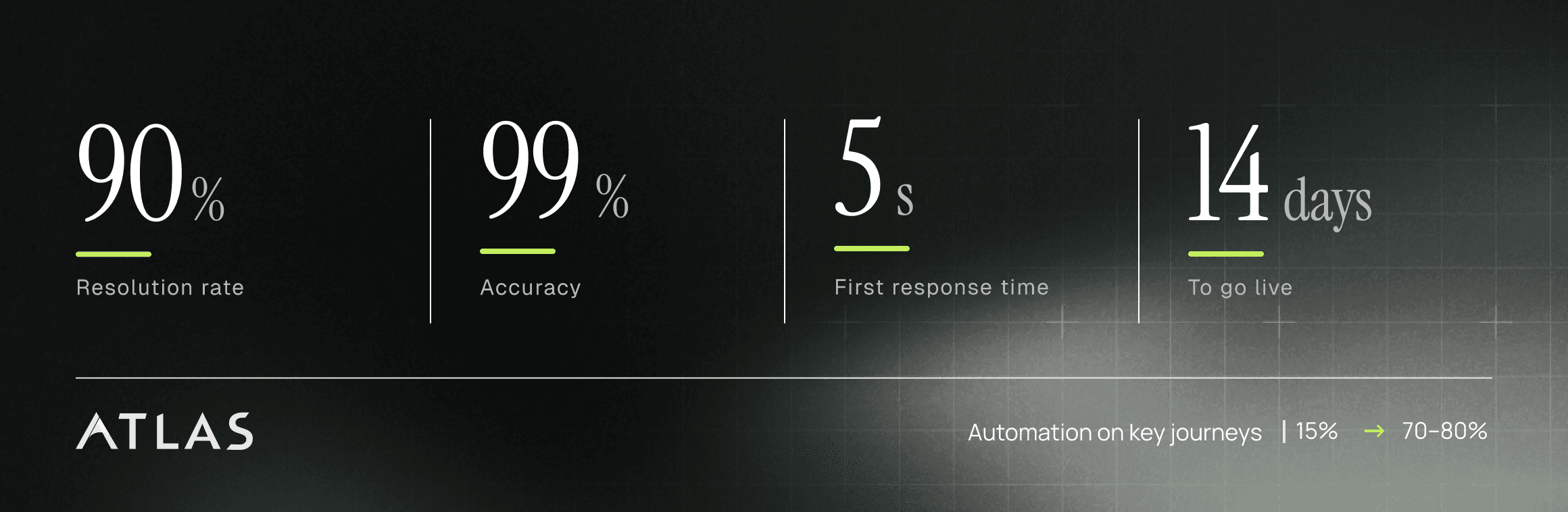
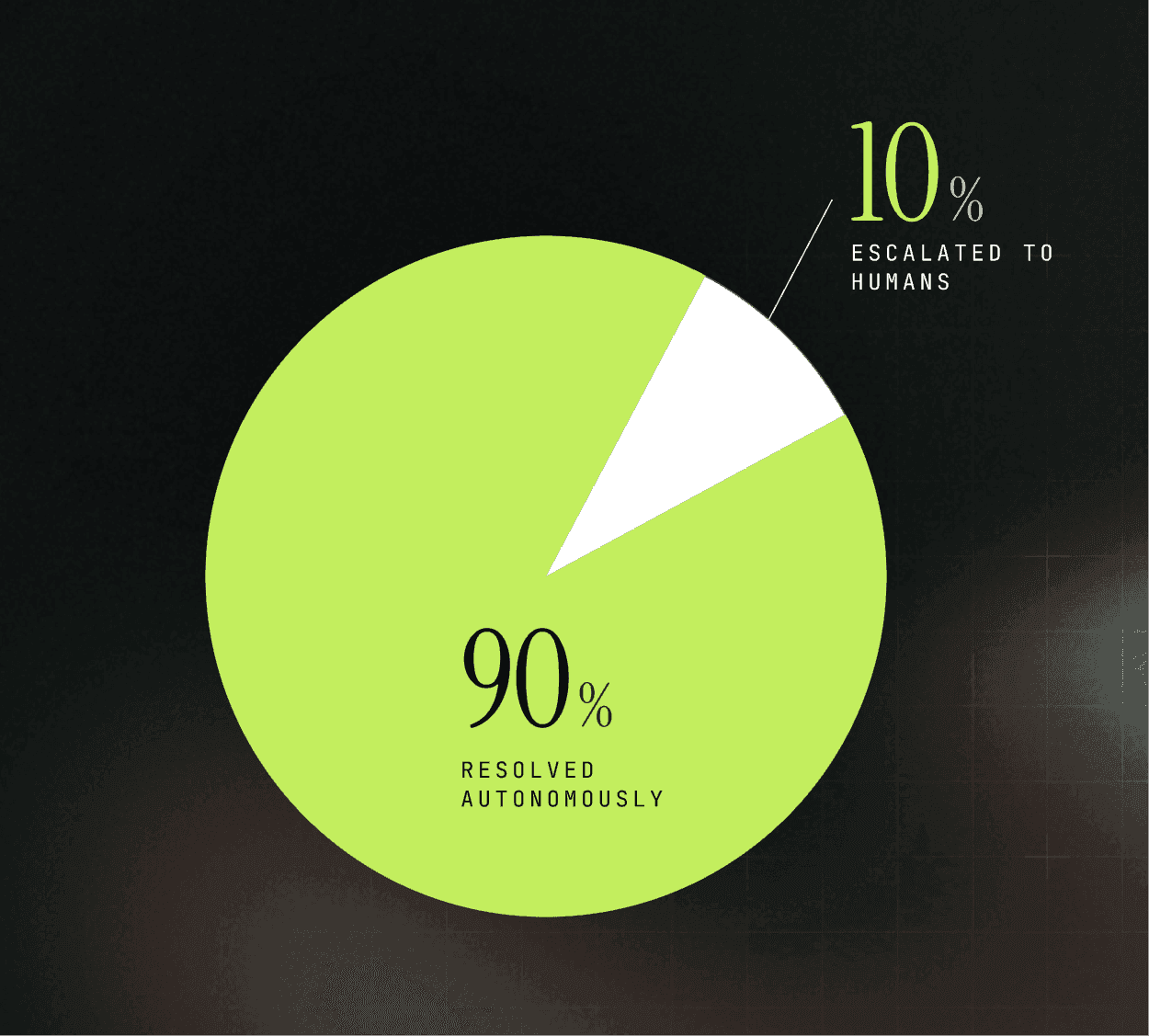
Fini is an AI customer-support agent priced per resolution, backed by Y Combinator and Matrix Partners. It connects natively to your helpdesk, knowledge base, CRM, billing, claims, and EHR systems, reaches a 90% resolution rate at 99% accuracy, and is built to go live in 30 days. Across its customer base, Fini handles 3M+ monthly resolutions in fintech and healthcare. The agent works across voice, chat, and email, answers in 130+ languages, and returns a first response in about five seconds.
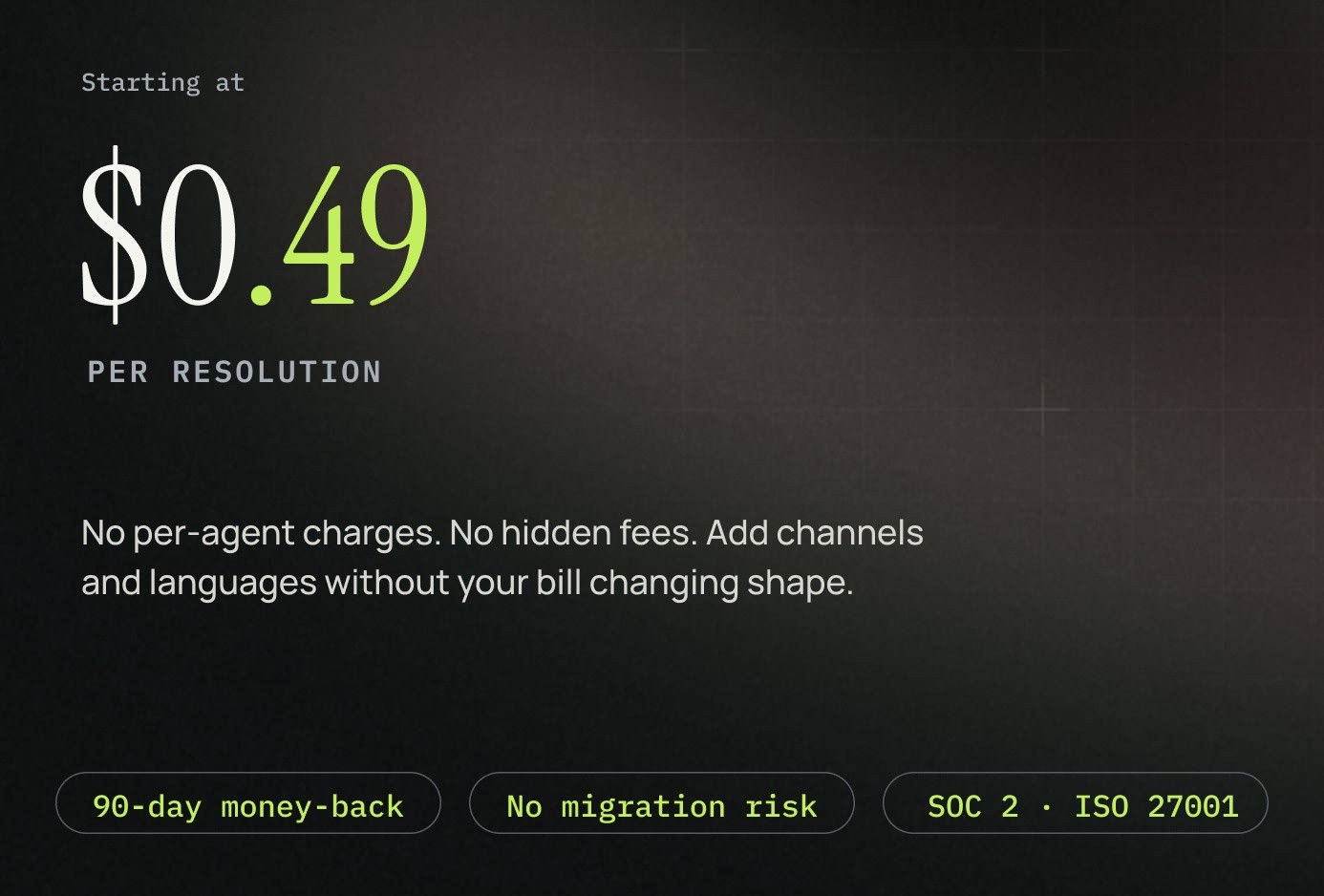
Pricing starts at $0.49 per resolved ticket, with no per-seat fees, so a team can model its own cost from ticket volume alone, before a sales conversation ever starts.
What is Ori?
Ori, built by Oriserve, calls itself an outcome execution platform: AI voice agents paired with human specialists for revenue-critical contact center conversations. Its own tagline is blunt about the split, AI runs the call, a person closes it, you get the outcome. The company was founded around 2016-2017 (sources conflict on the exact year) and says it has grown bootstrapped and profitable for 8 plus years, with no venture funding disclosed, an unusual claim for a company reportedly running 1M+ calls a day across 40+ enterprise clients.
Ori's core model is a hybrid one. AI agents handle 60 to 80% of interactions end to end, voice and chat, across sales, renewals, collections, and support, while human specialists close the remaining 20 to 40% on the same call through a warm handoff with full context, rather than routing to a separate escalation queue. The stack is sold as four integrated layers, an AI-native dialer, the AI voice and chat agents, a human agent console, and a QA and analytics loop, positioned against buyers who would otherwise stitch together a dialer vendor, a bot vendor, and a QA vendor separately. Named customers include Tata AIG (a reported 59.78% improvement in auto-renewal rate) and Muthoot Fincorp (a reported 31.56% improvement in best-bucket recovery); HDB Financial is also a named customer, though with no published outcome metric. Ori's target industries, BFSI, telecom, consumer brands, automotive, and e-commerce, are broader than Fini's fintech-and-healthcare focus. See Oriserve's own site for its full case-study library.
Ori pricing in 2026
Ori does not publish a price list. Its site describes outcome-based pricing, paid on the result rather than by the minute, and offers an ROI calculator so a prospect can model its own numbers instead of reading a rate card. Pilots reportedly run on the same commercial terms as production, so there is no separate discounted trial rate to compare either. That fits an enterprise, custom-quote sales motion, a buyer has to talk to Ori's team before it sees a number.
Fini publishes a single number instead, $0.49 per resolved ticket, with no per-seat fees. A Fini buyer multiplies one number by expected ticket volume before ever booking a call.
What buyers ask | Ori | Fini |
|---|---|---|
Published price list | No, custom quote only | Yes, flat rate |
Pricing model | Outcome-based, paid on the result | $0.49 per resolved ticket |
Trial or pilot pricing | Same commercial terms as production | Same published rate at any volume |
Can you model cost from one number? | No, requires a sales conversation | Yes |
See Fini's full pricing breakdown for plan details, add-ons, and a resolution calculator.
How Fini and Ori differ
Both companies are transparent, but about different things. Ori is upfront about its hybrid model, AI handles 60 to 80% of an interaction and a human specialist closes the rest live, and markets that human close as a feature rather than a fallback. Fini is upfront about its resolution rate instead, 90% resolved autonomously at 99% accuracy, backed by a 90-Day Money-Back Guarantee if that bar is not hit within 90 days. One sells an augmented-human outcome, the other sells an autonomous one with a financial guarantee attached.
The two companies also point at different jobs. Ori is voice-first and outbound-heavy, built for revenue-recovery motions like collections, renewals, and retention win-back across BFSI, telecom, consumer brands, automotive, and e-commerce. Fini is inbound support automation for two regulated verticals, fintech and healthcare, with native connections into claims and EHR systems built specifically for those industries. A team evaluating AI to recover overdue payments and a team evaluating AI to cut inbound support cost are often different buyers entirely, even when both companies get compared on the same AI-agent axis.

Capabilities side by side
Both platforms genuinely execute rather than only answer. Ori's four-layer stack, dialer, AI voice and chat agents, human console, and QA analytics, handles outbound campaign logic, compliance windows and DND rules, in-call payment capture (confirmed for Tata AIG and Muthoot Fincorp), and continuous QA scoring across every call. Fini connects natively across helpdesk, CRM, billing, claims, and EHR systems in one connector set, and adds voice as a native channel alongside chat and email.
Ori claims sub-1.5 second voice-to-voice latency, under 1% hallucination sourced from systems of record, and 10+ Indian languages including Hinglish and regional variants, claims that are self-reported and not independently audited. Fini publishes its outcome metrics directly instead, a 90% resolution rate at 99% accuracy, covered further in the Compliance section below.
Feature by feature
Feature | Fini | Ori |
|---|---|---|
Channels | Voice, chat, email | Voice, chat, dialer-led |
Primary motion | Inbound support resolution | Outbound revenue recovery, collections, renewals, retention |
Resolution model | Fully autonomous, AI resolves 90% of tickets | Hybrid, AI handles 60-80%, human closes 20-40% on the same call |
Core-system integrations (claims, EHR) | ✓, native | Not published; dialer, CRM, and payment-gateway integrations instead |
Self-serve signup | Not self-serve, staged onboarding team instead | Not self-serve, custom sales-led onboarding |
Published outcome guarantee | ✓ (90-Day Money-Back Guarantee) | None published |
Ease of use and admin experience
Fini's published 30-day, staged go-live is run by a dedicated onboarding team against a fixed timeline that applies to every customer. Ori has no equivalent public SLA; its site says pilots run on the same commercial terms as production, which implies a reasonably standardized pilot-to-production path, but no implementation-timeline figure, integrations catalog, or developer documentation page could be located for this comparison.
A verified G2 or Capterra rating could not be independently confirmed for Ori at the time of this research, both listings were inaccessible. Buyers should check G2 directly for current rating data.
Fini's differentiators
A fully autonomous resolution model
90% of tickets resolved by AI alone, at 99% accuracy, no human specialist required to close the loop on the same call.
Deep native integrations for two regulated industries
Native connections into claims and EHR systems, built for fintech and healthcare specifically, not a broad horizontal spread across BFSI, telecom, and automotive.
A fixed, staged 30-day go-live for every customer
Not a best-case study, a published timeline that applies company-wide.
A published outcome guarantee
The 90-Day Money-Back Guarantee ties payment to a 90% resolution rate within 90 days, at a publicly quoted rate. No equivalent guarantee was found on Ori's site.
Ori's recognized strengths
Ori earns real credit on specific, well-sourced points. Growing bootstrapped and profitable for 8 plus years, reportedly with no venture funding at all, is an unusual and citable trust signal for an AI company running 1M+ calls a day across 40+ enterprise clients. Its in-call payment capture is proven with named customers, not just a pitch-deck claim, Tata AIG reports a 59.78% improvement in auto-renewal rate and Muthoot Fincorp reports a 31.56% improvement in best-bucket recovery, both closed live on the call. Ori's language depth, 10+ Indian languages including Hinglish and regional variants, and its RBI FREE-AI compliance framing (human oversight, override capability, disclosure) speak directly to India's BFSI and telecom outbound market, a different depth axis than Fini's core-system integration focus.
What customers say
A verified G2 or Capterra rating could not be independently confirmed for Ori at the time of this research. Its own published case studies report a 59.78% auto-renewal rate improvement for Tata AIG across 8,662 customers, bilingual, with payment captured on the call, and a 31.56% improvement in best-bucket recovery for Muthoot Fincorp across 5 languages, also with in-call payment. HDB Financial is named as a customer in production for recovery and servicing, with no outcome metric published for that account. These are Oriserve's own case-study figures, see Ori's customer page directly; no independent audit was found to cross-check them.
The full side-by-side
Fini | Ori | |
|---|---|---|
Pricing | $0.49 per resolved ticket, starting rate | Outcome-based, custom quote, no published rate card |
Resolution model | Fully autonomous, 90% resolution at 99% accuracy | Hybrid, AI handles 60-80%, human closes 20-40% live |
Outcome guarantee | 90-Day Money-Back Guarantee, 90% in 90 days | None published |
Go-live | 30 days, staged, every customer | No public SLA; pilots run on production terms |
Channels | Voice, chat, email | Voice, chat, dialer-led outbound |
Vertical scope | Fintech and healthcare | BFSI, telecom, consumer brands, automotive, e-commerce |
Compliance | SOC 2 Type II, ISO 27001, GDPR, HIPAA-BAA-eligible, CCPA under agreement | ISO 27001:2022, SOC 2, GDPR, HIPAA-ready (self-reported, no report type or badge confirmed) |
Backing | Y Combinator, Matrix Partners | Bootstrapped, profitable, no disclosed VC funding |
Named customers | 3M+ monthly resolutions across fintech and healthcare | Tata AIG, Muthoot Fincorp, HDB Financial, plus 40+ enterprise clients |
Which should you choose?
Choose Fini if you want fully autonomous resolution backed by a published guarantee, a fixed 30-day go-live, and native integrations into claims and EHR systems for fintech or healthcare support. Choose Ori if your problem is outbound revenue recovery, collections, renewals, or retention, and you want AI to handle most of the call while a human specialist closes the remaining 20-40% live, in Indian languages including Hinglish and regional dialects.
A useful gut check: if you are trying to cut inbound support cost in a regulated industry and want one number to budget against before any usage begins, Fini's flat rate and autonomous resolution model are built for exactly that situation. If you are trying to recover overdue payments or drive renewals across an Indian BFSI or telecom book and are comfortable with a human closing part of every call, Ori is a different category entirely, not a head-to-head swap. See how Fini also compares against Floatbot and Zingly, two other AI-agent platforms in this category.
Compliance
Fini publishes SOC 2 Type II, ISO 27001:2022, GDPR compliance, HIPAA-compliant BAA-eligible contracting, and CCPA availability under agreement, all listed together in one place. Ori's homepage claims ISO 27001:2022, SOC 2, GDPR, and HIPAA-ready, plus AWS KMS encryption, MFA, VPC-isolated infrastructure, and India-resident data storage, with RBI FREE-AI compliance language around human oversight, override capability, and disclosure. A dedicated security or trust page returned a 404 during this research, and no SOC 2 report type, certificate, or independent trust-center listing was found to corroborate these claims.
That sourcing gap is worth raising directly with Ori's sales team before signing, since self-reported claims on a marketing page are weaker evidence than a vendor's own published trust center. Worth noting too, Ori's site says HIPAA-compliant rather than HIPAA-compliant, a softer claim than Fini's BAA-eligible HIPAA positioning, relevant if healthcare compliance is part of your evaluation.
Ready to compare on your own data?
The fastest way to know which platform actually fits your call volume and compliance requirements is to run the numbers against your own data rather than a vendor's published averages. See Fini's plans or talk to the team about a side-by-side pilot.
Is Ori's pricing public?
No. Ori does not publish a rate card, its site describes outcome-based pricing, paid on the result, with an ROI calculator instead of list prices, and pilots reportedly run on the same commercial terms as production. Fini publishes a single flat rate instead, $0.49 per resolved ticket.
Who founded Ori and when?
Ori was founded by Anurag Jain (CEO) and Maaz Ansari (CRO), with the company's own site pointing to 2016 and LinkedIn listing 2017. Treat the founding year as 2016-2017 rather than a single confirmed date.
Is Ori venture funded?
Ori says it is bootstrapped and profitable, grown entirely on revenue with no VC investment, over 8 plus years in production. This claim is single-sourced to Oriserve's own site and could not be cross-verified via Crunchbase or Tracxn. Fini is backed by Y Combinator and Matrix Partners.
What's the difference between Ori's hybrid model and Fini's autonomous model?
Ori's AI handles 60 to 80% of an interaction end to end, then a human specialist closes the remaining 20 to 40% on the same call through a warm handoff. Fini's AI resolves 90% of tickets on its own, with no human required to close, backed by a 90-Day Money-Back Guarantee if that rate is not hit within 90 days.
Who are Ori's named customers?
Tata AIG (a reported 59.78% auto-renewal rate improvement) and Muthoot Fincorp (a reported 31.56% best-bucket recovery improvement) are named with published metrics. HDB Financial is also a named customer, in production for recovery and servicing, but with no outcome metric published.
How fast can each platform go live?
Fini publishes a 30-day, staged go-live for every customer. Ori has no public implementation SLA; its site says pilots run on the same commercial terms as production, but no timeline figure was found.
Is Ori SOC 2 and HIPAA compliant?
Ori's homepage claims ISO 27001:2022, SOC 2, GDPR, and HIPAA-ready, but a dedicated security page returned a 404 and no SOC 2 report type or certificate was found to confirm these self-reported claims. Fini publishes SOC 2 Type II, ISO 27001:2022, GDPR, and HIPAA-BAA-eligible contracting together on its own site.
Does Fini offer any guarantee Ori doesn't?
Fini's 90-Day Money-Back Guarantee ties payment to results, a 90% resolution rate within 90 days, at a publicly quoted rate. No equivalent outcome guarantee was found published on Ori's site.
What industries does Ori serve compared to Fini?
Ori targets BFSI, telecom, consumer brands, automotive, and e-commerce with outbound motions like collections, renewals, and retention. Fini focuses specifically on fintech and healthcare inbound support, with native claims and EHR integrations.
Does Ori have independent reviews on G2 or Capterra?
A verified G2 or Capterra rating could not be independently confirmed for Ori at the time of this research. Both listings were inaccessible during this research pass.