A pricing brand vs. a published rate
A bank comparing AI vendors for its call center usually runs into the same wall twice: nobody wants to say the price out loud. Glia, a unicorn-valued customer interaction platform built for banks, credit unions, and insurers, markets its way around that wall with a branded pricing philosophy. Fini answers it by just publishing the number.
In this comparison: What each is · How they differ · Capabilities · Feature by feature · Ease of use · What customers say · The full side-by-side · Which to choose · Compliance · FAQ
What is Fini?
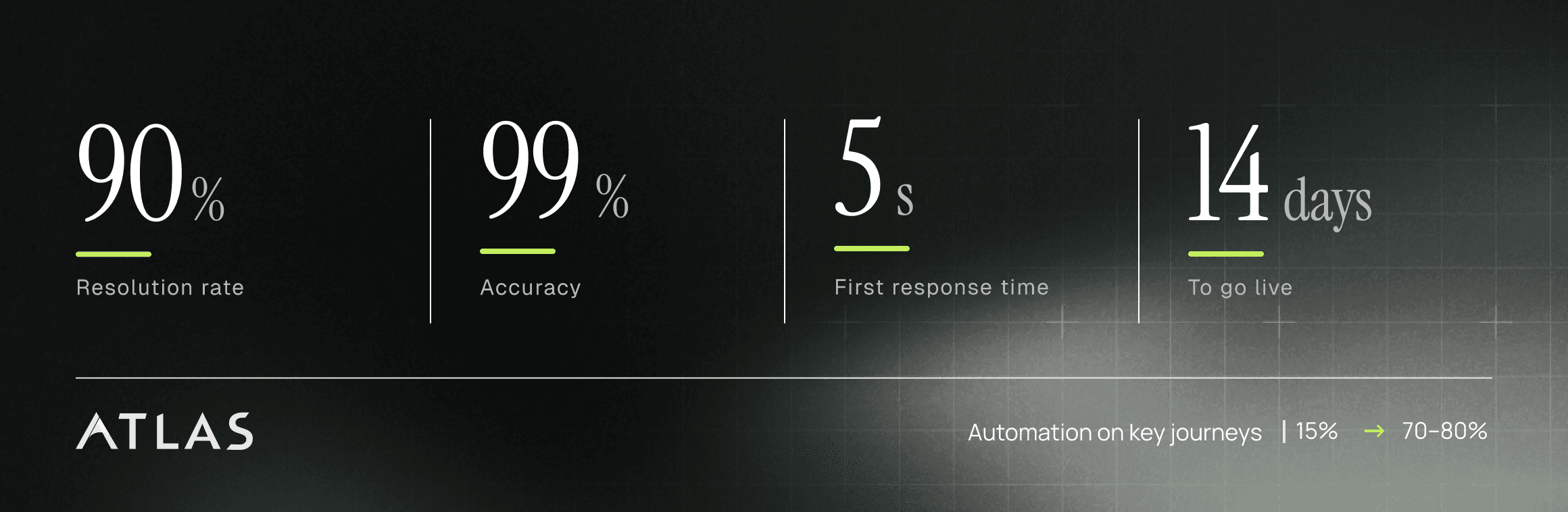
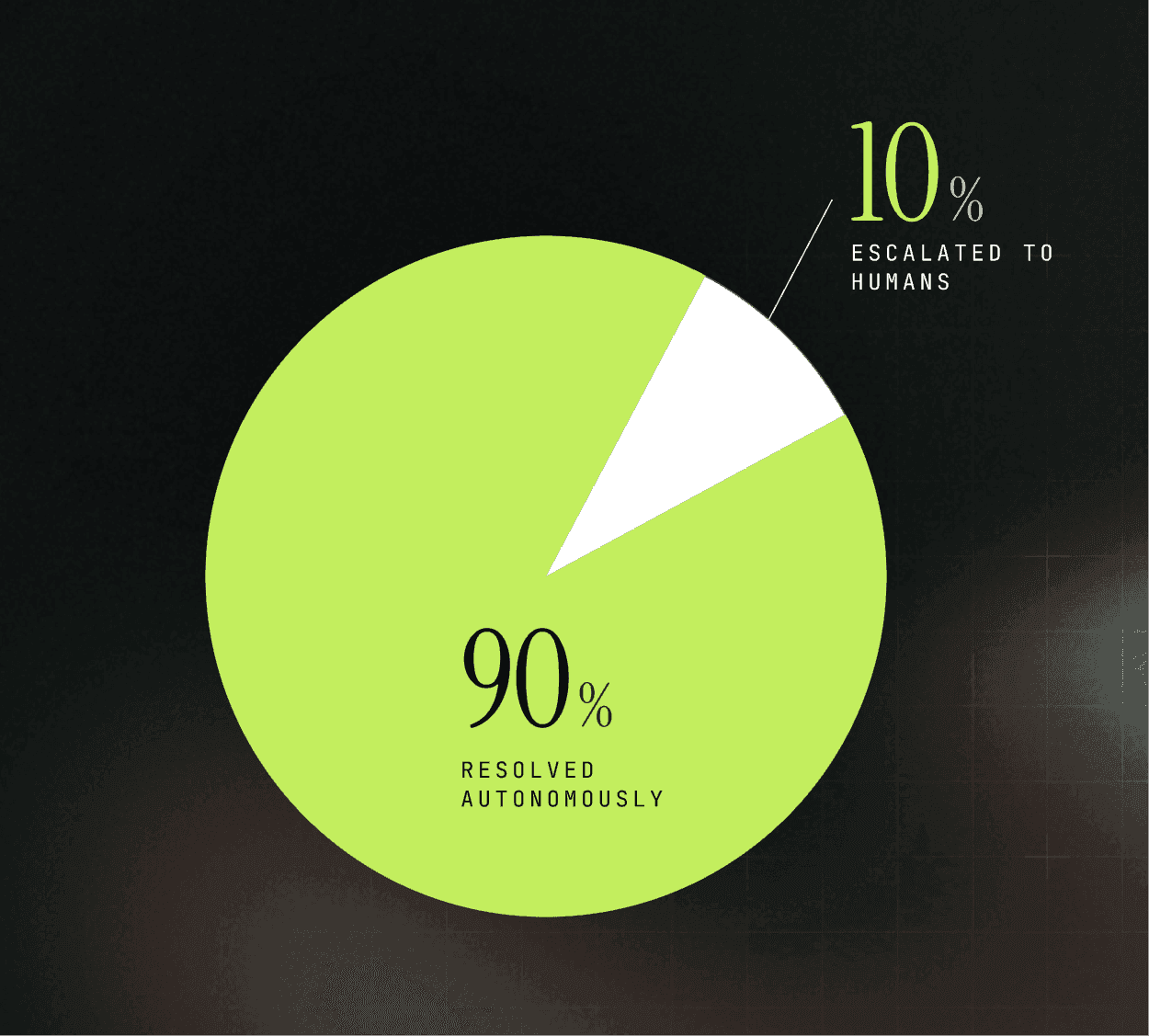
Fini is an AI customer-support agent priced per resolution, backed by Y Combinator and Matrix Partners. It connects natively to your helpdesk, knowledge base, CRM, billing, claims, and EHR systems, reaches a 90% resolution rate at 99% accuracy, and is built to go live in 30 days. Across its customer base, Fini handles 3M+ monthly resolutions in fintech and healthcare. The agent works across voice, chat, and email, answers in 130+ languages, and returns a first response in about five seconds.
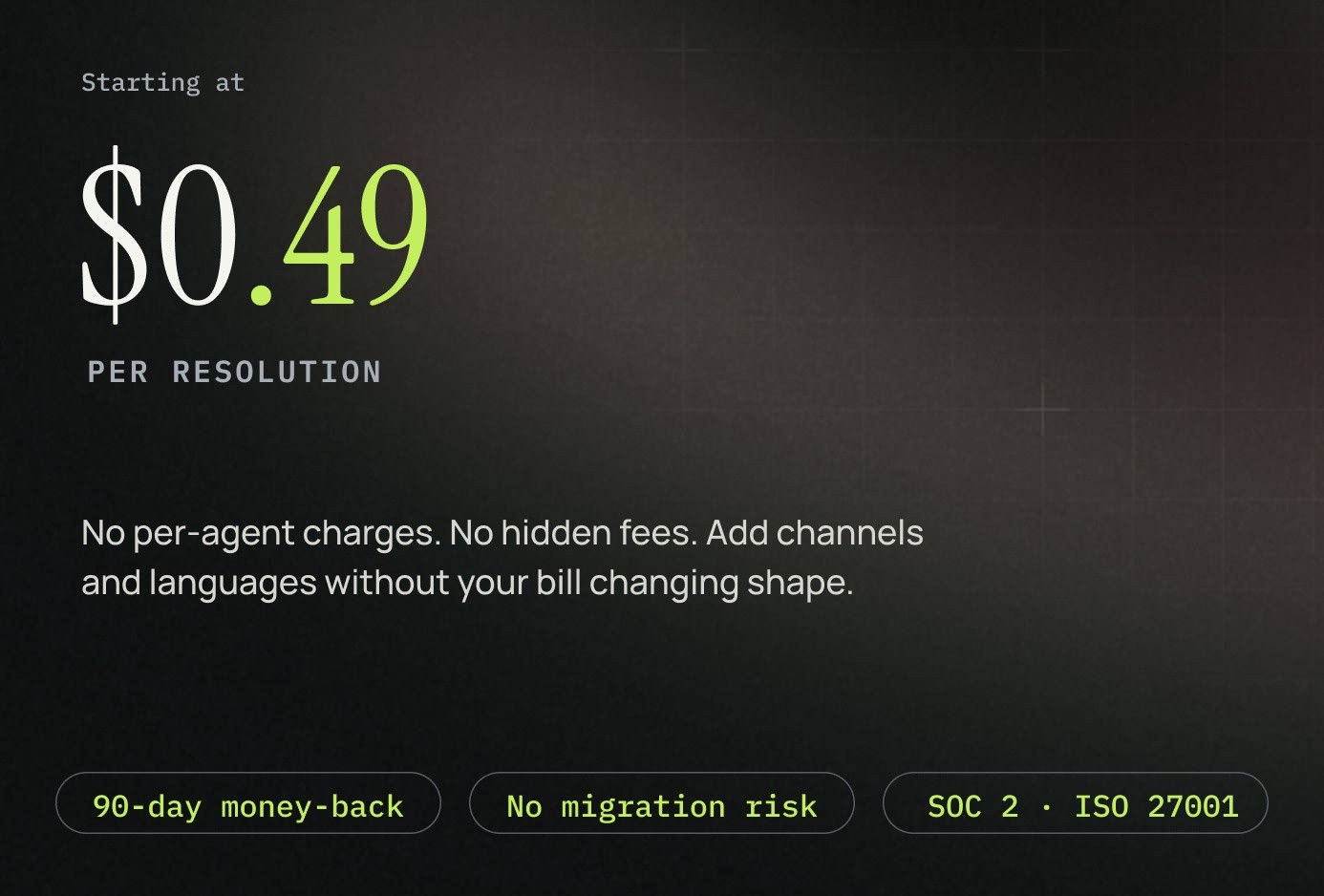
Pricing starts at $0.49 per resolved ticket, with no per-seat fees, so a team can model its own cost from ticket volume alone, before a sales conversation ever starts.
What is Glia?
Glia is a New York-based customer interaction platform founded in 2012 by Dan Michaeli, Carlos Paniagua, and Justin DiPietro, originally launched under the name SaleMove before rebranding. The company has raised over $150 million, including a $78 million Series C in January 2021 and a $45 million Series D in March 2022, both led by Insight Partners, with RingCentral joining as a strategic investor in the later round at a valuation of more than $1 billion. It is not Y Combinator or Matrix Partners backed.
Glia's platform is built around what it calls a "ChannelLess architecture," keeping one continuous interaction record across voice, chat, video, and messaging as a conversation moves between AI and human agents. Its product suite includes named modules like Glia Banker, Glia CoPilot, Glia Voice, and Glia Agentic Workflows, aimed specifically at banks, credit unions, and insurance companies. Glia's own site describes the platform as "field-proven" across more than 600 customers and partners, including Busey Bank, Bank of Guam, and Texas Tech Federal Credit Union.
Glia pricing in 2026
Glia markets its pricing under the brand "Priceless Pricing," positioned explicitly against competitors that charge per minute, per seat, or per token, with on-page messaging that reads "$0 per minute, $0 per seat, $0 per token." The actual model is a flat-rate subscription based on organizational needs, with unlimited seats and usage, but Glia does not publish specific tier names, dollar amounts, or thresholds anywhere. A quote still requires contacting sales.
Fini publishes its rate directly: $0.49 per resolved ticket, starting rate, with no per-seat fees and no separate platform charge. Glia's pricing philosophy and Fini's are aimed at a similar complaint, unpredictable usage-based billing, but only one of the two lets a buyer see the actual number before a sales call.
What buyers ask | Glia | Fini |
|---|---|---|
Published price list | ✗ | ✓ |
Price | Flat-rate, unlimited seats, amount not published | $0.49 per resolved ticket |
Free trial or self-serve | None, demo request only | Not self-serve, staged onboarding team instead |
Vertical served | Banks, credit unions, insurance | Fintech and healthcare |
Can you model cost before a sales call? | No | Yes |
See Fini's full pricing breakdown for plan details, add-ons, and a resolution calculator.
How Fini and Glia differ
Glia's "Priceless Pricing" is a real, defensible positioning against usage-based billing, no per-minute, per-seat, or per-token charges, but it still requires a sales call to learn the actual flat-rate figure. Fini's $0.49 per resolved ticket is a single number, visible before anyone talks to sales. Glia is also built for banks, credit unions, and insurance companies specifically, while Fini splits its focus across fintech and healthcare, with native connections into claims and EHR systems that a banking-and-insurance-only platform has no reason to build.
The two companies differ on scale and on what kind of guarantee they offer. Glia has raised more than $150 million, crossed a $1 billion valuation in 2022, and reports processing over 10 billion customer interactions historically, a scale advantage from more than a decade in the market, and markets what it calls an industry-first contractual guarantee against hallucinations and prompt injections, a quality-of-output guarantee. Fini is a newer entrant that competes on pricing transparency and the 90-Day Money-Back Guarantee, an outcome guarantee tied to resolution rate, a 90% resolution rate within 90 days, at a publicly quoted rate.

Capabilities side by side
Both platforms genuinely execute transactions rather than only answering questions. Glia's Glia Banker module is said to automate up to 80% of banking inquiries across more than 1,000 mapped banking journeys, and its Glia Agentic Workflows module targets complex, multi-step banking tasks specifically. Fini connects natively across helpdesk, CRM, billing, claims, and EHR systems in one connector set, and adds voice as a native channel alongside chat and email.
Glia's ChannelLess architecture is built to preserve one continuous interaction record as a conversation moves between channels and between AI and human agents, a genuinely distinctive design choice for contact centers running mixed AI-human workflows. Fini publishes its compliance posture as a fixed certification list rather than a named architecture pattern, covered in the Compliance section below.
Feature by feature
Feature | Fini | Glia |
|---|---|---|
Channels | Voice, chat, email | Voice, chat, video, messaging |
Languages | 130+, published | Not published |
Healthcare workflows (claims, EHR) | ✓, native | ✗, banking and insurance focus only |
Real-time human-agent coaching module | Not a published product line | ✓ (Glia CoPilot, Glia Analyst) |
Published outcome guarantee | ✓ (90-Day Money-Back Guarantee) | Hallucination guarantee referenced, full terms not public |
Published pricing | ✓ | ✗ |
Ease of use and admin experience
Glia does not publish a specific implementation or go-live timeline anywhere on its site. Fini's published 30-day, staged go-live is run by a dedicated onboarding team against a fixed timeline rather than an open-ended integration project.
Glia's homepage references "50+ reviews" without naming which platform that figure aggregates, and a verified, current G2 or Capterra star rating could not be independently confirmed for this comparison. Buyers should check G2 and Capterra directly for current, platform-specific rating data rather than relying on an unattributed homepage figure.
Fini's differentiators
Published, forecastable pricing
$0.49 per resolved ticket, visible before any sales call, versus Glia's flat-rate figure that only appears after a sales conversation.
Fintech and healthcare, not banking and insurance alone
Native connections into claims and EHR systems cover a second regulated vertical Glia does not serve.
A published outcome guarantee
The 90-Day Money-Back Guarantee ties payment to a 90% resolution rate within 90 days, a resolution-rate guarantee rather than a hallucination guarantee.
A fixed, staged 30-day go-live
A specific, published timeline where Glia publishes none.
Glia's recognized strengths
Glia earns real credit on specific, well-sourced points. It has raised more than $150 million from Insight Partners across two rounds and crossed a $1 billion valuation in March 2022, a scale of funding and validation few competitors in this category can match. Its ChannelLess architecture addresses a genuine, well-known pain point, disjointed customer records across channels, with a specific technical answer rather than a marketing label alone. And its named customer list spans a real mix of banks, credit unions, and one $7 billion bank M&A integration handled at Busey Bank, suggesting the platform can operate at meaningful institutional scale.
What customers say
A verified, current G2 or Capterra rating could not be independently confirmed for Glia at the time of this research, both platforms' review pages were inaccessible during this research pass, so independent, crowd-sourced feedback should be checked directly on G2 or Capterra before relying on it. Glia's own published case studies report figures including a 40% faster service and 62% lower abandonment rate at Heartland Credit Union, 81 agent-hours saved per month at Texas Tech Federal Credit Union, and a 151% loan-growth target achievement at Heritage Federal Credit Union. These are Glia's own reported numbers rather than third-party-audited ones, and should be read as company claims.
The full side-by-side
Fini | Glia | |
|---|---|---|
Pricing | $0.49 per resolved ticket, starting rate | Flat-rate "Priceless Pricing," amount not published |
Outcome guarantee | 90-Day Money-Back Guarantee, 90% in 90 days | Hallucination guarantee referenced, full terms not public |
Go-live | 30 days, staged | Not published |
Channels | Voice, chat, email | Voice, chat, video, messaging |
Vertical scope | Fintech and healthcare | Banks, credit unions, insurance |
Compliance | SOC 2 Type II, ISO 27001, GDPR, HIPAA-BAA-eligible, CCPA under agreement | SOC 2 Type 2, PCI DSS, HIPAA/HITECH Type 1, CCPA; ISO 27001 only via AWS infrastructure inheritance, not a first-party Glia certification |
Backing | Y Combinator, Matrix Partners | Insight Partners, RingCentral; $1B+ valuation (2022) |
Named customers | 3M+ monthly resolutions across fintech and healthcare | 600+ customers and partners including Busey Bank, Bank of Guam |
Which should you choose?
Choose Fini if you want a published, flat per-resolution rate you can model before a sales call, a fixed 30-day go-live, and coverage across both fintech and healthcare workflows including claims and EHR systems. Choose Glia if you are a bank, credit union, or insurer that wants a mature, well-funded platform with a unified ChannelLess architecture and real-time human-agent coaching tools built in.
A useful gut check: if your team needs healthcare workflows alongside fintech ones, or wants to see the exact per-resolution rate before a scoped sales conversation, Fini's published pricing and 30-day go-live are built for exactly that situation. If you run a large, multi-channel contact center in banking or insurance and value a platform with over a decade of market maturity, Glia's architecture and scale are the more relevant comparison. See how Fini also compares against Decagon and Sierra, two other well-funded platforms in this category.
Compliance
Fini publishes SOC 2 Type II, ISO 27001:2022, GDPR compliance, HIPAA-compliant BAA-eligible contracting, and CCPA availability under agreement, all listed together in one place. Glia's own security page confirms SOC 2 Type 2, PCI DSS, HIPAA/HITECH Type 1, and CCPA compliance directly, but its stated ISO 27001 reference is specifically to AWS's certification of the underlying infrastructure Glia runs on, not a first-party ISO 27001 certificate issued to Glia itself. No explicit GDPR compliance statement was found as a discrete line item on that page.
That distinction matters for a buyer weighing certifications carefully: infrastructure-inherited ISO 27001 coverage is real but narrower than a vendor's own end-to-end ISO 27001 certification. A team that also touches healthcare data outside what HIPAA/HITECH Type 1 covers should confirm the specific scope directly with Glia before assuming full coverage.
Ready to compare on your own data?
The fastest way to know which platform actually fits your ticket volume and compliance requirements is to run the numbers against your own data rather than a vendor's published averages. See Fini's plans or talk to the team about a side-by-side pilot. If you're also weighing another banking-focused platform, our Gradient Labs vs Fini comparison covers a similarly outcomes-oriented alternative, and our explainer on KYC automation covers how onboarding-checks workflows work across this category.
Is Glia's pricing public?
Not as a specific number. Glia markets a flat-rate model called "Priceless Pricing," with no per-minute, per-seat, or per-token charges, but the actual dollar figure is not published and requires a sales conversation. Fini publishes its rate directly: $0.49 per resolved ticket, starting rate.
Who founded Glia and when?
Glia was founded in 2012 in New York City by Dan Michaeli, Carlos Paniagua, and Justin DiPietro. The company originally operated under the name SaleMove before rebranding to Glia.
How much has Glia raised?
Glia has raised more than $150 million, including a $78 million Series C in January 2021 and a $45 million Series D in March 2022, both led by Insight Partners, with RingCentral joining as a strategic investor. The March 2022 round valued Glia at more than $1 billion. It is not Y Combinator or Matrix Partners backed.
Does Glia serve healthcare companies?
No. Glia is built for banks, credit unions, and insurance companies. Fini serves both fintech and healthcare, with native connections into claims and EHR systems.
How fast can each platform go live?
Fini publishes a 30-day, staged go-live. No specific implementation timeline is published anywhere on Glia's site.
What is Glia's "ChannelLess architecture"?
It's Glia's term for keeping one continuous interaction and data record across voice, chat, video, and messaging as a conversation moves between channels and between AI and human agents, rather than treating each channel as a separate silo, per Glia's own product pages.
Is Glia SOC 2 and ISO 27001 compliant?
Glia's own security page confirms SOC 2 Type 2, PCI DSS, and HIPAA/HITECH Type 1 compliance directly. Its ISO 27001 reference applies to AWS's certification of the infrastructure Glia runs on, not a first-party Glia certificate. Fini publishes SOC 2 Type II, ISO 27001:2022, GDPR, HIPAA-BAA-eligible contracting, and CCPA together, all as first-party certifications.
Does Fini offer any guarantee Glia doesn't?
Fini's 90-Day Money-Back Guarantee ties payment to results, a 90% resolution rate within 90 days, at a publicly quoted rate. Glia markets a contractual guarantee against hallucinations and prompt injections instead, a quality guarantee rather than a resolution-rate guarantee.
Who are Glia's named customers?
Busey Bank, Bank of Guam, Texas Tech Federal Credit Union, Heartland Credit Union, and Heritage Federal Credit Union are among the customers named in Glia's own case studies, out of more than 600 customers and partners it says it serves.
Does Glia have independent reviews on G2 or Capterra?
Glia's homepage references "50+ reviews" without naming the source platform, and a current, verified G2 or Capterra star rating could not be independently confirmed for this comparison. Check both platforms directly for up-to-date rating data.