
Built to resolve alone vs. built to hand off
Most vendors in this category eventually get asked the same question by a support leader: what happens when the AI cannot finish the ticket. Fini and Cresta answer that question from opposite starting points. Fini is built to resolve a ticket end to end by default, with escalation as the exception. Cresta is built the other way, with human hand-off treated as an explicit part of the architecture rather than a fallback.
Neither approach is wrong on its own. The difference matters because it changes what a resolution rate actually means, what an admin has to staff for, and how a contract gets priced. This comparison walks through both, fact by fact.
In this comparison: What each is · How they differ · Capabilities · Feature by feature · Ease of use · What customers say · The full side-by-side · Which to choose · Compliance · FAQ
What is Fini?
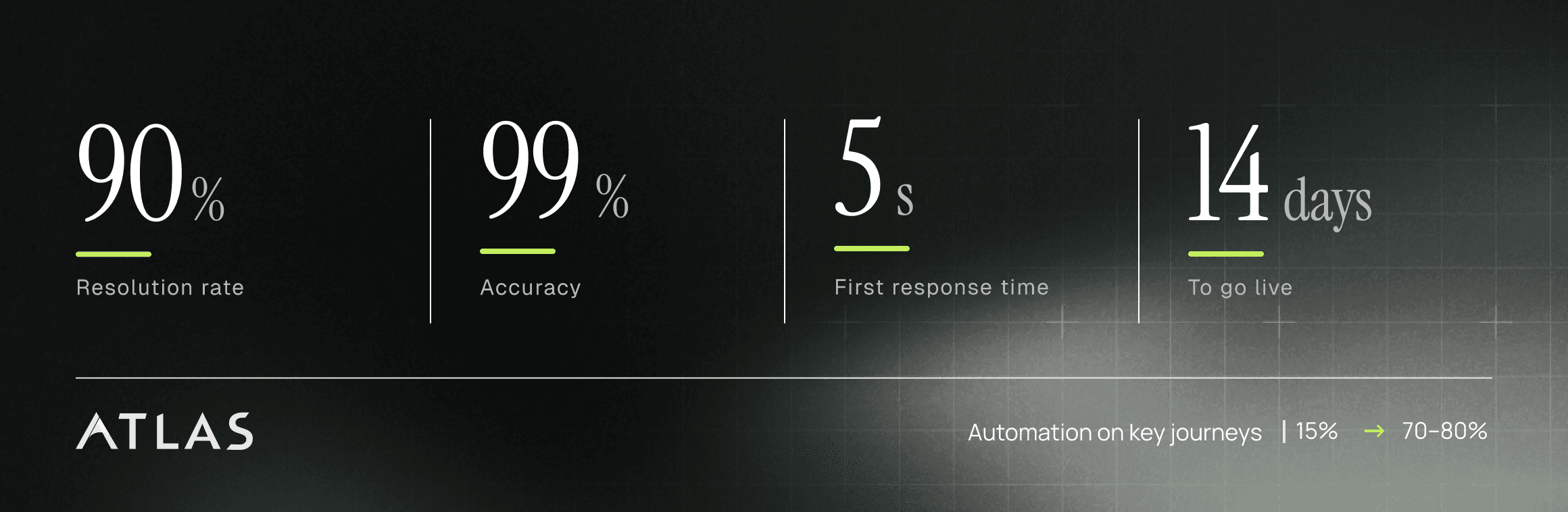
Fini is an AI customer-support agent priced per resolution, backed by Y Combinator and Matrix Partners. It connects natively to your helpdesk, knowledge base, CRM, billing, claims, and EHR systems, reaches a 90% resolution rate at 99% accuracy, and is built to go live in 30 days. Across its customer base, Fini handles 3M+ monthly resolutions in fintech and healthcare. The agent works across voice, chat, and email, answers in 130+ languages, and returns a first response in about five seconds.
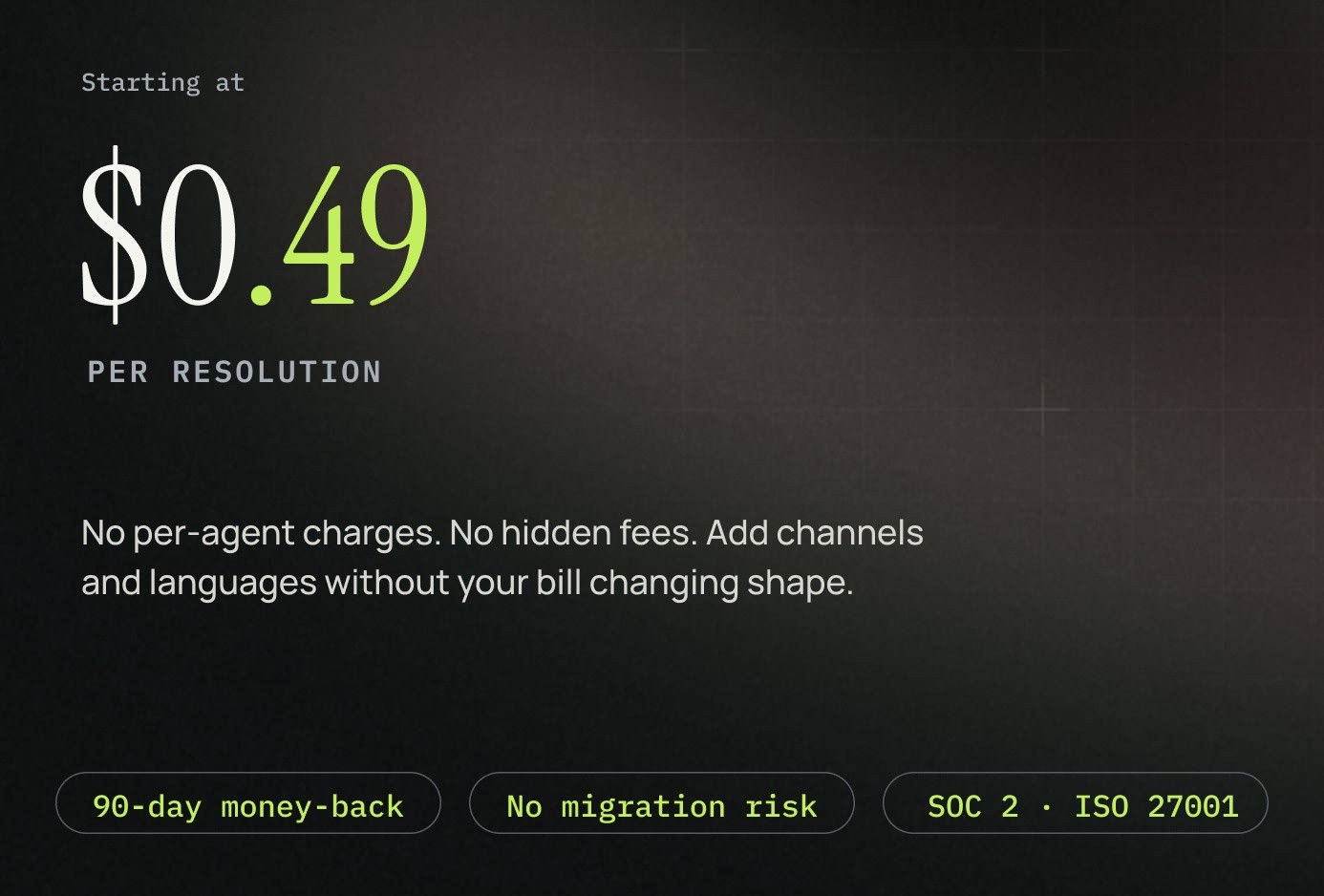
Pricing starts at $0.49 per resolved ticket, with no per-seat fees, so a team can model its own cost from ticket volume alone, before a sales conversation ever starts.
What is Cresta?
Cresta is a Sunnyvale, California based contact-center AI company founded in 2017 by Sebastian Thrun (Stanford AI Lab), Tim Shi (an early OpenAI researcher), and Zayd Enam. It has raised more than $270 million from Sequoia Capital, Andreessen Horowitz, Greylock Partners, and Tiger Global, alongside strategic investors Accenture, Comcast Ventures, Genesys, and J.P. Morgan. The company reports 600+ employees, 10+ global hubs across APAC and EMEA, and a customer base of Fortune 500 enterprises. See Cresta's site for its current customer list and product pages.
Cresta organizes its product around three pillars: Automate (the AI Agent), Augment (Agent Assist, a copilot for human agents), and Analyze (Conversation Intelligence). It positions itself as, in its own words, "the only unified platform for human and AI agents." Its clearest fintech-lending proof point is Oportun, which Cresta's own customer page credits with moving "from sample-based QA to 100% interaction monitoring." CVS appears in Cresta's homepage logo bar alongside Marriott, Intuit, and Hilton, but there is no dedicated CVS case study or metric published, so treat that relationship as a logo, not a proof point yet. If conversation intelligence and QA scoring are on your list too, see how Convin compares with Fini.
Cresta pricing in 2026
Cresta does not publish pricing. cresta.com/pricing returns a 404, and no public price list, tier, or per-seat rate could be found anywhere for the platform. Every deal runs through a demo and a custom enterprise quote, the standard motion for contact-center software sold to Fortune 500 buyers.
Fini publishes a single number instead: $0.49 per resolved ticket, starting rate, with no per-seat fees and no custom quote required to see it. A Cresta buyer has to get on a call before they see a number. A Fini buyer can model a monthly bill from ticket volume alone.
What buyers ask | Cresta | Fini |
|---|---|---|
Published price list | ✗, custom quote only | ✓, flat rate |
Price | Not published, enterprise sales only | $0.49 per resolved ticket |
Rate for additional usage | Negotiated per contract | N/A, flat rate |
Large enterprise contracts | Standard motion, every deal is custom | Same published rate at any volume |
Can you model cost from one number? | No, requires a sales call | Yes |
See Fini's full pricing breakdown for plan details, add-ons, and a resolution calculator.
How Fini and Cresta differ
The clearest difference is architectural, not cosmetic. Fini is built to resolve autonomously by default, reaching a 90% resolution rate without a human in the loop for most tickets. Cresta's own AI Agent product page markets "seamless human agent hand-off when AI reaches escalation thresholds" as a core feature, and its published containment numbers reflect that design: a 74% containment rate for Xanterra, and a 5.5x containment lift for Snap Finance, both real results, but neither an autonomous-first outcome. Cresta also ships an Agent Operations Center built specifically so a human can "take over instantly in critical moments," a live human-oversight layer baked into the architecture rather than an edge-case fallback.
The second difference is scope. Fini has held a consistent fintech-and-healthcare focus, with native connections into claims and EHR systems built for those two regulated industries specifically. Cresta sells across a much wider band of enterprise CX, from financial-services lenders like Oportun, Aqua Finance, and Snap Finance to hospitality and retail names like Marriott and Hilton appearing in its logo bar, alongside Agent Assist as a co-equal product line for teams that want a copilot for human agents rather than an autonomous one.

Capabilities side by side
Both platforms genuinely execute inside a live conversation rather than only answering FAQs. Cresta's AI Agent automates full conversations end to end where it is confident, hands off to a human at a defined escalation threshold, and its Agent Assist product coaches human agents in real time during the calls it does not automate. Conversation Intelligence, its third pillar, mines the full set of interactions for QA and coaching, exactly the workflow Oportun runs today. Fini connects natively across helpdesk, CRM, billing, claims, and EHR systems in one connector set, and adds voice as a native channel alongside chat and email.
Cresta reports a 74% containment rate on one published case (Xanterra) and a 5.5x containment lift on another (Snap Finance), both real but neither close to full autonomy. Fini publishes its outcome metrics directly instead: a 90% resolution rate at 99% accuracy, covered further in the Compliance section below.
Feature by feature
Feature | Fini | Cresta |
|---|---|---|
Channels | Voice, chat, email | Voice (contact center), chat, digital messaging |
Resolution model | Autonomous-first, escalation is the exception | Hybrid by design, human hand-off built into escalation thresholds |
Fintech workflows (billing, claims) | ✓, native | Financial-services customer base, no named claims or EHR integration |
Human-agent copilot product | Not the product's focus | ✓, Agent Assist, a co-equal pillar |
Self-serve signup | Not self-serve, staged onboarding team instead | Not self-serve, demo and custom quote only |
Published outcome guarantee | ✓ (90-Day Money-Back Guarantee) | None published |
Ease of use and admin experience
Cresta's Agent Operations Center is built for admins who want a live view into what the AI is doing and the ability to intervene mid-conversation, a meaningfully different admin experience from a platform built to run unattended. Onboarding is not published as a fixed timeline; every Cresta deployment goes through its enterprise sales and implementation process rather than a company-wide SLA. A verified G2 or Capterra rating could not be independently confirmed for Cresta at the time of this research; direct checks returned a 403 on G2 and a 404 on Capterra, and no star rating surfaced in search. Buyers should check G2 directly for current data.
Fini's published 30-day, staged go-live is run by a dedicated onboarding team against a fixed timeline that applies to every customer, not a case-by-case implementation schedule.
Fini's differentiators
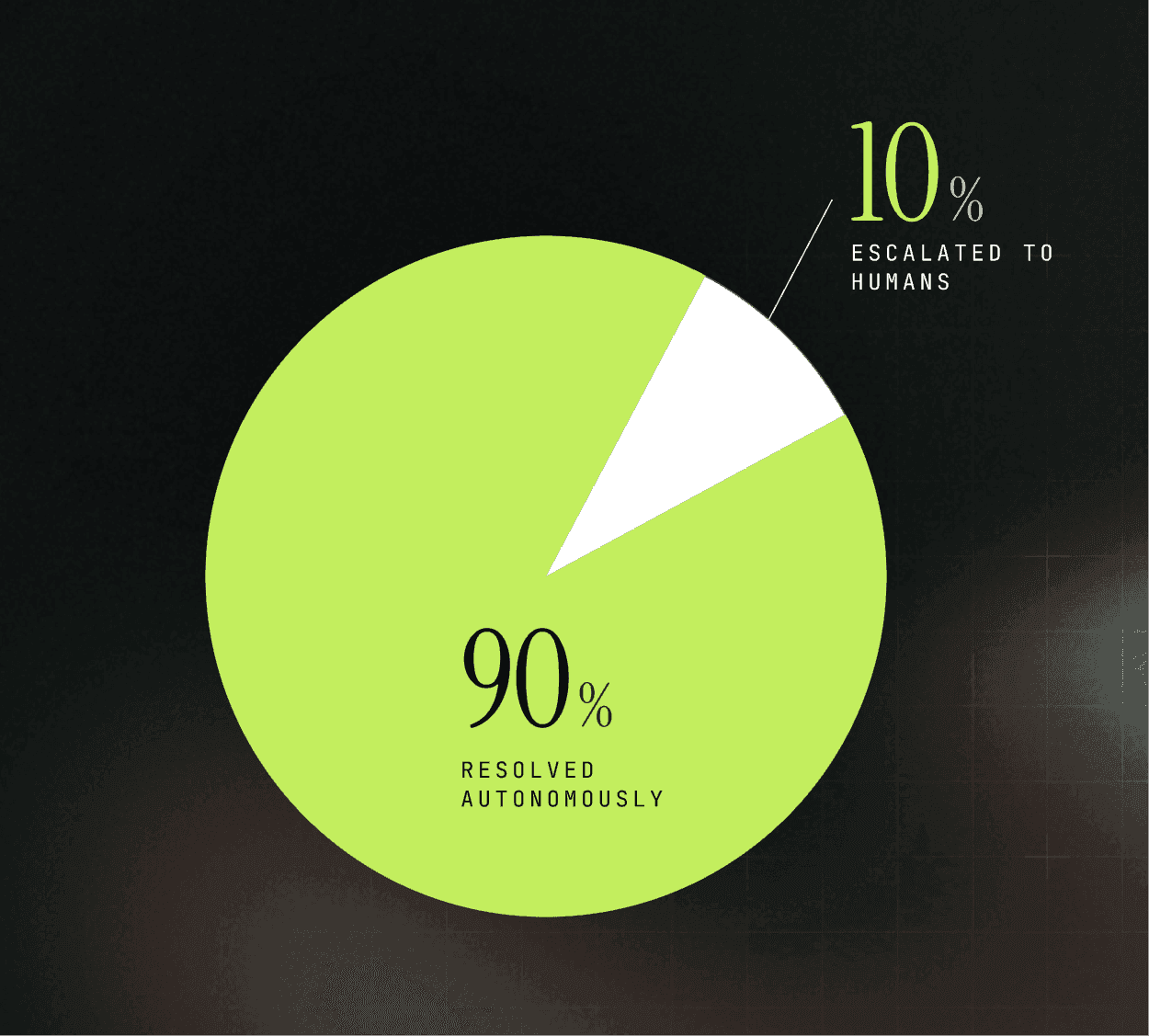
Autonomous by default, not hybrid by design
A 90% resolution rate with escalation as the exception, not a 74% containment rate built around a human hand-off threshold.
One flat number instead of a custom quote
$0.49 per resolved ticket, published, versus a demo and a negotiated enterprise contract with no visible starting price.
Fintech and healthcare, not a broad enterprise CX spread
Native connections into claims and EHR systems built for two regulated industries specifically.
A published outcome guarantee
The 90-Day Money-Back Guarantee ties payment to a 90% resolution rate within 90 days, at a publicly quoted rate.
Cresta's recognized strengths
Cresta earns real credit on specific, well-sourced points. Its compliance stack, covered in full below, is comprehensive and directly relevant to regulated industries, arguably the single strongest point in favor of taking Cresta seriously as a comparison target. Its founding team includes Sebastian Thrun of Stanford's AI Lab and Tim Shi, an early OpenAI researcher, a credible technical pedigree by any measure. It has raised more than $270 million from Sequoia Capital and Andreessen Horowitz, among others, and counts Fortune 500 enterprises as customers, evidence of real scale rather than an early-stage bet. And Oportun, a genuine fintech-lending case study, backs up the claim that its automation actually works: a documented move from sample-based QA to 100% interaction monitoring.
What customers say
A verified G2 or Capterra rating could not be independently confirmed for Cresta at the time of this research. Its most concrete published proof point is Oportun, credited on Cresta's own customer page with moving from sample-based QA to 100% interaction monitoring. Xanterra is cited at a 74% containment rate and Snap Finance at a 5.5x containment lift, both specific and sourced, though neither describes a fully autonomous outcome. CVS appears only as a logo on Cresta's homepage, with no case study or metric attached, so it should be read as a customer relationship signal rather than a proof point.
The full side-by-side
Fini | Cresta | |
|---|---|---|
Pricing | $0.49 per resolved ticket, starting rate | Custom quote only, not published |
Resolution model | Autonomous-first, 90% resolution rate | Hybrid, 74% containment (Xanterra), escalation built in |
Outcome guarantee | 90-Day Money-Back Guarantee, 90% in 90 days | None published |
Go-live | 30 days, staged, every customer | Not published, case-by-case enterprise rollout |
Channels | Voice, chat, email | Voice, chat, digital messaging (contact center) |
Vertical scope | Fintech and healthcare | Cross-industry enterprise CX, financial-services-heavy |
Compliance | SOC 2 Type II, ISO 27001, GDPR, HIPAA-BAA-eligible, CCPA under agreement | SOC2, SOC3, ISO27001, ISO27701, ISO42001, PCI DSS, HIPAA, GDPR, CCPA, CPRA, TISAX |
Backing | Y Combinator, Matrix Partners | $270M+ (Sequoia, a16z, Greylock, Tiger Global) |
Named customers | 3M+ monthly resolutions across fintech and healthcare | Oportun, Aqua Finance, Achieve, Snap Finance, Propel Holdings, Sunbit |
Which should you choose?
Choose Fini if you want a ticket to resolve autonomously by default, one flat published per-resolution rate you can model before a sales call, and coverage across both fintech and healthcare workflows including claims and EHR systems. Choose Cresta if your team wants a human agent to stay in the loop by design, values a copilot product for the humans who still handle escalations, and is comfortable running a full enterprise sales cycle to see a price.
A useful gut check: if you want a number you can put in a budget before any call happens, or your workflows sit in fintech and healthcare specifically, Fini's flat rate and autonomous-first design are built for that. If you want a unified human-plus-AI platform with a live operations center for supervisors, and enterprise procurement is not a blocker, Cresta is the more relevant comparison. See how Fini also compares against Ushur and Eltropy, two other platforms serving regulated industries.
Compliance
Cresta's compliance stack, confirmed directly on trust.cresta.com, is genuinely comprehensive: SOC 2 Type II, SOC 3, ISO/IEC 27001, ISO/IEC 27701, ISO/IEC 42001:2023 for AI governance (one of the first vendors certified under that new standard), PCI DSS, HIPAA, GDPR, CCPA, CPRA, and TISAX. That is a stronger, more complete published stack than most AI customer-support vendors, and it covers both fintech (PCI DSS) and healthcare (HIPAA) directly, the same two regulated industries Fini focuses on.
Fini publishes SOC 2 Type II, ISO 27001:2022, GDPR compliance, HIPAA-compliant BAA-eligible contracting, and CCPA availability under agreement, all listed together in one place. Cresta's stack is broader on paper, adding SOC 3, ISO 27701, CPRA, and TISAX, certifications more oriented toward a wide enterprise buyer base than a fintech-and-healthcare-specific one.
Ready to compare on your own data?
The fastest way to know which platform actually fits your ticket volume, your escalation tolerance, and your compliance requirements is to run the numbers against your own data rather than a vendor's published case studies. See Fini's plans or talk to the team about a side-by-side pilot. If you're weighing another platform built for regulated industries, our other comparison pages cover more of this category in detail.
Is Cresta's pricing public?
No. Cresta does not publish pricing; cresta.com/pricing returns a 404, and no price list has been found anywhere. Every deal runs through a demo and a custom enterprise quote. Fini publishes a single flat rate instead: $0.49 per resolved ticket.
Is Cresta's AI Agent fully autonomous?
No, by design. Cresta's own AI Agent page markets seamless human hand-off at defined escalation thresholds, and its published results are containment rates, not full resolution: a 74% containment rate for Xanterra and a 5.5x containment lift for Snap Finance. Cresta also ships an Agent Operations Center specifically so a human can take over in critical moments. Fini is built to resolve autonomously by default, reaching a 90% resolution rate.
Who founded Cresta and when?
Cresta was founded in 2017 by Sebastian Thrun (Stanford AI Lab), Tim Shi (an early OpenAI researcher), and Zayd Enam. The company is headquartered in Sunnyvale, California.
How much has Cresta raised?
More than $270 million, from investors including Sequoia Capital, Andreessen Horowitz, Greylock Partners, and Tiger Global, plus strategic investors Accenture, Comcast Ventures, Genesys, and J.P. Morgan.
Is LendingClub or Kiavi a Cresta customer?
No verifiable case study, press mention, or customer-page reference ties Cresta to either company. Cresta's confirmed financial-services customers are Oportun, Aqua Finance, Achieve, Snap Finance, Propel Holdings, and Sunbit.
Is CVS a real Cresta customer?
CVS appears as a logo on Cresta's homepage logo bar alongside Marriott, Intuit, and Hilton, but there is no dedicated CVS case study, metric, or quote published. Treat it as a customer relationship signal, not a proof point.
What is Cresta's strongest published case study?
Oportun, a fintech lender, which Cresta credits with moving from sample-based QA to 100% interaction monitoring. It is the most concrete, verifiable result in Cresta's public customer material.
Is Cresta SOC 2 and HIPAA compliant?
Yes, confirmed directly on trust.cresta.com. Cresta holds SOC 2 Type II, SOC 3, ISO 27001, ISO 27701:2023, PCI DSS, HIPAA, GDPR, CCPA, CPRA, and TISAX, a genuinely comprehensive stack covering both fintech and healthcare. Fini publishes SOC 2 Type II, ISO 27001:2022, GDPR, HIPAA-BAA-eligible contracting, and CCPA together on its own site.
Does Fini offer any guarantee Cresta doesn't?
Yes. Fini's 90-Day Money-Back Guarantee ties payment to a 90% resolution rate within 90 days, at a publicly quoted rate. No equivalent outcome guarantee was found published on Cresta's site.
Does Cresta have independent reviews on G2 or Capterra?
A verified rating could not be independently confirmed for Cresta at the time of this research. Direct checks returned a 403 on G2 and a 404 on Capterra, and no star rating surfaced in search results.